News
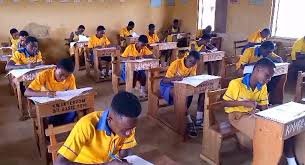
From panic to pass: how parents, teachers can help children beat BECE, WASSCE exam phobia- Part 1

- /home/u249204778/domains/spectator.com.gh/public_html/wp-content/plugins/mvp-social-buttons/mvp-social-buttons.php on line 27
https://spectator.com.gh/wp-content/uploads/2026/04/Some-BECE-candidates-writing-their-final-exams.jpg&description=From panic to pass: how parents, teachers can help children beat BECE, WASSCE exam phobia- Part 1', 'pinterestShare', 'width=750,height=350'); return false;" title="Pin This Post">
- Share
- Tweet /home/u249204778/domains/spectator.com.gh/public_html/wp-content/plugins/mvp-social-buttons/mvp-social-buttons.php on line 72
https://spectator.com.gh/wp-content/uploads/2026/04/Some-BECE-candidates-writing-their-final-exams.jpg&description=From panic to pass: how parents, teachers can help children beat BECE, WASSCE exam phobia- Part 1', 'pinterestShare', 'width=750,height=350'); return false;" title="Pin This Post">
Walk through any Junior High or Senior High compound in Ghana as BECE or WASSCE approaches and you will see it.
A bright girl suddenly quiet. A boy who led class debates now sleeping at his desk. A Form three student with stomach pains every Monday morning.
This is not laziness. This is academic stress. When left unaddressed, it hardens into exam phobia-overwhelming dread that pushes children into burnout, avoidance, and sometimes silence.
As a mental health professional who sits with these children and their parents at Counselor Prince & Associates Consult (CPAC) in Adenta Oyarifa-Teiman, I see the pattern clearly.
Research confirms it. Putwain and Daly (2014) found that high test anxiety predicts lower grades independent of ability. Zeidner (1998) showed that chronic academic pressure raises cortisol, weakens memory recall, and increases school dropout risk. The brain under fear cannot retrieve what it studied.
Understanding the storm: What academic stress really looks like
Exam phobia is not just “being nervous.” It shows up as headaches before mocks, sudden anger when books are mentioned, night-time insomnia, or perfectionism that ends in blank scripts.
Some children over-study until 2 a.m. and forget everything by 9 a.m. Others avoid books completely, scrolling phones instead. Both are distress signals. Dr Kenneth Ginsburg, a paediatrician specialising in adolescent resilience, notes: “Stress is not the enemy; feeling alone with stress is.” Too many Ghanaian children feel alone with it.
The home front: How parents and couples become safe havens, not extra pressure
The first antidote is at home. Structure beats shouting. Set a predictable study slot-same time, same place, with water and a light snack. Then protect sleep like you protect school fees. A tired brain fails faster than an unprepared one. Use the “15-minute start rule”: “Just sit for 15 minutes. If you still can’t, we close and try after a walk.” Often, starting is the hardest part.
Couples must watch their language. “Don’t disgrace us” plants fear. Replace it with “We see your effort. What part feels hardest today?” Praise process, not only position: “You revised three topics and asked for help—that is maturity.” Research by Dweck (2006) confirms that process praise builds resilience while outcome praise increases anxiety.
For caregivers, check your own anxiety. Children borrow our nervous system. If BECE makes you panic, they will panic. One parent grounds—keeps meals, prayer, and bedtime steady. The other pivots—talks to teachers, adjusts timetables, arranges counselling. Both protect rest. An empty cup cannot pour calm.
Resources
– Counsellor Prince & Associates Consult (CPAC): Award-winning Clinical Mental Health and Counselling Facility, accredited by the Ghana Psychology Council.
– School-Based Support: Speak to Guidance & Counselling units, or licensed school counsellors. E.g. Counsellor Blessing Offei – 0559850604 (School Counsellor).
– Contact CPAC for Parent Coaching/Counselling & Student Therapy: 055 985 0604 / 055 142 8486


Mr. Alban Sumani Kingsford Bagbin has announced private sector led initiative that will see “Visit Ghana” on the “front of jersey” of Sunderland Football Club for the 2026/2027 football season.
The “Visit Ghana” project is a special marketing drive that will have presence on the front of jersey of Sunderland Football Club during the English Premier League.
Under this initiative, Sunderland FC will have on the front of their jerseys, “Visit Ghana” as part of efforts to drive and promote tourism in Ghana.
“We are entering a formal engagement with them to put Visit Ghana on their jerseys and all paraphernalia.
“We have gone far with the discussions, and therefore they usually showing interest,” Mr. Bagbin stated this at the 37th sitting of Parliament.
Mr. Bagbin explained further that, the initiative is not being sponsored by Parliament, but by the private sector adding that, the project will boost tourism in Ghana.
“This is not being sponsored by parliament. Infact the main sponsor is from the private sector, we are leading under my canopy to get this done.
“The GFA, the Ministry of Sports and Recreation and the Ministry of Finance have also been very supportive in this project,” he stated.
The Visit Ghana Front of Shirt Partnership with Sunderland, is expected to make Ghana the first African country to occupy such a position with a premier league club, and also offer global promotion for Ghana through EPL broadcasts, digital platforms and international media channels.
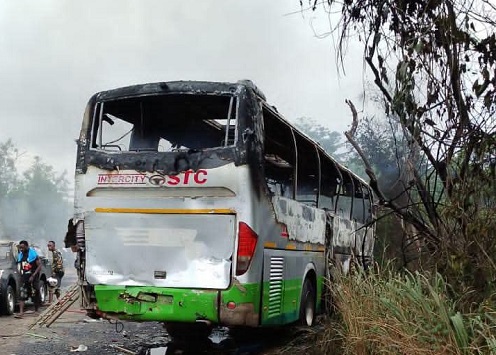
Motorists traveling between Accra and Kumasi are facing major delays today following a serious road crash at Birimso Bridge on the N6 Highway.
The accident, which involved a high-occupancy passenger bus, a loaded articulated truck, and a sedan, has completely blocked both lanes of the highway. As a result, all Accra-bound and Kumasi-bound traffic has been brought to a standstill.
Personnel from the Eastern South Regional Police MTTD, based in Kibi, are currently at the scene managing the situation.
To ease congestion, police have put in place temporary traffic diversions effective today.
By Edem Mensah-Tsotorme