News
Nana Yaa Serwaa Sarpong Shines at the 80th UN General Assembly – Speaks and Moderates key Panels on the SDGs, Media Leadership & Impact

- /home/u249204778/domains/spectator.com.gh/public_html/wp-content/plugins/mvp-social-buttons/mvp-social-buttons.php on line 27
https://spectator.com.gh/wp-content/uploads/2025/10/WhatsApp-Image-2025-10-03-at-11.32.41-1000x600.jpeg&description=Nana Yaa Serwaa Sarpong Shines at the 80th UN General Assembly – Speaks and Moderates key Panels on the SDGs, Media Leadership & Impact', 'pinterestShare', 'width=750,height=350'); return false;" title="Pin This Post">
- Share
- Tweet /home/u249204778/domains/spectator.com.gh/public_html/wp-content/plugins/mvp-social-buttons/mvp-social-buttons.php on line 72
https://spectator.com.gh/wp-content/uploads/2025/10/WhatsApp-Image-2025-10-03-at-11.32.41-1000x600.jpeg&description=Nana Yaa Serwaa Sarpong Shines at the 80th UN General Assembly – Speaks and Moderates key Panels on the SDGs, Media Leadership & Impact', 'pinterestShare', 'width=750,height=350'); return false;" title="Pin This Post">
On Thursday September 25, 2025, the 80th United Nations General Assembly (UNGA) witnessed a strong display of African leadership and global collaboration as celebrated Ghanaian media personality Nana Yaa Serwaa Sarpong moderated two high-level panel discussions and delivered remarks on another panel at the Goals Lounge – a special initiative convened by the UN Deputy Secretary-General and hosted by the UN Office for Partnerships.
Nana Yaa, a passionate SDG Advocate who currently celebrates 26 years of impact in media, made Ghana proud at this year’s UNGA in New York.
The Goals Lounge brought together world leaders, UN officials, private sector executives, and media practitioners to address urgent global issues.
Nana Yaa Sarpong shared the stage with distinguished figures including Jessica Alupo, Vice President of Uganda; Annemarie Hou, Executive Director of UN Partnerships; Gerd Müller, Director-General of UNIDO; Edmondo Cirielli, Vice Minister of Foreign Affairs and International Cooperation of Italy; Federica Diamanti, Associate Vice President for External Relations at IFAD; and Melissa Fleming, UN Under-Secretary-General for Global Communication.
The first session she moderated was dubbed “Brewing Sustainability: The Global Coffee Dialogue,” which examined sustainable sourcing and the future of global coffee trade as a means of sustaining livelihood.
The programme generated insightful sessions where people, ideas, and actions were shared on.
The event spotlighted a multi-stakeholder partnership, strengthening the global coffee value chain as a catalyst for sustainable development. Globally, over 12.5 million farmers depend on coffee production, with 80% grown by smallholder farmers.
The dialogue also brought to the fore coffee’s role linking agriculture, industry, and climate policy, while showcasing the Advancing Climate Resilience and Transformation in African Coffee (ACT) Programme as a platform for investment and collaboration.
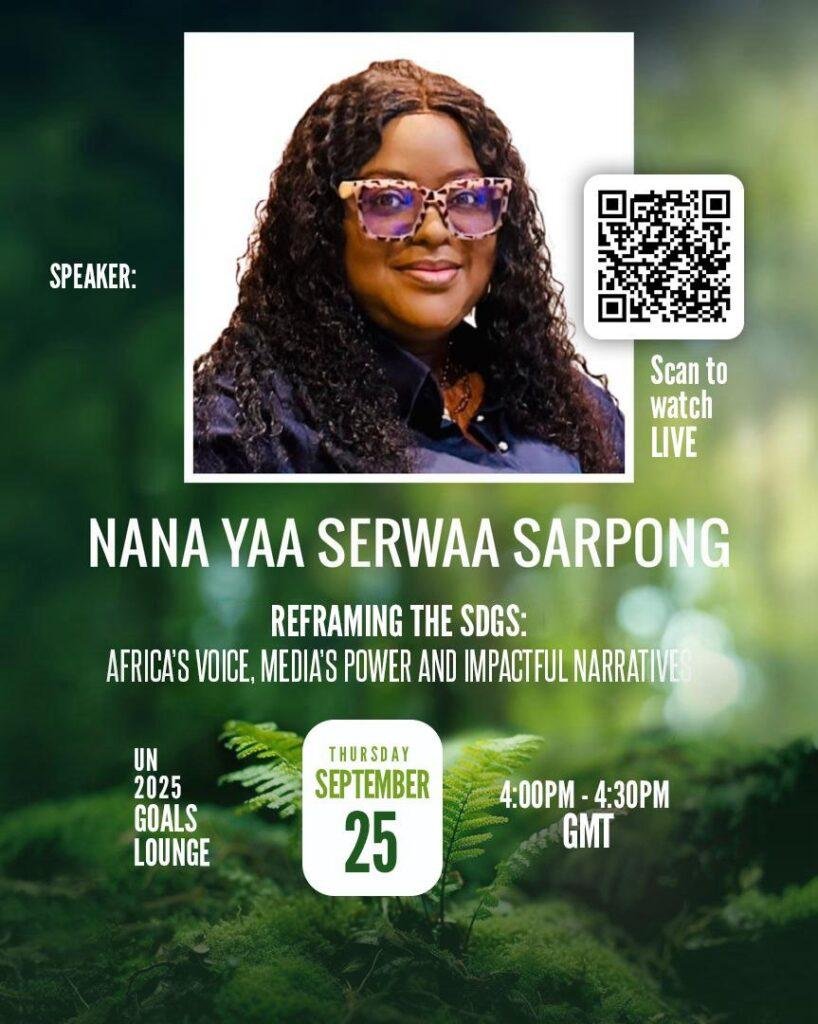
Subsequently, she again moderated the insighful panel on ‘Reframing the SDGs: Africa’s Voice, Media’s Power and Impactful Narratives.’
The session explored how Africa can reset the SDG narrative by centering its own voices, experiences, and innovations. Through storytelling for impact, panellists discussed how media can amplify African-led solutions and drive public engagement.
The conversation highlighted the role of journalists, creatives, and communicators in shaping a development narrative that reflects Africa’s complexity, resilience, and promise.
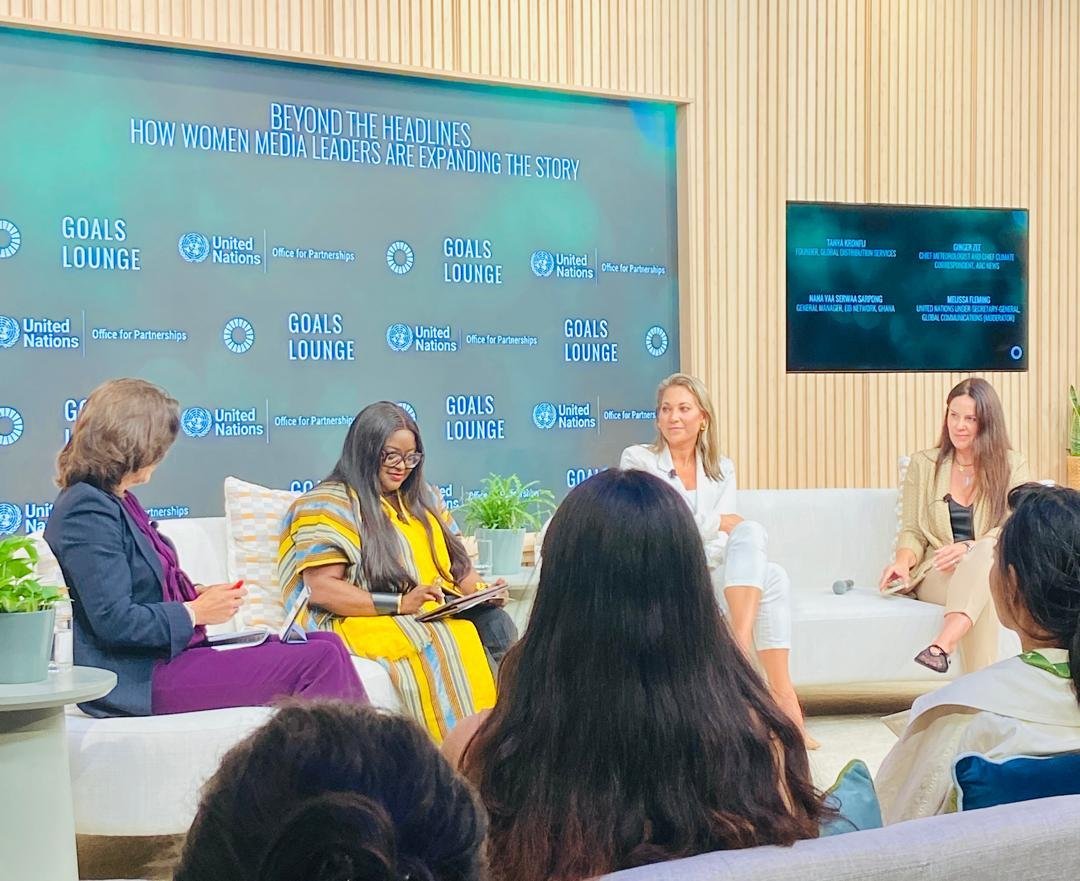
She addressed a session on “Beyond the Headlines: How Women Media Leaders Are Expanding the Story.”
Women media leaders are transforming the industry, breaking barriers, challenging bias, and the evolving role of women in media on reshaping narratives.
This session spotlighted the contribution of women media leaders, with insights from the UN Global Women in Media Report 2025, and the power of inclusive storytelling in shaping public understanding of peace, security, and progress in today’s complex global landscape.
Reflecting on her participation, Nana Yaa Sarpong described the opportunity as both an honour and a responsibility, underscoring the importance of amplifying African voices and centering women in global conversations.
“It is a privilege to use my platform to highlight issues of sustainability, gender equity, and Africa’s leadership in shaping global narratives,” she noted.
The sessions, now available for public viewing, form part of the broader activities of the 80th UNGA in New York, which continues to convene world leaders, policymakers, civil society, and private sector partners in pursuit of accelerated progress on the Sustainable Development Goals.
Also present were Arthur Karuletwa – VP Sustainable Sourcing and Impact, Chobani, Vanusia Nogueira – International Coffee Organization, Executive Director, Solomon Sabiti Rutega – Secretary General, Inter-African Coffee Organisation, Andrea Illy – President of illycaffè, Ambassador John Ulanga – Ambassador and Director of International Trade and Economic Diplomacy at Ministry of Foreign Affairs and East African Cooperation, Kalliopi Mingeirou, Chief of Ending Violence against Women at UN Women; Olusola Momoh, Co-founder and Vice Chairman of Channels Television in Nigeria; Jennifer Zabasajja, Chief Africa Anchor at Bloomberg; and Ginger Zee, Chief Meteorologist and Climate Correspondent for ABC News, among other global voices from international organizations and industry.
Nana Yaa Serwaa Sarpong is also an Entrepreneur, International Trade Consultant, Pastor, Women & Youth and SDG Advocate.
She is the General Manager of Ghana’s media group – EIB Network, and the Founder and President of Women In Sustainability Africa (WiSA), which was recently launched to mark a new beginning to accelerate growth towards the closure of the SDG gaps, including gender inequality.

The Ghana Bar Association (GBA) has urged Chief Justice Justice Paul Baffoe Bonnie to stop the conduct of selected trials during the ongoing legal vacation.
In a letter dated August 10, 2026, the GBA said it had received petitions from the law firms Zoe, Akyea & Co, Dame & Partners and Sam Okudzeto & Associates over notices requiring some lawyers to appear in court for part heard criminal cases during the vacation.
The Association maintained that the legal vacation, which runs from August 1 to September 30, is intended to give judges, lawyers and judicial staff a period of rest after the longest term of the legal year.
According to the GBA, Order 79 Rule 4 of the High Court (Civil Procedure) Rules, 2004, CI 47, provides for three legal vacations each year, with the second vacation being the longest.
The Association explained that, by convention, certain courts are designated as Vacation Courts to deal with urgent matters during the period.
It noted, however, that such courts traditionally handle emergencies and interlocutory matters and do not conduct trials.
The GBA further pointed out that virtual courts operating during the legal vacation also follow the same principle and do not conduct trials.
The Association said lawyers were not obliged to appear before a Vacation Court if they were unavailable during the vacation.
“Once Counsel in a matter indicates their unavailability to attend Court during the vacation,” the GBA stated, the court cannot proceed with the case where counsel on either or both sides are unable to attend.
It stressed that an accused or other party to a trial should not be forced to represent themselves simply because their lawyer is unavailable during the legal vacation.
The GBA said judges should instead adjourn such cases to dates proposed by the lawyers.
The Association expressed concern that compelling lawyers to conduct trials during the vacation could create the impression of bias or selective justice.
It noted that lawyers had already worked extended hours during the legal year, including under the newly introduced afternoon court sittings.
The GBA added that some lawyers had scheduled professional engagements in other jurisdictions, while some law firms had closed for the entire vacation period.
National President of the GBA, Mrs. Efua Ghartey, therefore appealed to the Chief Justice and the Judiciary to respect the rules and long-standing traditions governing legal vacations.
The Association said it remained committed to working with the Judiciary to ensure the speedy delivery of justice and expressed confidence that the petitions brought before the Chief Justice would be favourably considered.
By:Jacob Aggrey
Legal practitioner Dr. Justice Srem-Sai has faulted the President of the Ghana Bar Association (GBA) over claims made in a letter to the Chief Justice dated August 10, 2024, regarding the conduct of trials during the legal vacation.
In the letter, the GBA President made two key assertions. First, that “Vacation Courts” only handle emergencies, “usually interlocutory matters and never trials.”
Second, was that the decision to proceed with substantive matters during vacation “has always been the willingness, availability of Counsel to appear,” meaning “Counsel are not under any compulsion whatsoever to appear before a Vacation Court.”
However, Dr. Srem-Sai in statement says both claims are unsupported by law, rules, practice, or reason.
Dr. Srem-Sai explained that court work is divided into two: substantive proceedings which can finally determine a case, including trials; and interlocutory proceedings such as motions and summons which do not.
He noted that during the “long legal vacation” in August and September, superior courts only “scale down significantly”, they do not shut down. A few judges are designated to work by a warrant issued by the Chief Justice, who is the administrative head of the courts.
“It is the Chief Justice who determines when and where a Court should work,” Dr. Srem-Sai wrote. A lawyer or a body of them do not determine that,” he stated.
He argued that giving lawyers the power to decide whether to appear would undermine the purpose of courts.
According to him, “A lawyer’s primary duty is to his client not to the client of another lawyer. If allowed to determine how justice is administered… lawyers will decisively make decisions which will promote his client’s interest over the interest of another lawyer’s client.”
Citing England, where the vacation practice originated, he noted that the Civil Procedure Rules Practice Direction 2F vests discretion in the bench with phrases like “as the Court may direct” and “subject to the discretion of the Judge,” The same, he said, applies in Ghana.
He noted that contrary to the GBA President’s claim that trials are “never” held during vacation, Dr. Srem-Sai said vacation judges can and do conduct substantive proceedings, but only in respect of cases in their own courts.
According to him, this is because a vacation judge eventually takes his leave during term time, and another “term judge” then handles only interlocutory matters in his court until he returns.
The arrangement, he explained, prevents cases in a vacation judge’s court from suffering “disproportionate delays.”
For cases from other judges’ courts, a vacation judge may only take interlocutory matters, because only a substantive judge can finally determine a case.
“So, again, one is not particularly clear what the GBA President grounds the allegation that courts ‘never’ conduct trials during legal vacations on,” he stated.
Dr. Srem-Sai acknowledged that law practice is draining and that legal vacation offers a needed rest. He said judges have traditionally accommodated lawyers’ requests to scale down work, but “always upon request, on case-by-case basis, and is subject to the consideration of the Judge.”
“What a professional lawyer is not entitled to do, and cannot do is to, in vacuo, beforehand, declare that he will not attend proceedings at all,” he concluded.
He warned that the GBA President’s proposition “seeks to move the power to manage and control court proceedings and to do justice from the hands of the Judge into the hands of a lawyer,” a move with “severe and far-reaching policy implication for justice administration in Ghana.”
By Edem Mensah-Tsotorme