News
Hundreds walk to create awareness on cancer

- /home/u249204778/domains/spectator.com.gh/public_html/wp-content/plugins/mvp-social-buttons/mvp-social-buttons.php on line 27
https://spectator.com.gh/wp-content/uploads/2024/02/A-section-of-the-participants-at-the-walk.jpg&description=Hundreds walk to create awareness on cancer', 'pinterestShare', 'width=750,height=350'); return false;" title="Pin This Post">
- Share
- Tweet /home/u249204778/domains/spectator.com.gh/public_html/wp-content/plugins/mvp-social-buttons/mvp-social-buttons.php on line 72
https://spectator.com.gh/wp-content/uploads/2024/02/A-section-of-the-participants-at-the-walk.jpg&description=Hundreds walk to create awareness on cancer', 'pinterestShare', 'width=750,height=350'); return false;" title="Pin This Post">
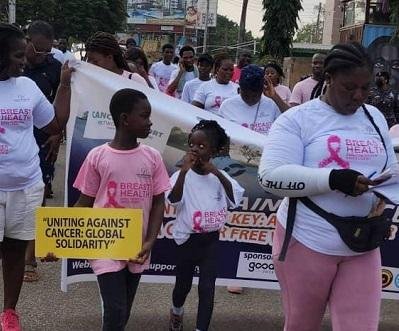
A section of the participants at the walk
Hundreds of cancer survivors embarked on a walk in some parts of Accra to raise awareness on the disease and its effects on victims and their relatives.
The event, organised by the Cancer Support Network Foundation (CSNF), commenced from the Accra Girls Senior High School near the 37 Military Hospital, winding its way through major streets in the area.
Participants actively engaged in the cause by displaying placards bearing inspirational messages, emphasising the urgent need to combat cancer.
This collective effort was not confined to the streets, as street vendors and drivers stuck in traffic were handed informational flyers detailing crucial facts about cancer.
The outreach extended to fuel attendants along the streets, ensuring that even those outside the immediate walking path were educated about the significance of cancer awareness.
This holistic approach aligns with the CSNF’s broader mission to disseminate knowledge and foster a culture of understanding regarding the disease.
The initiative, part of the NGO’s activities in observance of World Cancer Awareness Month, held annually in February, garnered appreciation from participants and onlookers alike.
The President of the CSNF, Mr Akwesi Osei Owusu, expressed gratitude to everyone who joined hands to make the day impactful.
He reserved special appreciation for the founder of the NGO, Dr Juliet Appiah Quansah, a Medical Oncologist whose unwavering commitment has been pivotal in supporting cancer patients in Ghana, especially those facing financial barriers to treatment.
During the event, Ms Raissa Sambou, an executive member of the CSNF, touched on the importance of taking cancer screening seriously.
Drawing from her personal experience as a cancer survivor, Ms Sambou mentioned the significance of early detection in effective treatment.
She also urged the public not to wait until it was too late, as delaying diagnosis could worsen the condition and reduce the likelihood of successful treatment.
Ms. Sambou called on the Ghana Health Service (GHS) to adopt a preventive approach in dealing with cancer, advocating for increased access to screening and treatment centers across the nation, especially in rural communities.
Her plea was rooted in the belief that enhancing accessibility would ultimately contribute to saving lives and reducing the impact of cancer on individuals and communities.
BY Raissa Sambou



The Office of the Special Prosecutor (OSP) has clarified that former Finance Minister Kenneth Nana Yaw Ofori-Atta remains the subject of criminal proceedings in Ghana and is still wanted under a valid arrest warrant issued by the High Court in Accra.
In a public notice, the OSP said it had taken note of a transcript of a hearing from a United States immigration court that has been circulated by some media organisations.
According to the office, the document has been interpreted by some to suggest that Mr. Ofori-Atta has not been credibly charged or linked to any wrongdoing in Ghana.
The OSP rejected that interpretation, explaining that it is not involved in Mr. Ofori-Atta’s immigration proceedings in the United States.
It said its involvement relates only to extradition proceedings, which are being handled through Ghana’s Attorney-General as the country’s central authority.
According to the OSP, the extradition documents are not before the US immigration court and the court has no authority to determine whether the criminal charges against Mr. Ofori-Atta are credible.
“The credibility or otherwise of the criminal charges against Mr. Ofori-Atta is a matter for determination by the courts in Ghana,” the OSP stated.
The office explained that there are three separate legal proceedings involving the former minister.
These include the immigration proceedings in the United States concerning his immigration status, extradition proceedings to determine whether he should be returned to Ghana, and the criminal case before the High Court in Accra involving corruption and corruption-related offences.
The OSP reiterated that Mr. Ofori-Atta remains before the High Court in Accra as an accused person and that a valid warrant has been issued for his arrest.
It maintained that he remains a fugitive from justice in Ghana and is required to appear before the High Court to answer the charges against him.
The Special Prosecutor also stressed that the criminal proceedings in Ghana would continue in accordance with the law and the directives of the High Court, whether or not Mr. Ofori-Atta is physically present in the country.
By: Jacob Aggrey

Telecel Ghana has announced that it has resolved the intermittent challenges that affected its voice and data services.
In a message to customers, the telecommunications company announced that its network services had been fully restored after experiencing temporary disruptions.
“We are pleased to inform you that intermittent challenges with our voice and data services have been resolved,” the company said.
Telecel apologised to customers for the inconvenience caused by the service interruptions and thanked them for their patience during the period.
“We appreciate your patience and apologise for any inconvenience this may have caused,” the company added.
The company assured customers of its commitment to providing reliable communication services under its slogan, “Connecting Energies.”
By: Jacob Aggrey