Hot!
Over 95 percent of Savings & Loans, Microfinance customers paid fully – Governor Addison

- /home/u249204778/domains/spectator.com.gh/public_html/wp-content/plugins/mvp-social-buttons/mvp-social-buttons.php on line 27
https://spectator.com.gh/wp-content/uploads/2020/08/ghghghgh.jpeg&description=Over 95 percent of Savings & Loans, Microfinance customers paid fully – Governor Addison', 'pinterestShare', 'width=750,height=350'); return false;" title="Pin This Post">
- Share
- Tweet /home/u249204778/domains/spectator.com.gh/public_html/wp-content/plugins/mvp-social-buttons/mvp-social-buttons.php on line 72
https://spectator.com.gh/wp-content/uploads/2020/08/ghghghgh.jpeg&description=Over 95 percent of Savings & Loans, Microfinance customers paid fully – Governor Addison', 'pinterestShare', 'width=750,height=350'); return false;" title="Pin This Post">
The Governor of the Bank of Ghana (BoG), Dr. Ernest Addison, has stated that all customers of the nine failed banks, and over 95 percent of customers of Specialised Deposit-taking Institutions (SDIs), which were affected by the banking sector clean-up have received their deposits.
According to Dr. Addison, the first phase of the banking sector clean-up involved the revocation of licenses of nine banks, for which all depositors were paid in full.
“The second phase has to do with the SDIs – these are the savings and loans, microfinance institutions and finance houses. In their case, for individual depositors who have been fully paid, the data that we have suggests that more than 95 percent of depositors have been fully paid,” he said.
The Governor continued, “So there are just about five percent depositors who have large amounts, these are the high net worth individuals who were settled with loans which were to be retired over five years. So, we think that most of it has been done.”
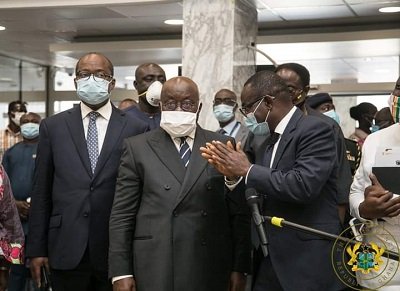
Dr. Addison made this known on Tuesday, 25th August 2020, when the President of the Republic, Nana Addo Dankwa Akufo-Addo, visited the BoG to familiarize himself with the operations of the Bank.
Touching on deposits of customers of GN Savings and Loans and First Allied Savings and Loans, the Bank of Ghana Governor noted that, over the last three weeks, all customers have been paid.
“The Government has provided a bond worth GH¢1.7 billion, for which we have monetized GH¢700 million. So, the receiver is also working at clearing the last few customers that are left in that segment. So, I think that we have made a lot of progress, Mr. President, with this depositor issue,” he added.
On helping to ensure the maintenance of a strong banking sector in the country, and to prevent the recurrence of a banking crisis, Governor Addison told President Akufo-Addo that the first step taken has been to pass the new corporate governance directive.
This, he said, had become necessary because, at the heart of the financial sector crises, was a breakdown in corporate governance in the various banks whose licenses were revoked.
“The second one has to do with misreporting of data, because of a lot of falsification of data by the financial institutions to the Central Bank. So we have brought in a new technology which will allow us to get the data directly from sources, so that no human interventions will be in there to distort the data that they send,” the Governor indicated.
The third step, he added, “has to do with the capital verification process, because a lot of the banks reported that they had capital when, in fact, they didn’t have any capital at all.”
He continued, “So we have reviewed the entire capital verification process of the bank, and it’s almost impossible now for us to have a bank that doesn’t have any capital, and yet it’s allowed to operate, and, of course, in addition to that, for all the staff of the banking solution department we have had a lot of training programmes with the IMF and other technical assistance have been provided.”
Dr Addison expressed appreciation of the country’s banking sector to President Akufo-Addo for the role he played in sanitizing the space, which has brought in its wake more confidence in its wake.
“ Your clear leadership and understanding of the role of the financial sector in the government’s transformation agenda, gave the leadership of the Bank the confidence and courage to embark on the comprehensive banking sector reforms over the last three years, which saw an increase in the minimum capital requirements, clean-up of the financial sector by the revocation of licenses of weak and insolvent institutions, and a revamp of the regulatory framework to stabilise and strengthen the sector,” he added.
The clean-up of the sector, he stressed, has resulted in a stable financial sector with fewer banks and Specialised Deposit-Taking Institutions (SDIs) that are well capitalised, liquid, and solvent, and better able to support our nation’s economic growth agenda.
“These efforts helped to earn the Bank international acclaim as the Central Bank of the Year in 2019. By the end of 2019, all the financial sector soundness indicators showed strong improvements as capital adequacy ratio, profitability, and liquidity levels increased significantly while non-performing loans declined,” he added.


General Secretary of the New Patriotic Party (NPP), Justin Kodua Frimpong, has filed his nomination to contest the position of General Secretary again as the party begins its rebuilding efforts ahead of the 2028 general elections.
He was accompanied by party stalwarts and supporters who were in high spirits, expressing confidence that he is the right person to hold the position.
Speaking after filing his nomination, Mr Kodua Frimpong assured the rank and file of the party that he would not disappoint them.
“I can assure you that the faith the rank and file of the party have had in me, I will never disappoint them,” he said.
He also pledged to run a clean campaign devoid of personal attacks.
“I can assure you that our internal campaign will be devoid of personal attacks,” he told his fellow contestants and the rank and file of the party as he seeks to retain his position.
His tenure has seen the party through the 2024 general elections, where the NPP lost power to the National Democratic Congress (NDC) after eight years in government.
The party is currently in a rebuilding phase, with internal elections scheduled to elect new national executives to lead its reorganization towards the 2028 polls.
The General Secretary position is considered one of the most influential in the party’s administrative structure, responsible for the day-to-day running of the party secretariat and implementation of party decisions.
By Edem Mensah-Tsotorme

The University of Ghana Medical Centre (UGMC) has disputed claims made on social media by comedian Michael Blackson concerning the treatment given to his late mother, saying a review found that the allegations did not accurately reflect what happened during her stay at the hospital.
In a statement issued in Accra on August 5, 2026, the management of UGMC expressed condolences to Mr. Blackson and his family over the death of his 83-year-old mother, who died at the facility on July 16, 2026.
The hospital said it had taken the concerns raised by Mr. Blackson seriously and conducted a thorough review in line with its clinical and administrative procedures.
According to the statement, the facts presented by Mr. Blackson on social media contained “numerous inaccuracies” and did not accurately reflect the medical care provided to his mother.
UGMC explained that she was referred to the facility from another hospital and received treatment there from May 27 to July 16, 2026, a period of about eight weeks.
The hospital stated that it would not release details of her diagnosis, treatment, medical records or other aspects of her care because it had a duty to protect patient confidentiality, even after death.
It said the decision was intended to respect the dignity of the deceased and the privacy of her family.
UGMC further stated that all clinical decisions at the facility are made by qualified healthcare professionals based on medical judgment, established standards of care and the best interests of the patient.
The statement added that such decisions are made in consultation with authorised family representatives where necessary and that billing and financial procedures are governed by institutional policies and are separate from clinical decision-making.
The hospital noted that it values feedback from patients and their families and considers both positive and negative comments important for improving the quality of care.
Mr. Blackson had earlier used social media to criticise the care his mother received at UGMC, prompting the hospital’s response.
By: Jacob Aggrey