
News
Abuakwa residents assured of more devt projects in era of COVID-19

- /home/u249204778/domains/spectator.com.gh/public_html/wp-content/plugins/mvp-social-buttons/mvp-social-buttons.php on line 27
https://spectator.com.gh/wp-content/uploads/2020/06/PROJECTS-Mr-Ofori-Safo-addressing-the-assembly-members-inset.jpg&description=Abuakwa residents assured of more devt projects in era of COVID-19', 'pinterestShare', 'width=750,height=350'); return false;" title="Pin This Post">
- Share
- Tweet /home/u249204778/domains/spectator.com.gh/public_html/wp-content/plugins/mvp-social-buttons/mvp-social-buttons.php on line 72
https://spectator.com.gh/wp-content/uploads/2020/06/PROJECTS-Mr-Ofori-Safo-addressing-the-assembly-members-inset.jpg&description=Abuakwa residents assured of more devt projects in era of COVID-19', 'pinterestShare', 'width=750,height=350'); return false;" title="Pin This Post">
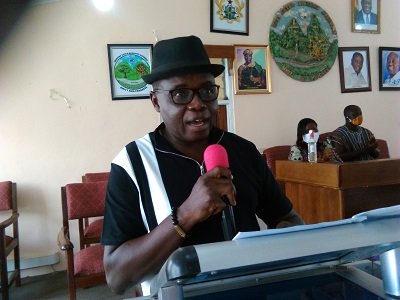
The Abuakwa South Municipal Chief Executive, Kojo Ofori-Safo, has assured residents of the assembly’s commitment and readiness to improve on the Internally Generating Fund (IGF) of the assembly in spite of the COVID-19 pandemic.
He appealed to assembly members to support and assist in efforts by the assembly to plug loopholes in generating funds to improve livelihoods of residents through growth and development projects.
Mr Ofori-Safo said the assembly had done quite well despite challenges including the COVID-19 pandemic and enumerated completed and ongoing projects in all sectors including education, security, health, sanitation, local governance in communities in the municipality.
He gave the assurance when he addressed the first Ordinary meeting of the first session of the 8th Assembly of the Abuakwa South at Kibi in the Eastern Region on Friday.
Mr Ofori-Safo also spoke extensively on the COVID-19 pandemic and sanitation and called on assembly members to help educate and sensitise residents on the need to stop stigmatisation, and adherence of safety directives of health authorities.
He asked security services especially Ghana Immigration and Police Services in the municipality to devise means to deal with illegal migrants who are not willing to comply with mining regulations of the country in the mist of COVID-19 and urged them to take legal action against landlords who accommodate such migrants in their households in the municipality.
He appealed to the assembly members to assist the security services to flush out those illegal migrants from the municipality because they were becoming a threat to the environment especially those from West African region who had colluded with some of the youth in the area and brought in sophisticated equipment to exploit the environment at an alarming rate.
“The influx of illegal migrants in the municipality has surged illegal mining (galamsey) to worrying levels with its attendant damage to the environment despite the assembly’s best efforts, including advocacy by Okyenhene’s Foundation, the youth continue to engage in galamsey with impunity which has worsened galamsey menace when they engage in business which has made it difficult to contain the situation,” Mr Ofori-Safo noted.
Source: Ghanaian Times


Minister for Education Haruna Iddrisu has questioned why Ghana continues to import toothpicks despite having the resources to produce them locally.
Speaking in Parliament, Mr. Iddrisu, who previously served as Minister for Trade and Industry, said he feels ashamed that the country still depends on imports for such a basic product.
“I have been Minister for Trade and Industry before and I carry the shame. How come that in Ghana we cannot produce toothpicks and we have to import them?” he asked.
According to him, Ghana has enough resources to support local businesses to manufacture products such as toothpicks instead of relying on imports. He said the country should encourage private sector investment in manufacturing to create jobs and reduce dependence on foreign goods.
Mr. Iddrisu alleged that some people who received government support under private sector initiatives failed to use the funds for their intended purpose.
“If you want, Honorable Kojo, because you… I can’t go there. There are people who took money in the name of the private sector and said they were going to farm. That money never went to their farms. You know that,” he told Parliament.
On job creation, the Education Minister said he agreed with the views expressed by a colleague on the need to create more employment opportunities. However, he argued that the One District, One Factory (1D1F) programme did not provide the solution to Ghana’s employment challenges.
Mr. Iddrisu made the remarks during parliamentary proceedings while contributing to discussions on job creation and the country’s industrial development.
By: Jacob Aggrey

New Patriotic Party (NPP) communications officer, Dennis Miracles Aboagye, has dismissed reports linking him to an alleged GH¢55 million case, insisting that no such issue was raised during his detention by the Economic and Organised Crime Office (EOCO).
In a Facebook post after his release from EOCO custody, Mr Aboagye stated that at no point during his detention was he questioned about any GH¢55 million.
“For the records: There was no discussion of any GH¢55 million with me by EOCO. None,” he wrote.
According to him, he was detained for four days, a day after announcing his intention to contest for the position of National Communications Director of the New Patriotic Party.
Mr Aboagye alleged that false narratives were circulated about his arrest but expressed confidence that the truth would eventually prevail.
He thanked NPP supporters who demonstrated and called for his release, saying news of the protests reached him while he was in detention and encouraged him.
Mr Aboagye indicated that the support shown by party faithful strengthened his resolve and reaffirmed his commitment to serve the NPP.
He maintained that his detention had not discouraged him from pursuing his political ambition.
“If the intention was to break me, it has failed. If the intention was to scare me, it has failed spectacularly,” he stated.
Mr Aboagye expressed appreciation to his legal team, the leadership of the NPP and all supporters who stood by him throughout his detention.
He reiterated his determination to lead the party’s Communications Directorate, declaring that he remained “ready to win” and committed to what he described as the party’s mission to “command the narrative.”
By: Jacob Aggrey


