Hot!
Eastern Region holds Festival of Arts and Culture


- /home/u249204778/domains/spectator.com.gh/public_html/wp-content/plugins/mvp-social-buttons/mvp-social-buttons.php on line 27
https://spectator.com.gh/wp-content/uploads/2022/11/Dr-Akosua-Abdallah-left-greeting-Daasebre-Kwaku-Boateng-III.jpg&description=Eastern Region holds Festival of Arts and Culture', 'pinterestShare', 'width=750,height=350'); return false;" title="Pin This Post">
- Share
- Tweet /home/u249204778/domains/spectator.com.gh/public_html/wp-content/plugins/mvp-social-buttons/mvp-social-buttons.php on line 72
https://spectator.com.gh/wp-content/uploads/2022/11/Dr-Akosua-Abdallah-left-greeting-Daasebre-Kwaku-Boateng-III.jpg&description=Eastern Region holds Festival of Arts and Culture', 'pinterestShare', 'width=750,height=350'); return false;" title="Pin This Post">
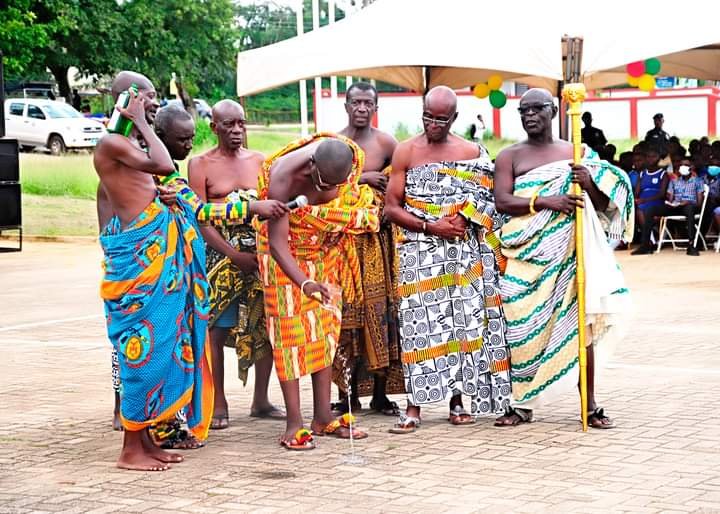
• Dr Akosua Abdallah (left), greeting Daasebre Kwaku Boateng III
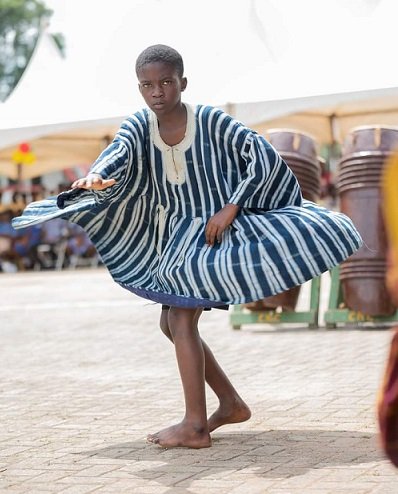
Cultural display was at its best in the Eastern Region during this year’s Regional Festival of Arts and Culture which was celebrated at the Koforidua Jubilee Park.
The region which has 11 traditional areas namely Anum, Boso, Manya and Yilo Krobo, Akuapem, Akyem Abuakwa, Bosome, Kotoku, Kwahu, Akwamu and New Juaben had their cultures displayed through beautiful performances.


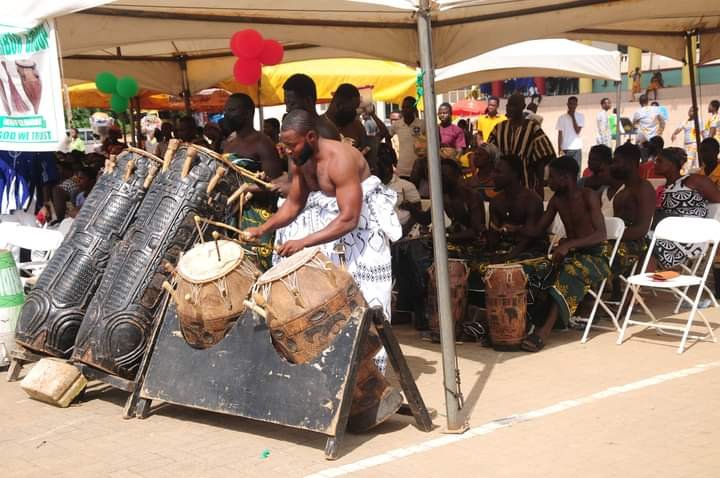


Several performances, including the dipo, adowa, borborbo, among other traditional dance were performed by the Ohu Cultural Group from Akropong, Klama Cultural Group from Odumase-Krobo, Nyanyui Borborbor and Centre for National Culture (CNC) Cultural Group in Koforidua, to the admiration of the audience.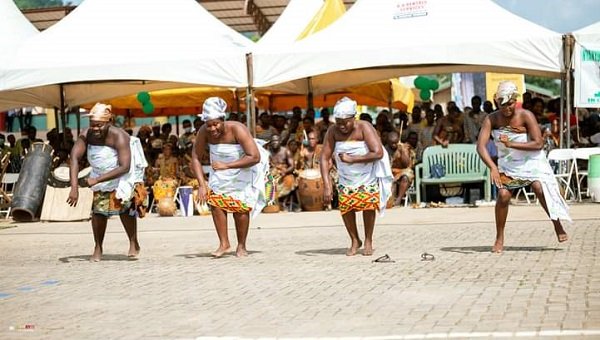




The Asokore Seventh Day Adventist, Oyoko Methodist and Ghana Senior High Schools were among schools that performed through poem recitals, brass band performance and singing of corals.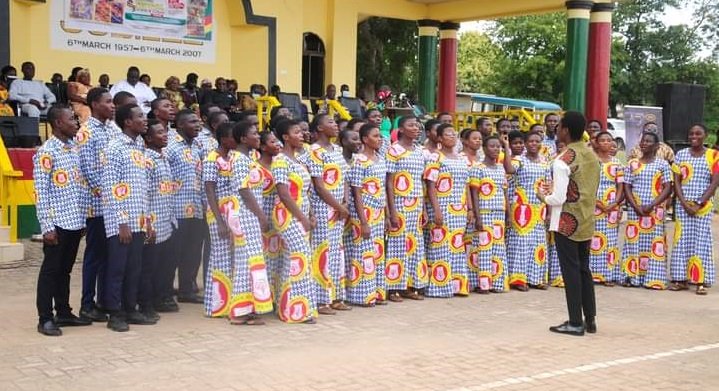



The Eastern Regional Police Band was also present to grace the occasion which was chaired by the Omanhene of New Juaben Traditional Area, Daasebre Kwaku Boateng III.
Speaking on the theme: “Reviving Patriotism, Peace and Unity Through Cultural Diversity for Sustainable Development,” the Director in charge of Community Education and Youth Development (CEYD) at the National Commission on Culture (NCC), Dr Akosua Abdallah said it was worrying to note that modernisation and globalisation had affected and continued to affect every aspect of national life and culture.
“You will go to a house and they are eating fried rice, noodles and other foods that are not Ghanaian. Where are our traditional foods like ampesi, fufu and the rest? We need to go back and teach our children our traditional foods and culture and stop adopting western culture which was depleting our culture,” she said.
She said there was an urgent need to imbibe into the youth, a sense of patriotism, nationalism, unity and a selfless ideal towards the country, adding that the NCC believed in a national strategy that sought to promote and sustain the interest of Ghanaians, particularly the youth and called for some stock-taking and deeper reflection on “our ideals so that we can teach our youth.”
She said the NCC was committed to promoting the national culture and would continue to hold such events to promote the cultures to the international community.
The Eastern Regional Minister, Mr Seth Kwame Acheampong stated that the Culture and Creative Arts Industry was an essential component of the country’s economy which was making significant contribution to national development.
“We consciously need to guard it by steadfastly holding on to it for employment and wealth creation and it is important to uphold the rich cultures handed to us by our ancestral heritage taking cognisance of its vitality and values,” he said.
He said the theme was apt since the country had allowed for western cultures to permeate the Ghanaian culture through technology, adding that the situation had caused a lot of indiscipline among the youth.
From Ama Tekyiwaa Ampadu
Agyeman, Koforidua



The Tema Regional Police Command has arrested a 32-year-old man for allegedly posing as a soldier and extorting money from unsuspecting members of the public at Ashaiman.
The suspect, identified as Bright Atsu Kudiabor, was arrested by the Ashaiman Police on Wednesday, September 16, 2026, at about 7:00 a.m.
According to the Police, he was arrested at an area known as “I Shall Return”, where he was allegedly parading himself as a soldier and demanding money from people.
The Police said Kudiabor, who is an ex-convict, was initially arrested by personnel of the Ghana National Fire Service in Ashaiman with assistance from other members of the public.
A search conducted on him after he was handed over to the Police reportedly led to the recovery of a set of military camouflage uniform.
The suspect is currently in Police custody and assisting with investigations.
The Tema Regional Police Command said he would be processed for court after investigations are completed.
The Police urged the public to remain vigilant and report anyone who falsely presents themselves as a soldier or a member of another security agency to deceive or extort money from the public.
By: Jacob Aggrey
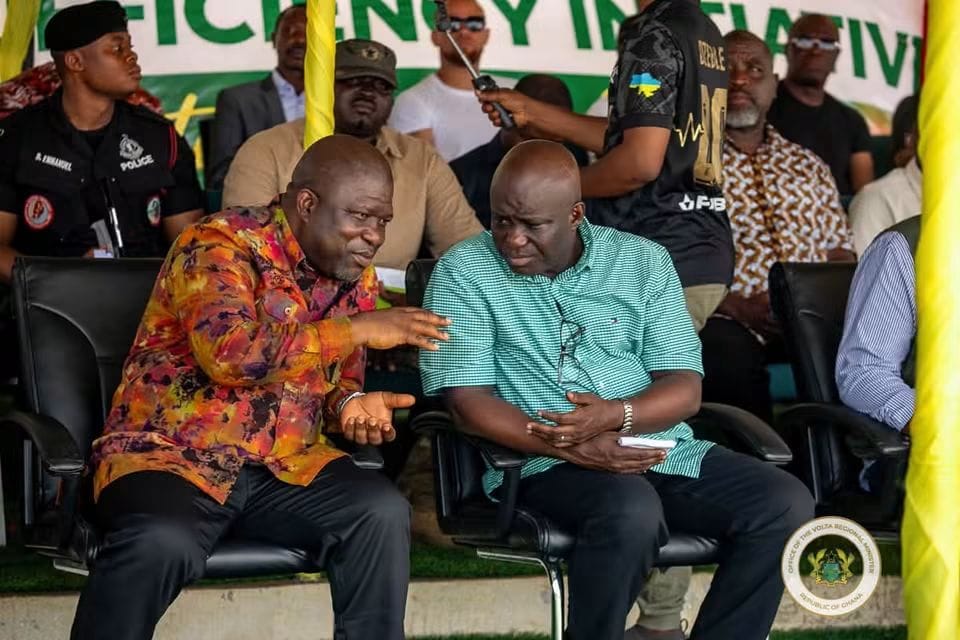
Volta Regional Minister, James Gunu, says the Volta Region holds enormous agricultural potential and efforts must be geared towards connecting farmers to the needed resources to unlock that potential.
He said focus must be on linking farmers to resources, technology, financing and markets to increase production, create jobs and build sustainable livelihoods.
Hon. Gunu made the remarks at the national launch of the Ghana Tomato Self-Sufficiency Initiative (GHATSI) held at Anloga in the Volta Region on Tuesday, September 15.
The initiative, under the theme “Produce at Home. Feed the Nation. Export the Surplus,” seeks to boost local tomato production, processing and marketing while reducing Ghana’s heavy reliance on imported tomatoes.
The launch was attended by the Minister for Food and Agriculture, Eric Opoku, his Deputy, John Setor Dumelo, Feed Ghana Coordinator, Bright Demordzi, Members of Parliament, traditional leaders, MMDCEs, farmers and other stakeholders.
Mr.Gunu expressed appreciation to the Minister for Food and Agriculture for the support announced for the region, including two excavators, 200 cartons of organic fertiliser, and GH¢200,000 for Ms. Kuatudzo Esther Dela, a tomato farmer and processor from Ziope.
He described the initiative as an important step towards making agriculture a stronger driver of food security, job creation and economic growth in the Volta Region.
By Edem Mensah-Tsotorme