News
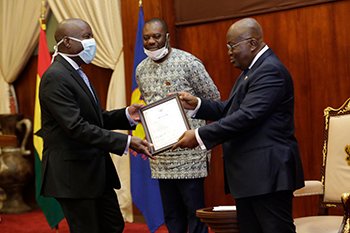
President grants presidential charters to 2 varsities

- /home/u249204778/domains/spectator.com.gh/public_html/wp-content/plugins/mvp-social-buttons/mvp-social-buttons.php on line 27
https://spectator.com.gh/wp-content/uploads/2020/05/University-College-1-President-Akufo-Addo-presenting-a-charter-to-Prof.-Aaron-Lawson-left-ChairmanBoard-of-Governors-All-Nations-University-with-them-is-Dr-Matthew-Opoku-Prempeh.jpg&description=President grants presidential charters to 2 varsities', 'pinterestShare', 'width=750,height=350'); return false;" title="Pin This Post">
- Share
- Tweet /home/u249204778/domains/spectator.com.gh/public_html/wp-content/plugins/mvp-social-buttons/mvp-social-buttons.php on line 72
https://spectator.com.gh/wp-content/uploads/2020/05/University-College-1-President-Akufo-Addo-presenting-a-charter-to-Prof.-Aaron-Lawson-left-ChairmanBoard-of-Governors-All-Nations-University-with-them-is-Dr-Matthew-Opoku-Prempeh.jpg&description=President grants presidential charters to 2 varsities', 'pinterestShare', 'width=750,height=350'); return false;" title="Pin This Post">
President Nana Addo Dankwa Akufo-Addo has granted the Pentecost University College in Accra and the All Nations University College in Koforidua presidential charters to operate as fully-fledged universities.
The two university colleges have transitioned into autonomous universities with the capacity to award their own degrees and diplomas, and will now be known as Pentecost University and All Nations University.
They are the second and third colleges to be given a presidential charter under the Akufo-Addo administration, following Ashesi University in 2018.
President Akufo-Addo congratulated the two institutions and said that they have gone through a period of academic mentorship and supervision by mentoring public institutions.
He said both universities have, over the past decade, demonstrated sufficient capacity in their governance, finances, academic matters and infrastructural development.
They have gone through rigorous accreditation and quality assurance processes of the National Accreditation Board, he said, stressing that based on the satisfactory recommendation of the board, the two institutions deserve to be awarded the charter.
“I am pleased to announce that Pentecost University and All Nations University have fulfilled the requirements and are considered to be in a good position to manage their own affairs as fully fledged tertiary education institutions”.
“They have been able to establish structures which will enable the respective institutions to forge ahead in the management of their academic programmes,” he said.
The two universities have gone through a period of tutelage by their mentoring universities, the University of Ghana, Kwame Nkrumah University of Science and Technology, and the University of Cape Coast.
This, according to the President, has led to the adoption and incorporation of best practices as required by the National Accreditation Board and the Council for Tertiary Education.
He entreated management of the universities to continue to improve and introduce more innovative programmes and courses which will develop skills needed to help develop the country.
By Yaw Kyei



Veteran Nigerian actor and African screen legend, Pete Edochie, has paid a courtesy call on the Chief Executive Officer of the Ghana Gold Board (GoldBod), Sammy Gyamfi, during his visit to Ghana.
Edochie is in Ghana to launch the African Legacy Project, which includes a book, documentary film and an African Youth Mentorship Initiative targeting about 500,000 young people across the continent.
Mr. Gyamfi welcomed the opportunity for GoldBod to support the mentorship initiative, noting that it aligns with the Board’s Special Intervention Programme and its focus on social impact and economic empowerment.
GoldBod’s work is also referenced in Pete Edochie’s new book, which highlights Ghana’s efforts to ensure its gold resources contribute to national development.
By Edem Mensah-Tsotorme
The Ministry of Foreign Affairs has warned Ghanaians seeking employment in Zambia to be cautious of fraudulent job offers that could expose them to human trafficking and forced involvement in cybercrime.
The warning follows the arrest of six Ghanaians in Lusaka, Zambia, during a joint operation by the Zambia Police Service, the Drug Enforcement Commission and the Department of Immigration on August 23, 2026.
According to the Ministry, the operation targeted a facility suspected of being involved in organised cybercrime activities and led to the arrest of 79 people, including 10 Zambians and 69 foreign nationals.
The Ministry said six of the foreign nationals arrested were Ghanaians.
It explained that reports received by the Ghana High Commission in Lusaka indicated that some of those arrested had been recruited through what appeared to be legitimate employment opportunities, including online data entry jobs.
However, the Ministry said some were allegedly forced into online scam activities after their passports were confiscated by their employers.
It warned that the situation highlights how human trafficking groups are using fake employment opportunities to lure unsuspecting job seekers into illegal activities.
The Ministry has therefore advised Ghanaians travelling to Zambia or seeking employment there to thoroughly verify job offers, recruitment agencies and prospective employers before travelling.
Ghanaians living in Zambia have also been urged to remain vigilant when responding to online job opportunities and maintain regular contact with the Ghana High Commission in Lusaka for consular assistance when necessary.
The Ministry said the government remains committed to protecting the welfare and interests of Ghanaians travelling to or living outside the country.
By: Jacob Aggrey