News
38-year-old man gets life imprisonment for killing Assemblies of God pastor in 2018


After close to seven years of trial, a seven-member jury on Wednesday, May 14, returned a guilty verdict in the murder case involving the killing of the Senior Pastor of the Central Assemblies of God church at Tema in 2018.
The convict, Francis Nabegmado, a relative of the deceased, inflicted a fatal knife wound on Rev. Dr. David Nabegmado on December 30, 2018, after alleging that the senior pastor was a false preacher who engaged in idol worship and human sacrifices.
After an hour of summing up by the judge, Mary Maame Ekue Yanzuh, the jury retired briefly and returned with a unanimous guilty verdict.
Based on the unanimous verdict of the jurors who had previously studied the statements of the five witnesses called by the prosecution, and listened to the summing up process, the judge sentenced the 38-year-old to life imprisonment.
When he was offered an opportunity to comment on the verdict, the convict told the judge that he wanted to go home to meet his family.
“My Lady, I want to see my family, and I want to be taken to Yendi”.
When the judge told him she couldn’t make such an order for him to go and see his family in Yendi, the convict forcefully said, “I insist”.
Francis, who will now spend the rest of his life at the Nsawam medium security prison, had told the court throughout the trial that the decision to attack his uncle, Rev. Nebegmado, was driven by insanity, but that did not save him from receiving a life sentence.
Speaking briefly after the sentencing, Senior Pastor of the Assemblies of God church at Tema Community 4, Rev. Emmanuel Kwesi Ofori, said the church has been waiting for this closure for the past seven years and will soon issue an official statement.
Source: Myjoyonline.com


A 30-year-old man has been sentenced to 25 years imprisonment with hard labour by the Bekwai Circuit Court for his role in a 2022 robbery at a mining site at Manso Akwasiso in the Ashanti South Region.
The convict, Dominic Ofori, also known as Fanta, was arrested on 16th February 2026 after years on the run. He pleaded guilty before the Bekwai Circuit Court to robbery contrary to Section 149 of the Criminal Offences Act, 1960 Act 29, and was accordingly sentenced to 25 years imprisonment with hard labour.
On March 20, 2022, the Manso Adubia District Police received intelligence that a group of armed men from Manso Abodom were planning to attack a mining site at Manso Akwasiso to rob the owner of gold concentrate. Acting on the information, police mounted a coordinated operation and laid an ambush at the site.
At about 5:30 pm the same day, four-armed men arrived at the site, fired indiscriminately, and robbed the miners of their gold concentrate. The police team on surveillance intervened, resulting in an exchange of gunfire.
Three of the suspects, Abu Abubakar, Musah Latif, and Gideon Takyi, sustained gunshot wounds and were pronounced dead on arrival at St Martins Catholic Hospital at Agroyesum. Dominic Ofori escaped at the time but was later arrested and put before the court.
The Ashanti South Regional Police Command has assured the public of its continued commitment to combating violent crimes and bringing offenders to justice.
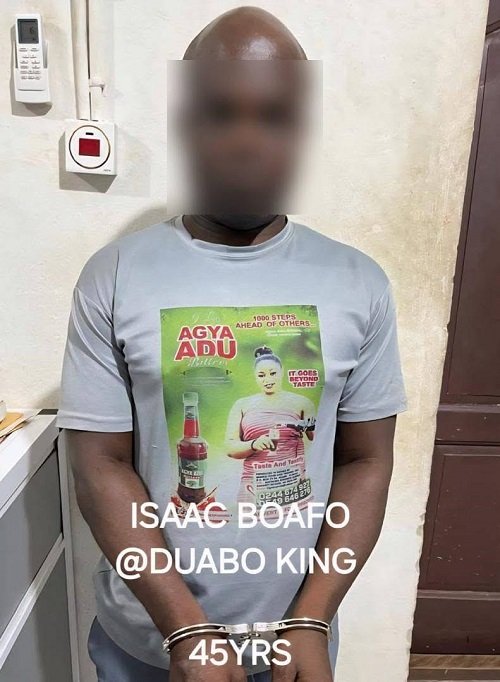
The Ashanti Regional Police Command has arrested 45-year-old Isaac Boafo, also known as “Duabo King,” for allegedly publishing false news intended to cause fear and panic.
Police said the arrest follows a viral TikTok video in which Boafo claimed that four officers at the Central Police Station in Kumasi engaged in inappropriate conduct with commercial sex workers during night patrols in Asafo.
Officers from the Police Intelligence Directorate (Ashanti Region) apprehended Boafo after receiving intelligence about the video.
During questioning, he admitted to creating the video to attract views and engagement online, and acknowledged that he could not prove the allegations.
Boafo also admitted making comments about the President of the Republic for content purposes and could not defend those statements.
He has been formally charged and is in detention as investigations continue.
The Ashanti Regional Police have warned the public against publishing or sharing false information on social media, noting that such acts can cause fear, panic, and damage reputations.
They said anyone found engaging in similar conduct will face legal action.
By: Jacob Aggrey