Hot!
1Billion Africa launches STEM for Africa Project


1Billion Africa (1BA) recently launched the Science, Technology, Engineering and Mathematics (STEM) for Africa (S4A) project in Hwidiem in the Asutifi South District of the Ahafo Region of Ghana.
The S4A project, which contributes Sustainable Development Goals 4, 5, 10 & 17 – Quality Education, Gender Equality, Reduced Inequalities, and Partnerships for Development, respectively, is a bold initiative
to raise young scientists and innovators from rural communities in Africa.
1Billion Africa, a non-profit civil society organisation in Africa, inspires and empowers Africa’s youth to be change-agents in their communities by finding problems and turning them into projects.
The S4A project in Hwidiem is funded under the Engineering X programme founded in partnership with Royal Academy of Engineering and Lloyd’s Register Foundation.
The Queen Mother, Nana Attaa Adwoa Agyeiwaa Kodie II, shared her commitment and vision of bringing quality education to Hwidiem, and why she believed the S4A project was helping to facilitate the initiative.
She applauded those funding the project and partners, and urged all stakeholders to commit to playing their roles diligently. She also urged parents to be involved, and student beneficiaries to take advantage of this golden opportunity to invest in their future.
“We are piloting this initiative in Hwidiem because of the immense support demonstrated by stakeholders during previous projects by 1BA in the district,” Mr Prince Adu-Appiah, Chief Executive Officer (CEO) and Founder of 1Billion Africa, said.
1Billion Africa and its partners appealed to the government, institutions, companies and individuals, to help scale the project to other communities in Ghana.
For the next two years, the S4A project will capacitate 1,000 student beneficiaries in 10 schools in Hwidiem to go through a total of 52,000 hours of practical STEM tuition using the innovative Science Set toolkit
developed by Dext Technologies Limited.
The project targets school children between the ages of 10 -15 years, who are in upper primary and junior high school in Hwidiem.
A total of 15 STEM clubs would also be set up to further engage the students in other innovative STEM activities, as well as have further practical sessions with the toolkit, which can be used to perform over 30 experiments.
The experiments include; building mini-robots, circuit systems, security alarm systems, and solar panel models.
Creativity, innovation, problem-solving and critical thinking skills to solve community problems is at the heart-beat of S4A, thus two Innovation Challenge competitions will be organised within the
project period.
In addition, 50 girls selected from within the 1,000 beneficiaries will receive mentoring from STEM Champions in liaison with Synergies Institute – Sankofa Mentorship Hub.
1BA has implemented and inspired over 25 projects in three countries – Ghana, Namibia and South Africa – impacting over 12,000 people, the majority being youth, women and children.
Key project partners include; Dext Technology, Synergies Institute – Sankofa Mentorship Hub, Nana Attaa Agyeiwaa II Foundation, D S Dayta Solution, Hwidiem Traditional Council, the Asutifi South District Education, the District and Local Government Assemblies, and Community Leaders.


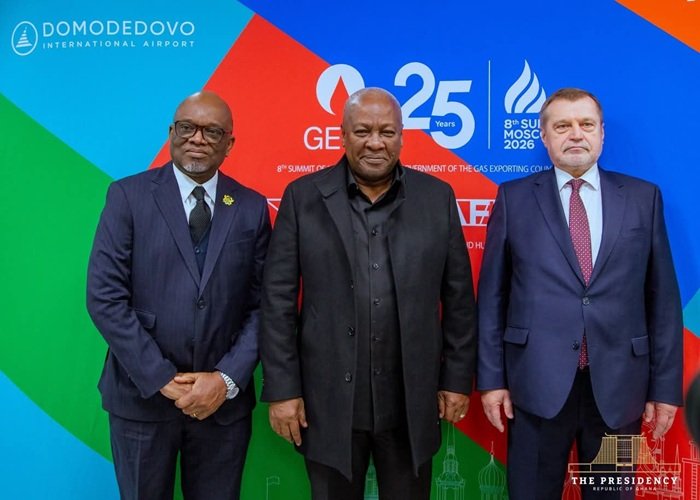
President John Mahama has arrived in Moscow, Russia, from Ethiopia to participate in the 3rd Russia-Africa Summit.
The summit is being hosted by Russian President Vladimir Putin.
During the visit, President Mahama will join fellow African leaders at the Economic and Humanitarian Forum and summit plenary sessions.
He is also scheduled to hold high-level bilateral talks with President Putin and attend a Kente exhibition organised by the Russia-Ghana Parliamentary Forum.
As part of the visit, the President will receive honorary doctorate degrees from the Russian University of Transport and the Peoples’ Friendship University of Russia.
He will also engage Russian businesses and state institutions to advance bilateral cooperation between Ghana and Russia.
By Edem Mensah-Tsotorme
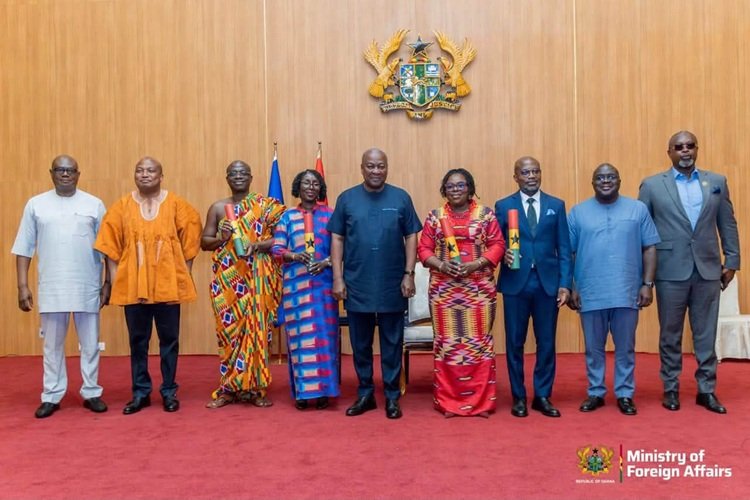
President John Dramani Mahama has commissioned four career diplomats as ambassador-designates to represent Ghana in four countries.
The commissioning ceremony took place on Friday, October 16, 2026.
The new envoys are Her Excellency Nana Antwiwaa Dodoo, Ambassador-Designate to Angola; His Excellency Louis Kwame Obeng, Ambassador-Designate to Qatar; Her Excellency Evelyn Korantemaa Ofosu-Amable, Ambassador-Designate to Israel; and His Excellency Jedidiah Reuben Adogla, Permanent Representative-Designate to Switzerland.
President Mahama charged them to advance Ghana’s national interests through strategic partnerships, economic diplomacy, investment mobilization, and expanded access to international markets.
He said Ghana’s diplomatic engagements must deliver tangible economic benefits, create jobs, and strengthen the country’s standing on the international stage.
The four envoys are career diplomats with over 27 years of experience.
On behalf of her colleagues, Her Excellency Nana Antwiwaa Dodoo thanked the President for the confidence reposed in them and pledged their commitment to emulate his leadership and deliver on the mandate given to them.
By Edem Mensah-Tsotorme