Connect with us

News

Church of Pentecost commission boreholes in two communities

Published

on

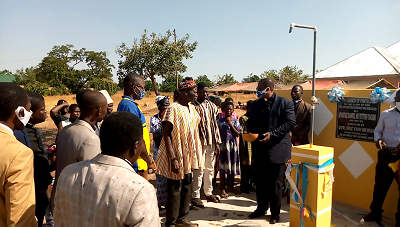
The Wa Area Church of Pentecost has commissioned two mechanised boreholes in Eremon and Babile Communities in the Lawra Municipality.

“They were drilled with support from the Pentecost Social Services, (PENTSOS), and the Suhum Area of the Church, to supply water to residents within the two beneficiary communities for drinking and other domestic chores.

Commissioning the projects, the Wa Area Head, Apostle Daniel Nii Tetteh Tackie expressed the church was delighted to provide amenities that would inure to the benefit of residents irrespective of their religious inclination and asked that residents maintained the facilities for longevity.

The Pentecost Church, he said, was ensuring that, the church was planted in every community across the country, with the construction and commissioning community-based church buildings (CBCB) .

Advertisement

In the Upper West Region, the church under the leadership of Apostle Tackie dedicated four CBCBs at Wapaani, Dapuoh, Danyauakura and Nator together with four other buildings at Kumbiehi, Bulenga, Lambussie and Buli in the Wa, Lawra, Wa East, Wa West, Nadowli-Kaleo, and Lambussie Political Districts respectively.

It dedicated two mission houses for its resident ministers at SabuliandLambussie in the Jirapa and Lambussie Political Districts, and laid the foundation stone for the construction of a CBCB at Gurumbelle and a mission house for the Bulenga Chapel in the Sissala West and Wa East Districts respectively.

The Area Head expressed delight in the collaboration the church enjoyed from traditional authorities in the region, with regard to land acquisition for its project and invoked God’s blessing upon them.

He used the opportunity to call on the chiefs and residents to assist the church to bring out the virtues in the society in order to project morality and mitigate social vices.

Advertisement

The chiefs in the respective areas where the projects were situated lauded the church for the boreholes and church auditoriums respectively.

They expressed confidence that with the presence of the church auditoriums in their communities, stakeholders would begin to scout their zones and include them in development efforts.

At Lambussie, the Assistant Director at the District Assembly, Mr Iddrisu Saphinu who was present at the commissioning of the church auditorium in the area praised the church for its vigilance inthe area and for alerting the assembly on key development issues.

From Lydia Darlington Fordjour, Wa

Advertisement
Continue Reading
Advertisement

News

Woman granted bail after being accused of absconding with GH₵156,445 ‘Susu’ money

Published

on

A woman who is accused of bolting with ‘susu’ money totaling GH₵156,445 has appeared before an Accra Circuit Court. 

Martha Nana Esi Afful was alleged to have collected the money from 35 complainants. 

Charged with 35 counts of fraudulent breach of trust, Martha, who was earlier remanded, pleaded not guilty. 

The court, presided over by Mr Joseph Y. Kuunsong on Wednesday, admitted the accused person to a GH₵200,000 bail with two sureties. 

Advertisement

One of the sureties, the court said, must be a public servant earning not less than GH₵5,000. 

She is expected to reappear on August 12, 2026. 

The Prosecution’s case before the court is that the complainants are traders and residents at La in Accra. 

Prosecution described Martha as a ‘Susu’ collector, who resided at Burma Camp. 

Advertisement

The court heard that the accused person run a business with the name ‘ZOE’ and she deceived the 35 complainants into believing that she collected ‘Susu’ daily, which was kept for a period of one-three years, and paid interest on the money invested. 

The complainants contributed in 2023 for a three-year period, prosecution said. 

In December 2025, when the complainants went to take their money with interest, Martha went into hiding and only took phone calls from a few complainants. 

Prosecution said the accused provided a MTN Momo number through which a few of the complainants still paid monies. 

Advertisement

It said all efforts made to collect the money, totaling GH₵156,445 from her, proved futile. 

On June 14, 2026, a report was made to the police and Martha was picked up at a washing bay at Tse Addo. 

During interrogation, she admitted the offence in her caution statement, saying she lost her husband and relocated to Swedru in the Central Region, hence the complainants were unable to reach her from December 2025 till date. 

Prosecution said Martha further stated that she had invested the monies into refuse collection business and she needed time to pay the amount. 

Advertisement

Police are investigating the claims. –GNA

Continue Reading

News

Health alert : Seek immediate medical care after exposure to flood water

Published

on

A Public Health Nurse at the Roman Ridge Sub-Municipal of the Ayawaso West Health Directorate, Ms Patience Adoli Kporxah, has cautioned the public against coming into contact with floodwaters, warning that exposure can lead to serious diseases, infections and injuries.

Floodwater, she said, should always be treated as contaminated, regardless of how clean it appears, because it may contain sewage, human and animal waste, chemicals, fuel, sharp objects and disease-causing micro-organisms.

In an interview with The Spectator in Accra on Thursday, Ms Kporxah explained that contact with contaminated floodwater exposes people to bacteria, viruses, parasites, hazardous chemicals and other physical hazards that can result in illness or injury.

Her advice came in the wake of recent exposure to floodwater following Monday’s torrential rains that left vast areas of the capital flooded.

Advertisement

As a result, a lot of people were seen either ‘swimming’ in the floodwater to rescue people or retrieving items being washed away.

According to her, exposure to floodwater could cause skin infections, particularly where there are cuts or open wounds, as well as diarrhoea diseases such as cholera, typhoid fever, dysentery and other forms of gastroenteritis if contaminated water was swallowed.

Other health risks, she said include hepatitis A, eye and ear infections, tetanus in people with untreated wounds or incomplete vaccination, and injuries from submerged sharp objects, debris or electrical hazards.

Ms Kporxah advised anyone who had contact with floodwater to monitor their health closely and seek immediate medical attention if they develop symptoms such as fever, diarrhoea, vomiting, abdominal pain, severe headache, muscle aches, skin rash, difficulty breathing, or yellowing of the eyes or skin.

Advertisement

She also urged people whose wounds became red, swollen, painful or begin to discharge pus, as well as those who accidentally swallow floodwater, to report to the nearest health facility without delay.

Although not everyone exposed to floodwater requires immediate treatment, she stressed that pregnant women, people with weakened immune systems, individuals living with chronic illnesses and those with significant wounds should seek prompt medical evaluation.

On water safety, Ms Kporxah cautioned that rainwater was not automatically safe for drinking or cooking, especially during or after flooding. She explained that rainwater collected from roofs, gutters or open containers could be contaminated by bird and animal droppings, dust, leaves, bacteria, viruses, parasites and chemical pollutants.

She advised that rainwater intended for drinking should first be treated by boiling, chlorination or another approved water purification method before use.

Advertisement

Touching on food safety, Ms Kporxah said factory-sealed bottled drinks and canned foods with intact packaging might still be safe after flooding.

However, she stressed that any containers submerged in floodwater should be thoroughly cleaned and disinfected before handling. Foods in paper packaging, damaged containers or products with broken seals should be discarded because contaminated water may have seeped into them.

She further warned that flooding increases the risk of outbreaks of cholera, typhoid fever and other waterborne diseases through contaminated water sources.

In addition, she said flooding could contribute to respiratory illnesses in overcrowded shelters and mould-infested buildings, foodborne illnesses from spoiled or contaminated food, and mental health conditions such as anxiety, stress, depression and trauma.

Advertisement

It could also disrupt access to medicines and healthcare for people living with chronic conditions, including diabetes, hypertension, asthma and kidney disease.

Ms Kporxah therefore urged the public to practice good hygiene, avoid unnecessary contact with floodwater, consume only safe food and drinking water, and seek medical attention promptly whenever symptoms develop.

She said observing these preventive measures would help minimise the risk of disease outbreaks and protect lives as the country continues to experience heavy rains and flooding in some communities.

By Esinam Jemima Kuatsinu

Advertisement
Continue Reading
Advertisement

Trending