Features
Your silence is more than deafening …speak now or forever hold your peace

- /home/u249204778/domains/spectator.com.gh/public_html/wp-content/plugins/mvp-social-buttons/mvp-social-buttons.php on line 27
Warning: Trying to access array offset on false in /home/u249204778/domains/spectator.com.gh/public_html/wp-content/plugins/mvp-social-buttons/mvp-social-buttons.php on line 27
&description=Your silence is more than deafening …speak now or forever hold your peace', 'pinterestShare', 'width=750,height=350'); return false;" title="Pin This Post">
- Share
- Tweet /home/u249204778/domains/spectator.com.gh/public_html/wp-content/plugins/mvp-social-buttons/mvp-social-buttons.php on line 72
Warning: Trying to access array offset on false in /home/u249204778/domains/spectator.com.gh/public_html/wp-content/plugins/mvp-social-buttons/mvp-social-buttons.php on line 72
&description=Your silence is more than deafening …speak now or forever hold your peace', 'pinterestShare', 'width=750,height=350'); return false;" title="Pin This Post">
I have had many people, both friends and otherwise, ask, “Why do you seem as such a different person now in your older age than you were in your youth?”
Usually, I laugh at these questions or insinuations of all kinds because all my life, I have endeavoured to live a very simple life; I guess that as one gets close to the ‘three scores and ten’ stage, one’s general attitude to everything changes, as one begins to question all things, particularly those that one had taken for granted all those years, beginning with not amassing wealth at any cost, especially from questionable sources but more on how one intends to leave this country in a ‘far better state’ than that which was bequeathed to him or her.
As you age, you begin to question yourself over how fairly you have treated others because you know deep down in your hearts of heart, you are most worried about how you will be received back home in the hereafter and equally important, how those you leave behind will be treated according to the weight and depth of your ‘sins’ here on earth or particularly how your children and their children will be treated for your name sake.
That is when you come to full circle to the weight of how badly you treated others, when by just uttering a word, you could have changed their fortunes for the better, and for which they would have been eternally grateful.
You see, the JUDGEMENT or ‘SELF-INTROSPECTION’ begins here on earth before you leave. Sometimes, they manifest in the way and manner you leave:- long sicknesses, accidents of all kind, isolated lives of no-care as you antagonised all those who could have been there for you in your last years, months, weeks, days, hours and moments.
This world isn’t just about YOU amassing riches in any manner and mode, even when the cost of it is denying use of resources to develop facilities like schools, recreation/health centres and better roads for use by the general public.
Funny but it is at this advanced ages that you realise that you had missed the whole essence of your life here on earth: ‘THE PRINCIPLE OF SOMEBODY’S CHILD – The Myth of Fleming – Churchill’. This myth will always serve as the basis for HELPING OTHER PEOPLE’S CHILDREN’.
You see, any child, in our old traditional or village setting ‘belonged’ to somebody and that’s why a whole
village in those days could contribute towards the education of their brightest pupil, irrespective of who the parents were, except that they are members of the same village who cannot afford to educate the child.
They all contribute, knowing that he or she will always come back to the community to support not only his or her parents but the entire community at large.
Even more importantly, the entire village believed in the principle that you never know who would be around at your worst or most critical need or moment: maybe not your own children but ‘SOMEBODY’S CHILD’.
That is why it is always important to do ‘good’ at all times, not pick and choose, because the person to save you at your worst need, wouldn’t be your own child.
If you just can’t help other people’s children, please refuse to be a conduit for denying them use of national resources through corruption, or their share thereof: denying them access to proper education through equal opportunities.
And if you think you can’t help in any way except concentrate on your own core or extended family, at least you could join the ‘unseen faces’ with voices to SPEAK TRUTH TO POWER, thereby ensuring that national resources are judiciously applied for the benefit of all, than just family and friends.
The OLD MAN ABOVE has a great sense of humour, and that is why He uses simple things of the world to confound the proud, self-conceited, hypocritical, arrogant and selfish people, who when they get to power forget, with no sense of appreciation, those people on whose backs and suffering they rode into office with the power of attorney to manage national or state resources for the general good other than themselves, family and friends.
If you are one of those ‘unseen faces’ with a voice to speak truth to power, but are sitting on the ‘fences of life’, pretending what is going on around the rest of the populace does not concern you, then it is a sad reflection of your own life; and you are better off reading the next passage of ‘FIRST THEY CAME’.
‘FIRST THEY CAME’ by Martin Niemöller
First they came for the Communists
And I did not speak out
Because I was not a Communist
Then they came for the Socialists
And I did not speak out
Because I was not a Socialist
Then they came for the trade unionists
And I did not speak out
Because I was not a trade unionist
Then they came for the Jews
And I did not speak out
Because I was not a Jew
Then they came for me
And there was no one left
To speak out for me.
MARTIN NIEMÖLLER (1892-1984), the writer, was a prominent Lutheran pastor in Germany, who emerged as an outspoken public foe of Adolf Hitler, and spent the last seven years of Nazi rule in concentration camps. He is perhaps best remembered for his post-war words, “First they came for the socialists, and I did not speak out…”
The quotation expresses Niemöller’s belief that Germans had been complicit through their silence in the Nazi’s imprisonment, persecution, and murder of millions of people. He felt this to be especially true of the leaders of the Protestant churches.
In 1920, Martin decided to follow the path of his father and began seminary training at the University of Münster. Niemöller enthusiastically welcomed the Third Reich under Adolf Hitler. But a turning point in his political sympathies came with a January 1934 meeting of Adolf Hitler, Niemöller, and two prominent Protestant bishops to discuss state pressures on churches.
At the meeting it became clear that Niemöller’s phone had been tapped by the Gestapo (German Secret State Police). It was also clear that the Pastors Emergency League (PEL), which Niemöller had helped found, was under state surveillance. Following the meeting, Niemöller would come to see the Nazi state as a dictatorship, one which he would oppose till his death years later.
You see, if you become like MARTIN NIEMÖLLER and pretend to not see what has been going on for the past 29 years of the Fourth Republican dispensation of ‘WINNER-TAKES-ALL’ mentality, where once your party goes into opposition, you are denied any fair share of the national cake or opportunities, treated like you do not belong to this country: to the extent others with impunity will dare say to all that “We Are Taking Back Our Nation”, as if to intimate that the rest of us are foreigners.
People’s children have finished university, sometimes with great grades yet cannot be employed because they do not belong or they have been contracted to offer services to this
nation under one regime but the next regime has to pay the bill but refuses to on the premises that, you do not belong to them – is that the kind of an all-inclusive people we want to be governed by? That state resources are only available to ‘them’ not us because we do not belong?
Is that how far back we have retrogressed as a nation and as a people; and worse, those with voices to speak truth to power have faded back into their individual cozy circumstances sponsored by state, under all kind of disguises?
These same voices who were so vociferous during the reign of other governments in the past, the Church, becomes as mute as a popstar who loses his voice – Remember MARTIN NIEMÖLLER’s last stanza of ‘FIRST THEY CAME’ piece: Then they came for me, And there was no one left, To speak out for me.
Need I say more, when we have been more than quiet over the years since 1993 on CORRUPTION, UNFAIR ALLOCATION OF RESOURCES AND SERVICES TO COMMUNITIES, ABANDONED PROJECTS (as if developed by someone’s private resources not state), NEGLECT OF PLACES (because that’s not where we get our most votes from during elections or come from), DENIAL OF OPPORTUNITIES (because our government is out of office).
What about those of us, who do not belong to the two dominant political blocks, WHERE DO WE BELONG IN THE SCHEME OF THINGS?
This is my sequel to Martin Niemöller’s piece: ‘SECOND THEY CAME’
Second they came for the NPP Appointees
And I did not speak out
Because I was not NPP Appointee
Then they came for the NDC Appointees
And I did not speak out
Because I was not NDC Appointee
Then they came for the TUC Executives
And I did not speak out
Because I was not a TUC Executive
Then they came for the UTAG Executives
And I did not speak out
Because I was not a UTAG Executive
Then they came for some GJA Members
And I did not speak out
Because I was not a GJA Member
Then they came for some Radio Presenters
And I did not speak out
Because I was not a Radio Presenter
Then they shot innocent bystanders during General Election
And I did not speak out
Because I was not a bystander
Then they came for me
And there was no one left
To speak for me.
Need I say any more?
By Magnus Naabe Rex Danquah is a land economist & appraiser, events architect & planner, sport business consultant, social commentator and an author


There is a scripture that is found in Matthew 6:22 which says that the lamp of the body is the eye and therefore the eye must see well to enable the body to get to its destination.
What most people do not know is that behind the scenes, there is a strong interaction between the eyes and the brain before a picture becomes clear. The state of mind therefore is crucial to the eye seeing clearly to enable the body to process accurately the information the eyes are feeding it for proper identification of what the eyes see.
This is similar to how a person behaves i.e. what informs the decisions that forms in the mind that results in the actions that a person performs. The actions of a person does not therefore just happen but is as a result of things that went on in the mind, which in most cases resulted from information passed on to it by the eyes either consciously or unconsciously.
There are so many issues that affect our society which makes one wonder, whether the people who displayed such acts were created by someone or something other than God.
How can a person see a beach created by God with beautiful beaches and fresh air blowing all around, decides to defecate at such places, and therefore desecrate the environment? lt is simply mind boggling?
When other people in other countries who dwell on the coast are using their beaches for tourist attraction purposes as a means of livelihood and also to promote environmental health, some people living around our beaches, have turned them into rubbish dumping sites and toilets.
It is a very sad situation and the earlier we did something about it the better. It is a national emergency that must engage the attention, first of the government and then the citizenry, where religious bodies and NGOs must play a critical role.
The things we focus on in this country, needs to be addressed. Our minds which processes the info the eyes send to the brain, must be disciplined. There are certain behaviours that a disciplined mind can ignore even when the eye has provided info to the brain. One of the things a disciplined mind does, is the avoidance of a second look, which is critical for every person who wants to avoid adultery or fornication.
Once a person is not blind, he will see things. The boobs, the ‘shankus’, the coca cola shapes, the light complexioned, the dark complexioned etc. the eyes will definitely see and report same to the brain. What the brain or the mind decides to do or instructs the eye to do is the issue.
It can decide to instruct the eye to take a second look and let the mind drool over it or say ignore it and that will be the end.
If the mind becomes trained to focus on environmental issues like clean environment, the eyes will automatically be reporting on insanitary conditions to the brain as and when it sees them. The mind will pay attention to such data and begin to process them and to identify solutions to deal with the reported insanitary conditions.
There is the need to encourage citizens to train the mind to focus on the right thing so that in tandem with the eyes, focus will be maintained. When the mind is so trained, it communicates with the eye to also focus on hood things that helps in both are spiritual life and our secular lives, for indeed the eyes are the lamp of the body. God bless.
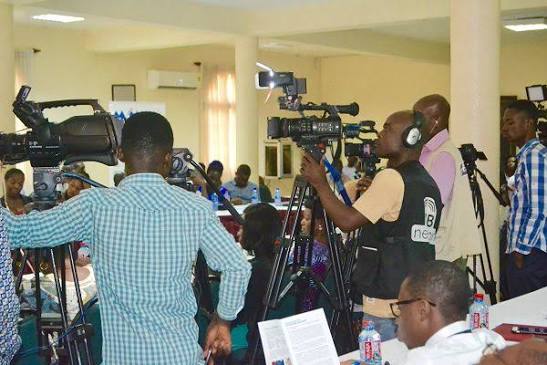
THE relationship between New Times Corporation (NTC) and African Concrete Productions (ACP) is based entirely on matters of the stomach. Each depends on the other in a dietary symbiosis, reinforced by the close proximity of each other
At lunchtime, you’d see a particular set of Times workers marching regimentally to ACP to face the wall. You’d think they are soldiers. It has long been declared that the company manufactures the best kokonte in the Greater Accra Region. ACP is, therefore, a culinary haven for those NTC kokonte fans, both male and female.
As the NTC kokonte warriors cross the border to ACP, you’d see some ACP banku fanatics dancing joyously to NTC. They are lucky folks because they do not have to obtain visa to enter into ‘Times’ to attack the balls of banku with precision and accuracy. They also claim that the lightsoup at ‘Times’ is arguably the best in West Africa.
So the relationship between the two entities was quite cordial and based practically on stomach palaver, until ACP workers staged an industrial revolution, whereupon the managing director, accountant and estate manager were allegedly stripped naked and locked up in a room. An insurgency had began in earnest.
An ACP worker came to ‘Times’, this time not to eat banku and okro. He had come to inform newsmen that juicy stuff awaited them at ACP. It could make a front page lead story.
A camerawoman and a female reporter were accordingly dispatched to go and bring back news, juicy news as juicy as kokonte and groundnut soup.
I was driving to work when I espied the familiar camerawoman clicking away outside the ACP premises. I didn’t see any ‘Times’ reporter but angry workers who were on the verge of getting violent. I slowed down and the driver behind blew his horn at me like a lunatic. I drove on.
Later, I heard the reporter and camerawoman were harassed and brutalised. The report came,. “The camerawoman, Mrs Salome Adonu-Agbottah and reporter Mrs Doreen Allotey, in an attempt to retrieve the camera which the workers had seized from them were severely beaten. They were manhandled and almost pushed into a big gutter opposite the company’s premises.
BRUISES
“….The camerawoman had bruises on her body, her hand bag was destroyed and the money in it stolen. Mrs Allotey’s watch was also snatched and her feet stamped on.”
Luckily, it was not her nose that was trampled upon. She has a beautiful nose.
The bad news was received with extreme sorrow. If the victims had been men, it would not have seemed too bad. But to brutalise women is just unacceptable. The New Times Corporation has not stopped mourning the incident which has been condemned in many circles.
Some people keep asking me why Times sent females to cover a potentially violent demonstration. I tell them they might as well ask why CNN’s amazon, Christina Amanpour, is assigned to cover the carnage in Bosnia-Herzegovina and Rwanda. She is always on the frontline in jeans and jacket.
Journalism is a potentially hazardous profession, and once you accept to study and practise the trade, you might as well bone up to face any assignment as long as your superiors feel you are capable of handling it or you have demonstrated the capacity to handle it. Both males and females can be assigned anywhere, anytime just like policemen and women are assigned.
The only difference between cops and pressmen is that the latter are armed only with a pen and the former with a gun. The question is should newsmen also arm themselves so that in any event of an assault they would not be found wanting in self-defence? They can’t adequately defend themselves with a pen and a jotter. A pen cannot even disfigure an opponent’s upper lip.
Photo-journalists have particularly suffered violence. Spectator ace-cameraman Vincent Dzatse was severely assaulted by AMA men when he attempted to take pictures of their indiscretions.
Sports cameraman, P. K. Arthur has been beaten more than once at the sports stadium when riots errupted and he wanted to capture it on his lenses.
Some sports journalists have been banned from entering the Accra Sports Stadium by supporters because in their comments, they didn’t write “sense”. Some supporters once nearly lynched Christian Abbew, Spectator Sports Editor, near a courtroom. He was stoned like the biblical Stephen. He had gone to defend a contempt charge.
I think it is time journalists met and discussed how best to defend themselves in any event of an attack by individuals or mobs. In the pursuance of their duty, they must be free from harassment and assault.
Some journalists go to work and return home with a black-eye or a double fore-head. It is just not right. Something has to be done about it. I think journalists should be armed. But first we must be trained in the use of firearms so that our warning shot do not hit below the belt. What about training in Kung Fu?
This article was first published on Saturday, October 17, 1998.