Features
Construction crew or demolition squad? [Final Part]


- /home/u249204778/domains/spectator.com.gh/public_html/wp-content/plugins/mvp-social-buttons/mvp-social-buttons.php on line 27
https://spectator.com.gh/wp-content/uploads/2022/01/Team-work-Pix.jpg&description=Construction crew or demolition squad? [Final Part]', 'pinterestShare', 'width=750,height=350'); return false;" title="Pin This Post">
- Share
- Tweet /home/u249204778/domains/spectator.com.gh/public_html/wp-content/plugins/mvp-social-buttons/mvp-social-buttons.php on line 72
https://spectator.com.gh/wp-content/uploads/2022/01/Team-work-Pix.jpg&description=Construction crew or demolition squad? [Final Part]', 'pinterestShare', 'width=750,height=350'); return false;" title="Pin This Post">
The twin evil of bribery and corruption in the country appears to defy all forms of exorcism. Given that Ghana’s anti-corruption laws criminalise active and passive bribery, extortion, willful exploitation of public office, use of public office for private gain, and bribery of foreign public officials, among other offences, what is the problem? Is it about enforcement? Who enforces the laws? Are they blind?
I hope my friends in the police are reading this. Years back, during the funeral of my late father, Odehye3 Akwasi Agyeman Prempeh, (God bless his soul), one of his surviving friends who had not seen me since I morphed into a man, approached me, and slipped his right hand into mine. My heart leapt with excitement as my thought raced to the possibility that he was going to give his funeral donation“nicodemously” as some sympathisers prefer to do. How wrong I was!
Instead, he whispered in the twi language: “Ohenenana, kyia me apolisifuornkyia,” which translates loosely to, “Prince, greet me like the way the police do it.” I understood him. He wanted some money and I obliged him. Instead of me receiving, I ended up giving.
I believe our police are doing a yeoman’s job, especially under the leadership of the no-nonsense, businesslike, uncompromising new IGP, COP Dr. George Akuffo Dampare. I was thrilled when I read that the police had traced and arrested a 31-year-old driver following a social media post by a good citizen about his reckless endangerment of lives through a scary and deadly overtaking on the Accra-Kumasi road on December 30 last year.
But a few bad eggs are tainting the image of an otherwise excellent service by their proverbial style of greeting. IGP, keep up the good work! Drain the swamp! COP Rev. Dr. David Ampah-Bennin, greetings to you. You are an exemplary member of the inky fraternity and the clergy.
Dear pastor, man of God so called! You call yourself a shepherd. Agreed! But whom do you feed, the flock or yourself?Why do you feed fat off the hard labour, sweat and tears of the congregation? Why are you exploiting their ignorance and gullibility to make a fortune out of their fears?
By your cunning methods you rip people off and line your pockets while most of your church members merely scrape by. Occasionally, you conjure a trick which you claim to be “a direction from the Lord, “using the Book of Psalms to reap an uncommon harvest. Starting from the highest number in the Psalms, that is, Psalm 150 you tell the congregation that the Lord says each member should sow a seed of 150 cedis times the number of their children. That means if you have four children, you ought to pay 600 cedis in obedience to a so-called “direction.”
And you prefer the three-digit Psalms – from 100 to 150. As the number drops to two digits, you apply new methods to keep the seed up where you want it. And so, if it is Psalm 20, you may say: “We are in the twelfth month and today is the 20th day. The Lord says we should sow a seed of 240 cedis which is 20 times 12. This is a direction from the Lord.”How did you receive that “direction?” Through dreams, visions, slumbering upon your bed after a bowl of fufu, or was it God’s audible voice? God sits on His throne and says, “You rascals!”
God commands us to honour mothers and fathers, but you teach people to dishonour their parents, especially their mothers. With unproven claims of clairvoyance, you label certain mothers witches. By what foul spirit did you receive that vision? Do you have any idea about the magnitude of the chaos your lies have caused among some families? Why should you so callously tarnish somebody’s image and pierce her heart with the sword of your untamed and poisonous tongue? “Thou shalt not bear false witness,” but you do just that under the guise of speaking the oracles of God. And the last time I checked you were still hunting for more prey.
Mr. and Madam Honourable, what is happening in Parliament? Are we tearing the nation apart with unnecessary squabbles bordering on pettiness? Parliamentary rules of engagement should not be a replica of the ideas of Joseph Paul Goebbels, master propagandist of the Nazi Party who notoriously said: “We do not come as friends, nor neutrals. We come as enemies. As the wolf bursts into the flock, so we come.” That tone is the beat of war drums. Do the recent events in the nation’s parliament reflect the words of Goebbels? This is an “urgent question” on the floor.
Our nascent democracy demands the thinking of the 19th century British lawyer, judge, philosopher, law reformer, and writer, Sir James Fitzjames Stephen (1829-1894) who famously said: “Parliamentary government is simply a mild and disguised form of compulsion. We agree to try strength by counting heads instead of breaking heads, but the principle is exactly the same… The minority gives way not because it is convinced that it is wrong, but because it is convinced that it is a minority.”That is some food for thought.
The majority, on its part, must learn to accommodate opposing views that can be proven to conduce to our national development aspirations.Every political party with a genuine desire to develop the country has only one option as espoused by that charismatic president of the United States, John F. Kennedy. “Let us not seek the Republican answer or the Democratic answer, but the right answer. Let us not seek to fix the blame for the past. Let us accept our own responsibility for the future.”Spot on! That is all we need to forge ahead.
Democracy thrives on the exchange of ideas but in an amicable atmosphere. Needless to say, two wrongs do not make a right. Is it not appalling that while most Ghanaians are beset with some of the most monstrous inequalities in the world, the seat of Ghana’s democracy, Parliament, which should lead the way in correcting those wrongs, should turn into an arena of confusion and melodrama?
For those who took part in the recent brawl in Parliament, what do you think you were teaching your children?In this era of social media, your disgraceful behaviour gained much currency in no time. It is likely that some of your children spotted you in the thick of affairs.When they queried you about your conduct, what did you tell them? Defending democracy?
Mr. Osei Kyei-Mensah-Bonsu, the Majority Leader, apologised on behalf of his colleagues on both sides. As admirable as it was to eat humble pie,an impression had already been etched on the minds of Ghanaians about the kind of people we elected to represent us. The only way people will hit the delete button in their memory, and consign the incident to history,is for our parliamentarians to work together and accelerate the pace of our national development in a manner that can be felt by all and sundry.
There are plenty of policy differences to discuss that do not warrant any unnecessary distraction. By any acceptable means, let your differences be ironed out but let the process lead to development for the longsuffering people of this land of gold and oil.
And for those who are so blinded by politics that they can stoop so low as to utter unprintable words against another, why do you even go to the house of God on occasion; to seek forgiveness and repent, or to deceive God? Of course, no one can hoodwink God. I believe politicians do not hate one another but unfortunately, they allow politics to make their blood boil.
We should all take a cue from the late President J.J. Rawlings and President Akufo-Addo who were sworn political enemies, yet, made some room for accommodation. Why would these guys reconcile, at least, to some extent? It was all in the interest of nation building.
Fellow Ghanaians I leave you with two quotes from Nelson Mandela: “Everyone can rise above their circumstances and achieve success if they are dedicated to and passionate about what they do.” He said also: “It is in your hands to make a better world for all who live in it.”
Where do you stand, with the Construction Crew or the Demolition Squad? As the King James Version of the Bible would put it: “Choose ye this day!”
And remember that a stitch in time saves nine!
Contact: teepeejubilee@yahoo.co.uk
BY TONNT PREMPEH


There is a scripture that is found in Matthew 6:22 which says that the lamp of the body is the eye and therefore the eye must see well to enable the body to get to its destination.
What most people do not know is that behind the scenes, there is a strong interaction between the eyes and the brain before a picture becomes clear. The state of mind therefore is crucial to the eye seeing clearly to enable the body to process accurately the information the eyes are feeding it for proper identification of what the eyes see.
This is similar to how a person behaves i.e. what informs the decisions that forms in the mind that results in the actions that a person performs. The actions of a person does not therefore just happen but is as a result of things that went on in the mind, which in most cases resulted from information passed on to it by the eyes either consciously or unconsciously.
There are so many issues that affect our society which makes one wonder, whether the people who displayed such acts were created by someone or something other than God.
How can a person see a beach created by God with beautiful beaches and fresh air blowing all around, decides to defecate at such places, and therefore desecrate the environment? lt is simply mind boggling?
When other people in other countries who dwell on the coast are using their beaches for tourist attraction purposes as a means of livelihood and also to promote environmental health, some people living around our beaches, have turned them into rubbish dumping sites and toilets.
It is a very sad situation and the earlier we did something about it the better. It is a national emergency that must engage the attention, first of the government and then the citizenry, where religious bodies and NGOs must play a critical role.
The things we focus on in this country, needs to be addressed. Our minds which processes the info the eyes send to the brain, must be disciplined. There are certain behaviours that a disciplined mind can ignore even when the eye has provided info to the brain. One of the things a disciplined mind does, is the avoidance of a second look, which is critical for every person who wants to avoid adultery or fornication.
Once a person is not blind, he will see things. The boobs, the ‘shankus’, the coca cola shapes, the light complexioned, the dark complexioned etc. the eyes will definitely see and report same to the brain. What the brain or the mind decides to do or instructs the eye to do is the issue.
It can decide to instruct the eye to take a second look and let the mind drool over it or say ignore it and that will be the end.
If the mind becomes trained to focus on environmental issues like clean environment, the eyes will automatically be reporting on insanitary conditions to the brain as and when it sees them. The mind will pay attention to such data and begin to process them and to identify solutions to deal with the reported insanitary conditions.
There is the need to encourage citizens to train the mind to focus on the right thing so that in tandem with the eyes, focus will be maintained. When the mind is so trained, it communicates with the eye to also focus on hood things that helps in both are spiritual life and our secular lives, for indeed the eyes are the lamp of the body. God bless.
THE relationship between New Times Corporation (NTC) and African Concrete Productions (ACP) is based entirely on matters of the stomach. Each depends on the other in a dietary symbiosis, reinforced by the close proximity of each other
At lunchtime, you’d see a particular set of Times workers marching regimentally to ACP to face the wall. You’d think they are soldiers. It has long been declared that the company manufactures the best kokonte in the Greater Accra Region. ACP is, therefore, a culinary haven for those NTC kokonte fans, both male and female.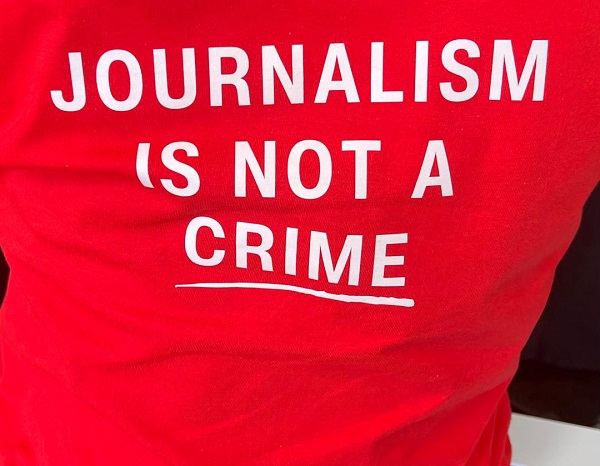
As the NTC kokonte warriors cross the border to ACP, you’d see some ACP banku fanatics dancing joyously to NTC. They are lucky folks because they do not have to obtain visa to enter into ‘Times’ to attack the balls of banku with precision and accuracy. They also claim that the lightsoup at ‘Times’ is arguably the best in West Africa.
So the relationship between the two entities was quite cordial and based practically on stomach palaver, until ACP workers staged an industrial revolution, whereupon the managing director, accountant and estate manager were allegedly stripped naked and locked up in a room. An insurgency had began in earnest.
An ACP worker came to ‘Times’, this time not to eat banku and okro. He had come to inform newsmen that juicy stuff awaited them at ACP. It could make a front page lead story.
A camerawoman and a female reporter were accordingly dispatched to go and bring back news, juicy news as juicy as kokonte and groundnut soup.
I was driving to work when I espied the familiar camerawoman clicking away outside the ACP premises. I didn’t see any ‘Times’ reporter but angry workers who were on the verge of getting violent. I slowed down and the driver behind blew his horn at me like a lunatic. I drove on.
Later, I heard the reporter and camerawoman were harassed and brutalised. The report came,. “The camerawoman, Mrs Salome Adonu-Agbottah and reporter Mrs Doreen Allotey, in an attempt to retrieve the camera which the workers had seized from them were severely beaten. They were manhandled and almost pushed into a big gutter opposite the company’s premises.
BRUISES
“….The camerawoman had bruises on her body, her hand bag was destroyed and the money in it stolen. Mrs Allotey’s watch was also snatched and her feet stamped on.”
Luckily, it was not her nose that was trampled upon. She has a beautiful nose.
The bad news was received with extreme sorrow. If the victims had been men, it would not have seemed too bad. But to brutalise women is just unacceptable. The New Times Corporation has not stopped mourning the incident which has been condemned in many circles.
Some people keep asking me why Times sent females to cover a potentially violent demonstration. I tell them they might as well ask why CNN’s amazon, Christina Amanpour, is assigned to cover the carnage in Bosnia-Herzegovina and Rwanda. She is always on the frontline in jeans and jacket.
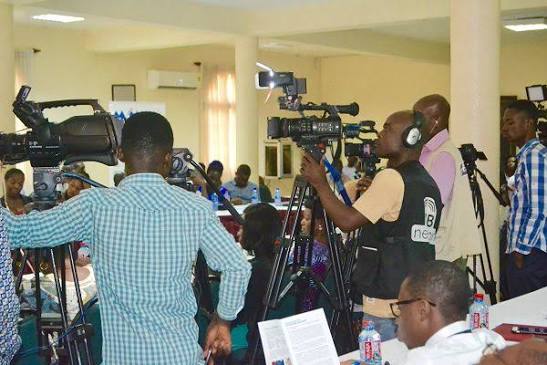
Journalism is a potentially hazardous profession, and once you accept to study and practise the trade, you might as well bone up to face any assignment as long as your superiors feel you are capable of handling it or you have demonstrated the capacity to handle it. Both males and females can be assigned anywhere, anytime just like policemen and women are assigned.
The only difference between cops and pressmen is that the latter are armed only with a pen and the former with a gun. The question is should newsmen also arm themselves so that in any event of an assault they would not be found wanting in self-defence? They can’t adequately defend themselves with a pen and a jotter. A pen cannot even disfigure an opponent’s upper lip.
Photo-journalists have particularly suffered violence. Spectator ace-cameraman Vincent Dzatse was severely assaulted by AMA men when he attempted to take pictures of their indiscretions.
Sports cameraman, P. K. Arthur has been beaten more than once at the sports stadium when riots errupted and he wanted to capture it on his lenses.
Some sports journalists have been banned from entering the Accra Sports Stadium by supporters because in their comments, they didn’t write “sense”. Some supporters once nearly lynched Christian Abbew, Spectator Sports Editor, near a courtroom. He was stoned like the biblical Stephen. He had gone to defend a contempt charge.
I think it is time journalists met and discussed how best to defend themselves in any event of an attack by individuals or mobs. In the pursuance of their duty, they must be free from harassment and assault.
Some journalists go to work and return home with a black-eye or a double fore-head. It is just not right. Something has to be done about it. I think journalists should be armed. But first we must be trained in the use of firearms so that our warning shot do not hit below the belt. What about training in Kung Fu?
This article was first published on Saturday, October 17, 1998.