Features
From panic to pass: how parents, teachers can help children beat BECE and WASSCE exam phobia- Part 2

Walk through any Junior High or Senior High compound in Ghana as the Basic Education Certificate Examination (BECE) or West African Secondary School Certificate Examination (WASSCE) approaches and you will see it.
A bright girl suddenly quiet. A boy who led class debates now sleeping at his desk. A Form three student with stomach pains every Monday morning.
This is not laziness. This is academic stress. When left unaddressed, it hardens into exam phobia-overwhelming dread that pushes children into burnout, avoidance, and sometimes silence.
As a mental health professional who sits with these children and their parents at Counselor Prince & Associates Consult (CPAC) in Adenta Oyarifa-Teiman, I see the pattern clearly.
Research confirms it. Putwain and Daly (2014) found that high test anxiety predicts lower grades independent of ability. Zeidner (1998) showed that chronic academic pressure raises cortisol, weakens memory recall, and increases school dropout risk. The brain under fear cannot retrieve what it studied.
The classroom lifeline: What teachers can do before, during and after exams
Teachers, you are the second parent. Seat the anxious child where eye contact is easy. Break instructions into two steps, written and verbal. Allow a 2-minute stretch break after 25 minutes of study movement resets the brain. Before mock exams, do a 60-second breathing exercise with the whole class: in for 4, hold for 4, out for six. It tells the body “we are safe.” Grade effort and method, not only final answers, especially in term work. A child who shows working will try again. A child marked “wrong” only learns to hide.
Avoid public comparison. “Why can’t you be like Esi?” creates shame, and shame shuts down learning. The goal is competence, not competition. Where possible, link topics to life-compound interest to MTN mobile money, photosynthesis to why Grandma’s backyard garden survives Harmattan. Meaning reduces fear.
Building back better: Daily habits that prevent burnout and restore joy in learning
Recovery is daily, not dramatic. Families can adopt CPAC’s “3-2-1 Rule” during exam seasons: 3 balanced meals, 2 hours total screen time outside study, 1 hour of non-academic joy-football, dance, church youth, sewing. Joy is not a distraction from success; it is fuel for it.
Teach the “Name, Tame, Reframe” skill. Name: “I feel my heart beating fast.” Tame: “That’s my body trying to help me focus.” Reframe: “I have prepared. I will answer what I know first.” For children who freeze, teach them to write their name, date, and index number slowly. Motor action unlocks cognition.
Know when to seek help. If your child vomits before exams, fakes illness weekly, speaks of self-harm, or has not slept properly for two weeks, see a mental health professional. Academic stress that lasts beyond the exam season may mask anxiety disorders or depression. Early support prevents long-term wounds.
Parents, teachers, churches-our children are not machines for grades. They are minds and hearts we are shaping for life. BECE and WASSCE end in days. But the beliefs they form about themselves during those days last for decades. Let us choose words, routines and compassion that say: “You are more than a score. We see you. We will walk through this with you.”
One calm morning. One chunked topic. One repaired conversation after a meltdown. That is how we move from panic to pass. That is how we raise children who are not only educated, but emotionally whole.
Resources
– Counsellor Prince & Associates Consult (CPAC): Award-winning Clinical Mental Health and Counselling Facility, accredited by the Ghana Psychology Council.
– School-Based Support: Speak to Guidance & Counselling units, or licensed school counsellors. E.g. Counsellor Blessing Offei – 0559850604 (School Counsellor).
– Contact CPAC for Parent Coaching/Counselling & Student Therapy: 055 985 0604 / 055 142 8486
To be continued …

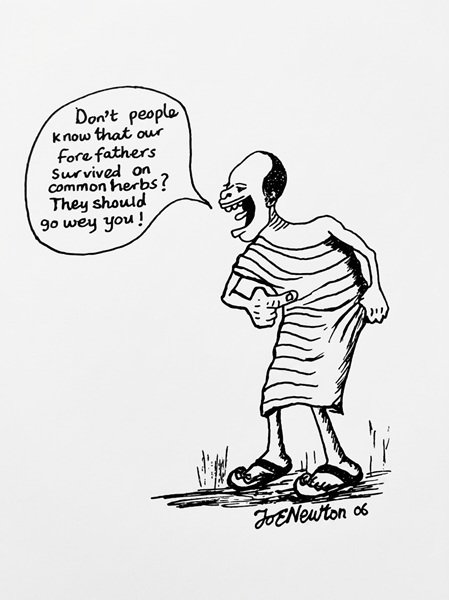
THE typical itinerant salesman in Sikaman is a herbalist. He is normally a slim macho with the capacity to perambulate the expanse of area covering the triangle of Accra-Tema-Ashiaman. In short, he can walk a total of 60 miles a day, marketing a product that cures every disease, including poverty. 
The door-to-door herbal pharmacist advertises his product by word of mouth. He has nothing to do with the Food and Drugs Board (FDB). After all, his concoctions do not feature on FM stations.
Those herbalists who cannot walk to propagate the herbal gospel, liaise with drivers of mass transportation and their mates. They are, therefore, given the chance to sell their products on Benz buses that ply the routes.
Normally, the herbalist starts his sales message with a prayer and Bible study. He asks the passengers to bow down their heads in supplication to God the father, the son, the Holy Spirit.
When a herbalist asks the passengers to close their eyes and bow their heads, Moslems on board naturally feel offended. They feel that the herbalist has no right to assume that every passenger is a Christian. They think such an assumption is an affront to Islam.
So a Moslem on board will raise the hand for a point of order. He’ll remind the herbalist that it would be in his own interest to mind his language.
“Be careful the way you address people in a public place. Not every person here is a Christian,” he’d state assertively.
Of course, the herbalist will promptly ignore him, but would all the same “watch” his tongue. Who knows whether or not the Moslem brother is inspired by Quoranic zeal to defend the tenets of Islam to the hilt?
When he starts saying, “Wallahi!” and “Inshallah!” it could be the beginning of proclaiming Islam as supreme, a point which must be driven home with talibanic precision.
So the herbalist must tread carefully lest he steps on fire.
The herbalist could even add a measure of mirth to it all, by announcing that Christians on board today have very interesting company on the journey, but that should not detract from the business of the day.
The Moslem brother will weigh the words carefully and offer a wry smile.
He must be careful the occasion does not degenerate into the use of semantics and proverbial oration to deride his conviction that public utterances must be mindful of religious sensibilities. He has made his point very clear and expects that it is taken in good faith in the interest of a peaceful journey.
The herbalist will now open the New Testament and preach salvation, stating clearly that salvation can come only through Jesus Christ and NOBODY else.
The Moslem brother will now start twitching his moustache. The visible and almost revolutionary reflexes of his upper lip can be an indication that sentiments have begun superseding reason, and the outcome could well be tragic now shift uneasily in his seat.
The time has come for him to also express his right to the religion of his fore-bears. He’ll put his hand into his pocket and rise to his feet. The time has indeed come!
This article was first published on Saturday, September 9, 2006
When the cause of a particular problem like sickness, disease, sudden illness, a social issue etc. are not known, it stands to reason that resolving it becomes a huge challenge.
Citizens would understand the government when public announcements are made to the effect that government is trying to find a solution to the issue, even though it is taking a while for it to be resolved because citizens are rational beings.
On the other hand, if the solution to a particular issue is known to everybody but the government for whatever reason, is dragging its feet in resolving it, citizens become frustrated and begin to lose trust in their leaders.
One such issue is the heavy traffic along a section of the Kasoa – Odokor road. A short stretch of bad road between the traffic light at the Weija Government Hospital and the entrance to the entrance of the overhead that leads to the N1, is the cause of the problem but nothing is being done about it, day after day, week after week, month after month. Thus is clearly unacceptable.
Another issue that requires urgent attention is the lack of pavements along a lot of streets in parts of the various Municipal Assemblies. Exercise is a prerequisite for long life and healthy living and for those of us who it has become a way of life, this issue of people putting up structures right to the edge of the drains beside the roads, are making life difficult for us.
We are compelled to walk along the roads, putting our lives at serious risk. Pedestrians should never be compelled to compete with vehicles on our streets and roads. Roads and streets are made for vehicles and pavements are made for pedestrians. That is the norm. Any attempt to normalise a situation where pedestrians are mingling with vehicles is insanity.
It is the road regulations that makes it so and therefore district or municipal assemblies are to take responsibility and ensure that spaces for pavements are not encroached upon. Citizens have rights that must be protected by their leaders and making pavements available to pedestrians, is one of them.
When we hear of teachers having sex with students, it appears it is something recent. It is not a new phenomenon. It has been there since Adam. Perhaps this issue is getting much attention due to the proliferation of social media. It was an open secret in times past when Teachers were in relationships with female students and some married them immediately after completion of school.
Some teachers were also known to be having unholy interactions with female pupils but due to the times that these acts occurred, human rights issues and the awareness around it, allowed such unscrupulous teachers to get away with their crimes.
Now we are in a different era and so a Headmaster is now in hot waters. He is alleged to have raped about 19 female students and as usual, some officials tried to cover it up and are also in hot waters and their actions or inactions in the matter are under investigation.
Why the man has been allowed to roam freely without being arrested is simply mind boggling. It appears that the law applies differently, depending on who you are. This issue came to public attention sometime in August this year, yet the police had not arrested or invited this man for question regarding the rape allegation.
It has come out that he is a Constituency Secretary of the ruling party and the question in the public domain is that, is it because he is a political figure that is why he is still walking around without questioning? I believe in the rule of law so let us hold our breadth and let the proper thing be done.
The police must however be seen to be active in this matter. God bless.
SKIP THE QUEUE, TAP THE NEWS
You can now read the Ghanaian Times and The Spectator newspapers from the comfort of your device via TimesNewsPlus.
Join our WhatsApp Channel: https://whatsapp.com/channel/0029VbBElzjInlqHhl1aTU27