News
Minority leader criticises removal of Big Six from new banknotes

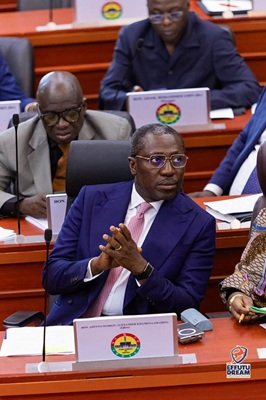
Minority Leader Alexander Afenyo-Markin has criticised the government’s decision to remove the collective portrait of the Big Six from Ghana’s newly unveiled banknotes, describing it as a troubling revision of the country’s national history.
The new notes, unveiled last Thursday, retain only the portrait of Dr Kwame Nkrumah. The change comes as Ghana prepares to commemorate its 70th Independence Anniversary.
According to Mr Afenyo-Markin, in a statement, the Big Six were not a creation of the New Patriotic Party (NPP), but historical figures whose recognition stemmed from their organised leadership in the independence struggle and their detention following the 1948 disturbances.
He noted that the Convention People’s Party (CPP) emerged from the United Gold Coast Convention (UGCC) in 1949, and argued that the contribution of the UGCC leaders cannot be separated from the independence story.
“The NPP did not invent the Big Six. Their place in history arose from their organised leadership in the struggle for independence,” he stated.
Mr Afenyo-Markin further referenced the Watson Commission, which investigated the causes of the 1948 disturbances, and the subsequent Coussey constitutional process, both of which preceded the formation of the NPP and the National Democratic Congress (NDC).
He also cited Dr Nkrumah’s autobiography, in which Nkrumah referred to the group as “The ‘Big Six’, as we came to be known,” and named the other five members.
The Minority Leader recalled that the Big Six appeared together on the redenominated banknotes introduced in 2007 under President John Agyekum Kufuor and Bank of Ghana Governor Paul Acquah, during Ghana’s Golden Jubilee celebrations.
He added that under President John Evans Atta Mills, the GH¢2 note bore Nkrumah’s portrait alone, while the other denominations retained the Big Six, demonstrating that individual recognition did not require the removal of others.
While welcoming the recognition of Theodosia Salome Okoh, Ephraim Amu, Kofi Annan and other distinguished Ghanaians, Mr Afenyo-Markin questioned why honouring additional patriots should necessitate the removal of the Big Six.
He also called for broader national recognition for other historical figures, including Chief Simon Diedong Dombo, Otumfuo Sir Osei Agyeman Prempeh II, and Dr J.B. Danquah, whom he credited with advancing the adoption of the name Ghana.
On the controversy surrounding the portrait of Mrs Okoh, Mr Afenyo-Markin noted claims by her nephew, Dr Eddie Obeng, that the image resembles his mother, Dr Letitia Obeng, rather than his aunt. He urged the Bank of Ghana to publish the source photographs and resolve the matter transparently with the family.
He concluded by urging President John Dramani Mahama to ensure that national recognition reflects the breadth of Ghana’s history.
“Your government can remove the Big Six from the currency, but can never withdraw them from history,” he noted.
By Edem Mensah-Tsotorme








On World Diabetes Day , I think about what access to diabetes care means for a person living far from a capital city. Who will recognise their risk? Who will diagnose their condition early? Who will help them manage it, prevent complications and understand the changes they need to make in their daily lives?
Awareness is essential. But awareness must be supported by healthcare professionals who have the knowledge and skills to turn that understanding into effective care.
At Merck Foundation, we bring these priorities together. Through medical education, active partnerships and creative community awareness, we are helping transform the diabetes care landscape across Africa and Asia—one blue point at a time.
Every Blue Point Represents a Person
Our signature Diabetes and Hypertension Blue Points Program has provided more than 970 scholarships to healthcare providers from 52 countries.
Each blue point on our map represents a healthcare provider who has graduated through our scholarships. Behind that point is a person equipped with specialist knowledge, ready to apply it in the service of their community.
Our ambition has always extended beyond capital cities and major urban centres. We want these blue points to reach more regions, districts, towns and villages, bringing expertise closer to rural and underserved populations.
Our vision is to turn the whole country blue.
For me, this means building a nationwide network of trained healthcare providers, so that more people can access knowledgeable care closer to home.
Caring for the Whole Person
Diabetes care requires us to look beyond blood sugar alone.
Hypertension, cardiovascular risk, obesity, nutrition and hormonal health can all shape a person’s health and care needs. Healthcare professionals need the expertise to recognise these connections and respond to the whole person.
This is why our scholarships encompass Diabetes, Endocrinology, Cardiology, Cardiovascular Preventive Care, Obesity & Weight Management, and Clinical Nutrition, alongside our Clinical Diabetes and Hypertension Fellowship Programme.
Through one-year online postgraduate diplomas, two-year master’s degrees and one-year onsite clinical fellowships, we support complementary areas of expertise that strengthen prevention and patient care.
Our aim is to help healthcare providers identify risks earlier, guide healthier lifestyles, manage disease effectively and address the factors that can lead to serious complications.
Partnerships That Bring Expertise Closer to Communities
Lasting change requires strong local partnerships.
Together with our partners, the First Ladies of Africa and Asia, Ministries of Health, medical societies and academic institutions, we work to expand access to relevant medical education and respond to local healthcare priorities.
Our Ambassadors, the First Ladies bring advocacy and visibility to these efforts. Ministries of Health and professional societies contribute essential knowledge of national needs and gaps in healthcare capacity. Academic and clinical partners provide the education through which healthcare professionals develop their expertise.
These contributions reinforce one another. They connect training opportunities with the communities that need stronger care.
Taking Health Knowledge Beyond the Clinic
Even the best clinical expertise needs an informed community around it.
People need to understand why screening matters, how everyday habits affect their health, and when to seek professional advice. Health information must be accessible, engaging and relevant to their lives.
Alongside our healthcare training, Merck Foundation works with media professionals, artists, musicians, filmmakers and other creative voices to bring health messages into homes, schools and public conversations.
Our songs, “No More Sugar” and “Life Is Sweeter Without Sugar,” encourage healthier lifestyles through music. Our children’s storybooks, “Sugar-Free Jude” and “Mark’s Pressure,” also adapted into animated films, help introduce health messages to young audiences and their families.
Through our television programme, Our Africa by Merck Foundation, we bring health and social issues to wider audiences. Our health media training and healthy lifestyle awareness awards of media , song , film and fashion encourage journalists and creative communities to communicate responsibly and use their talents to deliver health awareness messages and support healthier lifestyle in their communities.
Each format offers a different opportunity to reach someone: a child watching an animation, a family listening to a song, a viewer following a television discussion, or a reader learning from a journalist’s story.
A Complementary Strategy for Lasting Impact
What gives this approach its strength is the connection between its parts.
Medical education strengthens the care available. Community awareness helps people understand and seek that care. Partnerships connect both efforts to local priorities. Creative storytelling helps health messages travel further.
This multisectoral approach is central to Merck Foundation’s contribution. It brings healthcare, education, government, media and the arts together around a shared purpose.
We are investing in the people who provide care and the people who need it.
A Legacy That Lives Through Others
Some of the most meaningful milestones in our wider capacity-building work are the first specialists we have helped train in countries , counties , cities or villages where that expertise was previously absent or extremely limited.
These achievements carry a profound responsibility. A scholarship can help a healthcare professional begin a journey that brings new knowledge into a hospital, strengthens a service in a town, mentors colleagues or makes expertise more accessible to surrounding villages.
This is history in the making through the work of our alumni and partners.
Our legacy will be carried forward by the healthcare providers who continue to serve, share knowledge with colleagues and care for future generations of patients.
On World Diabetes Day, I thank our Ambassdor’s , the First Ladies of Africa and Asia , Ministries of Health, medical societies, academic partners, alumni and creative communities for their commitment to this shared vision.
Every blue point represents knowledge. Every graduate carries the possibility of better care. Together, we are helping transform the diabetes care landscape across Africa and Asia—one blue point at a time.
By Senator Prof. Dr. Rasha Kelej, CEO of Merck Foundation
The Police Hospital in Accra has announced plans to conduct a mass burial of about 350 unclaimed and unidentified bodies currently kept at its mortuary.
The exercise, scheduled for the fourth quarter of 2026, is aimed at making space available at the mortuary to ensure the proper functioning of its refrigeration facilities.
In a letter dated November 11, 2026, and signed by the Medical Director of the Police Hospital, Dr Samuel Otu-Nyarko, the hospital appealed to the general public to help identify the bodies and enable relatives to claim them before the burial.
It urged persons who suspect that their missing relatives may be among the bodies to contact the hospital’s Pathology Department for information and assistance with identification and collection.
The hospital has set December 10, 2026, as the deadline for relatives to come forward.
The management appealed for public cooperation in the exercise.
By: Jacob Aggrey