News
When desire overpower: A family guide to sexual addiction recovery

- /home/u249204778/domains/spectator.com.gh/public_html/wp-content/plugins/mvp-social-buttons/mvp-social-buttons.php on line 27
Warning: Trying to access array offset on false in /home/u249204778/domains/spectator.com.gh/public_html/wp-content/plugins/mvp-social-buttons/mvp-social-buttons.php on line 27
&description=When desire overpower: A family guide to sexual addiction recovery ', 'pinterestShare', 'width=750,height=350'); return false;" title="Pin This Post">
- Share
- Tweet /home/u249204778/domains/spectator.com.gh/public_html/wp-content/plugins/mvp-social-buttons/mvp-social-buttons.php on line 72
Warning: Trying to access array offset on false in /home/u249204778/domains/spectator.com.gh/public_html/wp-content/plugins/mvp-social-buttons/mvp-social-buttons.php on line 72
&description=When desire overpower: A family guide to sexual addiction recovery ', 'pinterestShare', 'width=750,height=350'); return false;" title="Pin This Post">
Easter is already in the air church plays, family trips to Kwahu, fish money count in Kumasi market stalls. But for some families, the season also sharpens a private pain: a teenager who hides his phone under the mattress, a wife who finds transfers to unknown numbers, a father who smells stale hotel soap on his son’s shirt. Sexual addiction does not announce itself. It steals trust slowly, then all at once.
I see it at CPAC intake rooms: mothers trembling not from anger but exhaustion, men blaming themselves for “raising him badly.” Here is what we know and what actually helps.
Research frames compulsive sexual behaviour less as moral failure and more as an intimacy disorder tied to anxiety, untreated trauma, and a dysregulated reward system (Giordano et al., 2021).
In Ghanaian homes, shame thickens the silence. Carnes (2020) found that structured family disclosure guided by a therapist raised treatment entry by 38 per cent. Grubbs et al. (2020) showed spiritual support lowers relapse risk only when paired with accountability, not preaching.
Name the behaviour without drowning the person
At our Adenta Oyarifa-Teiman office, I often ask a couple to write down one line: “I felt scared when I saw __; I need __.” Not “you are dirty,” but “I saw pornography at 2 a.m. on your laptop; I need us to meet CPAC on Thursday.” I remember Kofi (name changed), a car dealer from Spintex, sitting across me saying, “If I call him addict he will run.” We drafted a text instead: “Yaw, I love you. I saw Mastercard bills. I’ve made us an appointment. I’ll drive you.” He came.
Use Easter’s rhythm, not its sermons
The season’s power is ordinary belonging. Invite your son to peel yam for Good Friday soup; ask your husband to lead the family in a simple sunrise prayer at 6 a.m., phone left in the hall.
A Shai Hills walk, a shared taxi to church-these re-anchor a nervous system.
Invite, do not ambush. Then bind that belonging to a step: install accountability software that blocks explicit sites and sends a report to a trusted person, agree on weekly attendance at a Sex Addicts Anonymous meeting, schedule therapy session with experts from Counselor Prince & Associates Consult – CPAC. Grubbs’ finding holds: faith helps when it carries accountability.
Build containment the Ghanaian way
Few Accra families have study rooms; rural families share one chamber. Make rules fit: “No phones in bedrooms after 10 p.m. -all devices charge in the sitting room.” Keep a single MTN phone for night calls. Agree on cash, not mobile money, for daily spend. For betrayed spouses, CPAC names betrayal trauma without gossip; the relief is immediate.
Parents need their own slice: a 20-minute walk, a radio prayer, a friend who listens. Empty cups spill.
City reality versus village reality
In Accra, you may afford an expert from CPAC and monitoring software. In Bawku, you may lean on CPAC’s online service or a community nurse, a well-trained and trusted pastor or imam, and a strict routine.
Both depend on three moves: containment, treatment, connection. I have watched both work.
Sexual addiction thrives in secrecy. It withers in small, repeated honesty. One week clean, one meeting attended, one budget table opened-these are Easter’s quiet resurrection.
At CPAC we do not promise miracles; we promise a plan. Some sons make tea safely again. Some husbands show receipts. Shame shrinks when families speak early, set boundaries, and bind to help.
Source: Field notes from Counselor Prince Offei’s practice in mental health, marriage counselling, and addiction support at CPAC.
References
Carnes, P. J. (2020). Sexual addiction and compulsivity: Journal of Treatment & Prevention, 27(1), 1-12.
Giordano, A. L., et al. (2021). Family communication in sexual addiction recovery. Journal of Marital and Family Therapy, 47(2), 312-327.
Grubbs, J. B., et al. (2020). Spirituality, shame, and compulsive sexual behaviour. Archives of Sexual Behaviour, 49(5), 1665-1677.
To be continued …
Source: REV. COUNSELOR PRINCE OFFEI’s insights on sexual addiction, relationships, and mental health in Ghana. He is a leading mental health professional, lecturer, ADR Expert/Arbitrator, renowned author, and marriage counsellor at COUNSELOR PRINCE & ASSOCIATES CONSULT (CPAC COUNSELLOR TRAINING INSTITUTE)

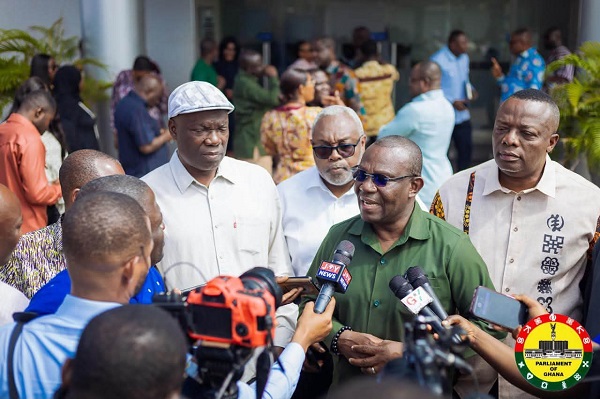
The Parliamentary Select Committee on Energy has appealed to the Ministry of Finance to release GH¢5.6 million to the Petroleum Commission to enable it to establish and operate a world-class data centre.
According to the Committee, access to the funds will strengthen the Commission’s capacity to manage critical upstream petroleum data and improve its operations.
Speaking during the appeal, Chairman of the Committee, Emmanuel Kwasi Bedzrah, said the move was crucial to efforts to revitalise Ghana’s upstream petroleum industry and increase oil production.
He noted that although investment and hydrocarbon production had declined in recent years, Parliament’s approval of an extension of the petroleum agreement to 2030 had attracted additional funding and contributed to an increase in production from about 80,000 to 120,000 barrels per day.
Meanwhile, concerns have been raised over repeated budget allocations for oil exploration in the Voltaian Basin.
Mr. Bedzrah stressed that funds approved for exploration must produce tangible results, adding that the Committee would require clear evidence of progress before supporting future budget allocations for the programme.
The appeal was made during a working visit to the Petroleum Commission as part of the Committee’s oversight activities to assess its operations and management procedures.
During the engagement, the Chief Executive Officer of the Petroleum Commission, Emeafa Hardcastle, took the Committee through the Commission’s working procedures and mandate, which includes regulating, managing and coordinating upstream petroleum activities.
She disclosed that since assuming office in 2025, government had pursued measures to reverse the decline in crude oil production, sustain output and reposition Ghana as an attractive destination for investment in Africa’s increasingly competitive petroleum sector.
In addition, she said government had secured fresh commitments of about US$35 billion to help revitalise the sector.
As part of the oversight exercise, the Committee is expected to conclude its monitoring visit with engagements at the National Petroleum Authority (NPA) and the Ghana Oil Company Limited (GOIL).
By Edem Mensah-Tsotorme
News
“No civilisation deserves to be annihilated” – Mahama calls for dialogue on global conflicts at UNGA 81
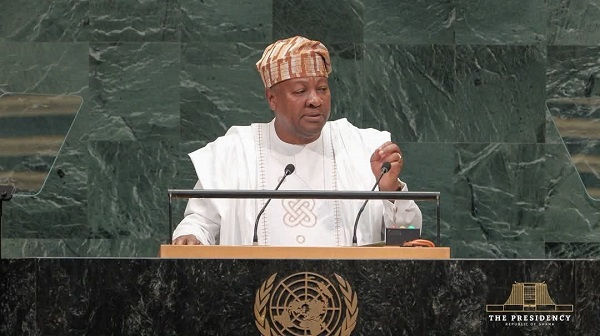
President John Dramani Mahama has called for solidarity and dialogue in resolving global conflicts, insisting that no civilisation deserves to be wiped out.
“No human civilisation deserves to be annihilated, certainly not a member state of the United Nations,” President Mahama stated in his address at the 81st United Nations General Assembly in New York.
He called for solidarity with nations facing terrorism, especially the Alliance of Sahel States (AES), and for a uniform approach to conflicts in Europe, the Middle East and Africa.
On the Middle East, the President called for a return to negotiations, saying “The current Middle East crisis is having a deleterious effect on the world economy.”
“I believe that dialogue can resolve even the most intractable of problems,” he added.
By Edem Mensah-Tsotorme

 Entertainment1 week ago
Rhythms On Da Runway returns November 28 with 16th edition themed ‘Unbound’
- Entertainment1 week ago
Ohemaa Mercy’s Tehillah Experience outfit was priestly regalia, not costume – Management clarifies
 News1 week ago
Janet Asana Nabla criticises Mahama over China curriculum controversy involving Haruna Iddrisu