News
Tullow Oil signs new production sharing licence in Côte d’Ivoire


- /home/u249204778/domains/spectator.com.gh/public_html/wp-content/plugins/mvp-social-buttons/mvp-social-buttons.php on line 27
https://spectator.com.gh/wp-content/uploads/2022/12/Tullow-Pix.jpg&description=Tullow Oil signs new production sharing licence in Côte d’Ivoire', 'pinterestShare', 'width=750,height=350'); return false;" title="Pin This Post">
- Share
- Tweet /home/u249204778/domains/spectator.com.gh/public_html/wp-content/plugins/mvp-social-buttons/mvp-social-buttons.php on line 72
https://spectator.com.gh/wp-content/uploads/2022/12/Tullow-Pix.jpg&description=Tullow Oil signs new production sharing licence in Côte d’Ivoire', 'pinterestShare', 'width=750,height=350'); return false;" title="Pin This Post">
• Tullow offshore facility
Tullow Oil has signed a production sharing contract for an offshore exploration licence in Côte d’Ivoire.
UK-listed Tullow will operate the licence with 90 per cent equity and the remaining 10 per cent is held by PetroCi.
The licence covers an area of 1,345 square kilometres and is adjacent to licence CI-524 which is also held by Tullow and PetroCi.
The oil company said in a statement on Wednesday that, “with this new exploration licence, Tullow strengthens its position in the Tano Basin where significant prospectivity has been identified within the proven Cretaceous turbidite plays, similar to the plays which are producing in the adjacent TEN and Jubilee Fields.”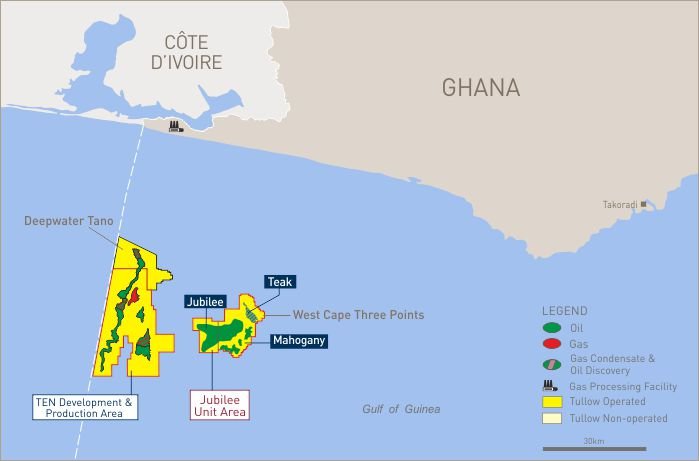
Tullow said “the work programme for the initial two and a half years includes reprocessing of existing 3D seismic data, along with prospect evaluation. In CI-524, a number of drill candidates are being matured while preparations continue for an exploration well to be drilled during 2024.”
Rahul Dhir, Chief Executive Officer, Tullow Oil plc, commented: “This new licence underscores our strong commitment to investing in and unlocking the resource potential in Côte d’Ivoire.
“Our exploration strategy is focussed around existing producing fields in basins where we have a differentiated understanding, in this case through our deep understanding of the Tano Basin.”
Since 2006, Tullow has had interests in two exploration licences offshore Ghana.
Following seismic acquisition and interpretation, Tullow and its partners drilled two successful exploration wells in 2007. The wells discovered the major Jubilee oil field in the Gulf of Guinea’s Tano Basin. The Jubilee Cretaceous turbidite reservoir straddled both licences; Deepwater Tano and West Cape Three Points.
In October 2008, Tullow was appointed as the Jubilee field operator and set about working with the partners and Government of Ghana on developing the field to bring Ghana its first major oil production.
The Ministy of Energy in Ghana formally approved the Jubilee field Phase 1 Development Plan and Unitisation Agreement on behalf of the Government of Ghana in July 2009.
In November 2010, following a successful development programme, which included the building of a Floating Production Offtake Vessel (FPSO), first oil was achieved from the Jubilee field.
This was some 40 months post the initial discovery well which represents the fastest ever comprehensive full scale deepwater development. The field is Tullow’s key asset and generates significant high-margin oil production for the Group.
Tullow’s second major discovery and subsequent development in Ghana is the TEN field. In May 2013, the Plan of Development for TEN was approved by the Government of Ghana and Tullow commenced its second major operated deepwater development.
First oil was achieved on time and on budget in August 2016, three years after the Plan of Development was approved by the Government of Ghana.
In March 2022, Tullow completed the pre-emption related to the sale of Occidental Petroleum’s interests in the Jubilee and TEN fields in Ghana to Kosmos Energy for a total consideration of $126 million.
The transaction took Tullow’s equity interests to 39.0 per cent in the Jubilee field and to 54.8 per cent in the TEN fields and added c.4 kbopd of annualised unhedged production to Tullow’s portfolio for 2022.
Tullow and its partners will invest over $4 billion over this decade through an ambitious ‘Value Maximization Plan’ that will deliver over 50 wells and consistent revenue to Tullow and the Government of Ghana.
In April 2021, Tullow began a multi-year, multi-well drilling campaign. In 2021 two producers, one water injector and a work over were delivered on Jubilee. On TEN, a gas injector at the Ntomme Field was brought onstream.
The Ghana Value Maximisation Plan is also focusing on a programme of operational turnaround which is targeting in excess of 95 per cent uptime at both FPSOs.
Tullow is also making sure that both fields continue to be consistent and reliable suppliers of natural gas. Gas from the Jubilee and TEN fields contributes significantly towards Ghana’s domestic energy supply.
Tullow is a recognised independent oil and gas, exploration and production group. The Group has interests in over 30 exploration and production licences across eight countries.

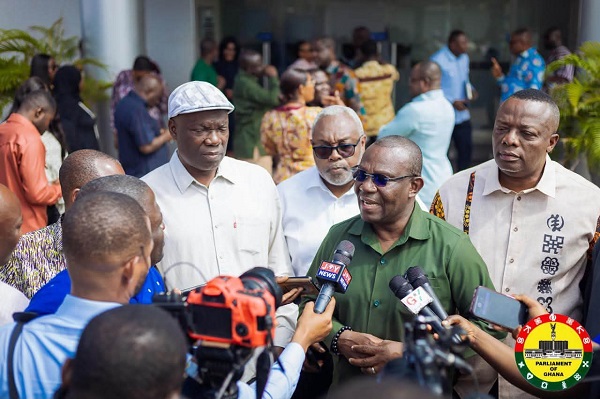
The Parliamentary Select Committee on Energy has appealed to the Ministry of Finance to release GH¢5.6 million to the Petroleum Commission to enable it to establish and operate a world-class data centre.
According to the Committee, access to the funds will strengthen the Commission’s capacity to manage critical upstream petroleum data and improve its operations.
Speaking during the appeal, Chairman of the Committee, Emmanuel Kwasi Bedzrah, said the move was crucial to efforts to revitalise Ghana’s upstream petroleum industry and increase oil production.
He noted that although investment and hydrocarbon production had declined in recent years, Parliament’s approval of an extension of the petroleum agreement to 2030 had attracted additional funding and contributed to an increase in production from about 80,000 to 120,000 barrels per day.
Meanwhile, concerns have been raised over repeated budget allocations for oil exploration in the Voltaian Basin.
Mr. Bedzrah stressed that funds approved for exploration must produce tangible results, adding that the Committee would require clear evidence of progress before supporting future budget allocations for the programme.
The appeal was made during a working visit to the Petroleum Commission as part of the Committee’s oversight activities to assess its operations and management procedures.
During the engagement, the Chief Executive Officer of the Petroleum Commission, Emeafa Hardcastle, took the Committee through the Commission’s working procedures and mandate, which includes regulating, managing and coordinating upstream petroleum activities.
She disclosed that since assuming office in 2025, government had pursued measures to reverse the decline in crude oil production, sustain output and reposition Ghana as an attractive destination for investment in Africa’s increasingly competitive petroleum sector.
In addition, she said government had secured fresh commitments of about US$35 billion to help revitalise the sector.
As part of the oversight exercise, the Committee is expected to conclude its monitoring visit with engagements at the National Petroleum Authority (NPA) and the Ghana Oil Company Limited (GOIL).
By Edem Mensah-Tsotorme
News
“No civilisation deserves to be annihilated” – Mahama calls for dialogue on global conflicts at UNGA 81

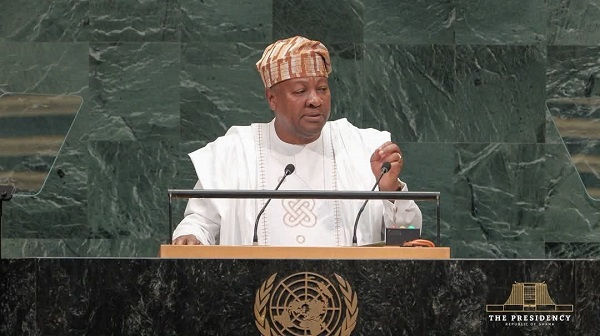
President John Dramani Mahama has called for solidarity and dialogue in resolving global conflicts, insisting that no civilisation deserves to be wiped out.
“No human civilisation deserves to be annihilated, certainly not a member state of the United Nations,” President Mahama stated in his address at the 81st United Nations General Assembly in New York.
He called for solidarity with nations facing terrorism, especially the Alliance of Sahel States (AES), and for a uniform approach to conflicts in Europe, the Middle East and Africa.
On the Middle East, the President called for a return to negotiations, saying “The current Middle East crisis is having a deleterious effect on the world economy.”
“I believe that dialogue can resolve even the most intractable of problems,” he added.
By Edem Mensah-Tsotorme