Features
Musicians, the Whiteman’s toilet and MEGASTAR


I have often been saddened by the condition of Sikaman musicians. Of course, some are not musicians. They are jokers who think anybody who can sing a hymn is a musician. And why wouldn’t they think so when people think that every man wearing a rasta hair is a reggae musician?
Well, these days, almost everybody is dreaming of becoming a musician, even some ministers and parliamentarians. And it is never too late for them to begin learning the solfas and composing songs like “If You Do Good You Do For Yourself,” after all, life begins at 60 these days. If you die three years later, that’s your luck.
For the jobless, becoming a musical star is an everyday dream. They think when you are a music maker, you automatically break alliance with poverty. They are often mistaken.
I know people who claim they are musicians but are always fasting not because they are devout moslems or are on a hunger strike, but because even one square meal a day is a perpetual wahala. And the only drink they can afford is the poor man’s holy whisky which has a thousand names including ‘Nyame Bekyere’.
Even most of the popular musicians we see in town claiming they are foreign-based stars are more of hustlers than musicians. When they tell you they are going on tour abroad, it is a careful way of saying they are going overseas to scrub the whiteman’s toilet or pick tomato or apples to save their neck from musical poverty.
When they are back to Sikaman, they appear quite flamboyant with chains hanging all over them. They change the few dollars they have scraped, spread it around and promptly get broke. Then they can organise another ‘tour’. In between tours, they struggle to release an album and that levels them up a bit on the financial balance.
It all points to the fact that the life of the average musician isn’t quite organised. He has no calendar, no programme and no concentration on the job. He has to wash plates, become a waiter, janitor and toilet scrubber while finding time to make music. No musician succeeds in life that way.
One musician I’ll always respect, who thinks deeper than the ordinary Sikaman musicians is Carlos Sakyi. He is not like the Kokoase guitar musicians who see the world just in terms of bitters, a willing girlfriend, constant supply of kokonte and jot.
Carlos, often loved for his percussive overtones in gospel music, and once a gospel-rock star, has studied the life of Sikaman musicians and has evolved a blue-print for a great improvement in their lives work, finances and comfort.
In short, he has simulated a Motown-style environment for musicians and his formula is working with accuracy with the five musicians he has started with. The blue-print is what has brought MEGASTAR into being. It was launched on September 15, 1995 at the National Theatre.
When it got launched, many probably thought Carlos was “too know or was dreaming more than he should and won’t think about himself. Anyhow, the MEGASTAR is now an institution musicians can look up to, a big phenomenon with lots of promise for struggling musicians.
Music business in the developed world is not the way we regard it cheaply here. A musician is never distracted by how his finances go; his contracts are entered, his engagements made, his interviews arranged, his personal security guaranteed.
Music is his business and that is where his mind is and his attention focuses. Other aspects of his life are programmed for him by his managers. They hire who has to light his cigarettes, massage him, drive his car and the one who will say “Good Luck” when he sneezes.
A bodyguard whose face is exactly like that of the devil is hired to scare off muggers, psychopaths and criminals in general. Sometimes his girls are organised for him.
So the only thing the musician does apart from sleeping and snoring is to concentrate on making music, and true to it, no one can succeed in any venture when he is distracted.
This is how the Michael Jacksons, Lionel Richies, Dolly Patons and Whitney Houstons have made it with dollars packed and over-flowing. They aren’t any better than Sikaman musicians. The only difference is that they know how to organise their lives.
I managed to corner Carlos Sakyi and asked him to tell me how MEGASTAR was doing. He is the Managing Director of Megastar Limited, a music company that has a board of directors and a chairman. Carlos Sakyi shares the proprietorship with a partner. Carlos himself was one great musician who played for a band that beat Eddy Grant on the charts.
“Megastar is in fact a concept born out of the idea that the future security of the Ghanaian musician which has always been in jeopardy can now be guaranteed. Artistes spend too much of their time doing things on their own, chasing money and not concentrating on music. So their full potential is never realised. Some are in fact producing at quarter-rate. That is why they aren’t making much headway,” he told me.
“Megastar is now giving them the chance of the lives. We handle the interviews of Megastar artiste, their press releases, costume, engagements and everything they hitherto used to do themselves. We get them exposed on M-Net and we have contacted BB to get on their programmes. We handle their finances pay them salaries and bonuses, so they only have to concentrate on music
“Most importantly,” he continued, “we do not make all the decisions. Management always meet with the musicians to take the decisions that affect them.”
But who are the Megastar musicians? One is the great Amakye Dede, a star from birth delivered onto the earth with music on his lips; he is the man who feeds hungry ears with musical salad and harmonic sausages. He is the recipient of many national awards.
Next is Naana Frimpong, a latter-day Carlos-groomed songbird with the voice of an angel. She sings to kill. Her beauty has charmed her audience and they stare and stare at her.
The sensational and fantalising Tagoe Sisters are the next. The twin music machine is one that has produced the cream, arguably the very best, of gospel music all these years. I hear they are inseparable; not even their better-halves can keep them apart. Are they Siamese? They dance, and when on stage, they move the crowd.
Then comes Reverend Yawson who is a known songwriter. He is imbued with the Holy Spirit, speaks in tongues and of course sings in tongues. He is God’s representative on the group.
What about my good friend and super-heavyweight, Jewel Ackah? He is a star figure. His appearance is awe-inspiring, his voice golden. A great delight to be-hold when at his best in stage-craftsmanship, he has beaten his contemporaries to it both on land and on sea.
They are the pioneers of the Motown idea. They are all releasing new albums this year. Let’s see how it all goes.

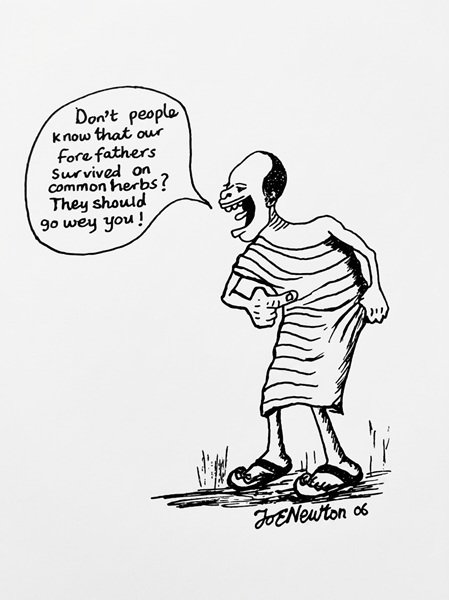
THE typical itinerant salesman in Sikaman is a herbalist. He is normally a slim macho with the capacity to perambulate the expanse of area covering the triangle of Accra-Tema-Ashiaman. In short, he can walk a total of 60 miles a day, marketing a product that cures every disease, including poverty. 
The door-to-door herbal pharmacist advertises his product by word of mouth. He has nothing to do with the Food and Drugs Board (FDB). After all, his concoctions do not feature on FM stations.
Those herbalists who cannot walk to propagate the herbal gospel, liaise with drivers of mass transportation and their mates. They are, therefore, given the chance to sell their products on Benz buses that ply the routes.
Normally, the herbalist starts his sales message with a prayer and Bible study. He asks the passengers to bow down their heads in supplication to God the father, the son, the Holy Spirit.
When a herbalist asks the passengers to close their eyes and bow their heads, Moslems on board naturally feel offended. They feel that the herbalist has no right to assume that every passenger is a Christian. They think such an assumption is an affront to Islam.
So a Moslem on board will raise the hand for a point of order. He’ll remind the herbalist that it would be in his own interest to mind his language.
“Be careful the way you address people in a public place. Not every person here is a Christian,” he’d state assertively.
Of course, the herbalist will promptly ignore him, but would all the same “watch” his tongue. Who knows whether or not the Moslem brother is inspired by Quoranic zeal to defend the tenets of Islam to the hilt?
When he starts saying, “Wallahi!” and “Inshallah!” it could be the beginning of proclaiming Islam as supreme, a point which must be driven home with talibanic precision.
So the herbalist must tread carefully lest he steps on fire.
The herbalist could even add a measure of mirth to it all, by announcing that Christians on board today have very interesting company on the journey, but that should not detract from the business of the day.
The Moslem brother will weigh the words carefully and offer a wry smile.
He must be careful the occasion does not degenerate into the use of semantics and proverbial oration to deride his conviction that public utterances must be mindful of religious sensibilities. He has made his point very clear and expects that it is taken in good faith in the interest of a peaceful journey.
The herbalist will now open the New Testament and preach salvation, stating clearly that salvation can come only through Jesus Christ and NOBODY else.
The Moslem brother will now start twitching his moustache. The visible and almost revolutionary reflexes of his upper lip can be an indication that sentiments have begun superseding reason, and the outcome could well be tragic now shift uneasily in his seat.
The time has come for him to also express his right to the religion of his fore-bears. He’ll put his hand into his pocket and rise to his feet. The time has indeed come!
This article was first published on Saturday, September 9, 2006
When the cause of a particular problem like sickness, disease, sudden illness, a social issue etc. are not known, it stands to reason that resolving it becomes a huge challenge.
Citizens would understand the government when public announcements are made to the effect that government is trying to find a solution to the issue, even though it is taking a while for it to be resolved because citizens are rational beings.
On the other hand, if the solution to a particular issue is known to everybody but the government for whatever reason, is dragging its feet in resolving it, citizens become frustrated and begin to lose trust in their leaders.
One such issue is the heavy traffic along a section of the Kasoa – Odokor road. A short stretch of bad road between the traffic light at the Weija Government Hospital and the entrance to the entrance of the overhead that leads to the N1, is the cause of the problem but nothing is being done about it, day after day, week after week, month after month. Thus is clearly unacceptable.
Another issue that requires urgent attention is the lack of pavements along a lot of streets in parts of the various Municipal Assemblies. Exercise is a prerequisite for long life and healthy living and for those of us who it has become a way of life, this issue of people putting up structures right to the edge of the drains beside the roads, are making life difficult for us.
We are compelled to walk along the roads, putting our lives at serious risk. Pedestrians should never be compelled to compete with vehicles on our streets and roads. Roads and streets are made for vehicles and pavements are made for pedestrians. That is the norm. Any attempt to normalise a situation where pedestrians are mingling with vehicles is insanity.
It is the road regulations that makes it so and therefore district or municipal assemblies are to take responsibility and ensure that spaces for pavements are not encroached upon. Citizens have rights that must be protected by their leaders and making pavements available to pedestrians, is one of them.
When we hear of teachers having sex with students, it appears it is something recent. It is not a new phenomenon. It has been there since Adam. Perhaps this issue is getting much attention due to the proliferation of social media. It was an open secret in times past when Teachers were in relationships with female students and some married them immediately after completion of school.
Some teachers were also known to be having unholy interactions with female pupils but due to the times that these acts occurred, human rights issues and the awareness around it, allowed such unscrupulous teachers to get away with their crimes.
Now we are in a different era and so a Headmaster is now in hot waters. He is alleged to have raped about 19 female students and as usual, some officials tried to cover it up and are also in hot waters and their actions or inactions in the matter are under investigation.
Why the man has been allowed to roam freely without being arrested is simply mind boggling. It appears that the law applies differently, depending on who you are. This issue came to public attention sometime in August this year, yet the police had not arrested or invited this man for question regarding the rape allegation.
It has come out that he is a Constituency Secretary of the ruling party and the question in the public domain is that, is it because he is a political figure that is why he is still walking around without questioning? I believe in the rule of law so let us hold our breadth and let the proper thing be done.
The police must however be seen to be active in this matter. God bless.
SKIP THE QUEUE, TAP THE NEWS
You can now read the Ghanaian Times and The Spectator newspapers from the comfort of your device via TimesNewsPlus.
Join our WhatsApp Channel: https://whatsapp.com/channel/0029VbBElzjInlqHhl1aTU27