Features
The pervasive issue of racism

- /home/u249204778/domains/spectator.com.gh/public_html/wp-content/plugins/mvp-social-buttons/mvp-social-buttons.php on line 27
Warning: Trying to access array offset on false in /home/u249204778/domains/spectator.com.gh/public_html/wp-content/plugins/mvp-social-buttons/mvp-social-buttons.php on line 27
&description= The pervasive issue of racism', 'pinterestShare', 'width=750,height=350'); return false;" title="Pin This Post">
- Share
- Tweet /home/u249204778/domains/spectator.com.gh/public_html/wp-content/plugins/mvp-social-buttons/mvp-social-buttons.php on line 72
Warning: Trying to access array offset on false in /home/u249204778/domains/spectator.com.gh/public_html/wp-content/plugins/mvp-social-buttons/mvp-social-buttons.php on line 72
&description= The pervasive issue of racism', 'pinterestShare', 'width=750,height=350'); return false;" title="Pin This Post">
Racism is a complex and deeply ingrained issue that affects individuals, communities, and societies worldwide.
It can manifest in various forms, including discrimination, prejudice, xenophobia, and micro aggressions. The consequences of racism are far-reaching, perpetuating social inequality, damaging mental health, and creating community divisions.
In this article, we will explore the forms, consequences, and solutions to racism, with the aim of promoting a more inclusive and equitable society.
Forms of racism
Racism can take many forms, including:
1. Discrimination: Unfair treatment based on race, ethnicity, or national origin, which can limit access to opportunities, resources, and services.
2. Prejudice: Negative attitudes or stereotypes about certain racial or ethnic groups, which can perpetuate biases and discriminatory behavior.
3. Xenophobia: Fear or dislike of people from other countries or cultures, which can lead to exclusionary policies and practices.
4. Micro aggressions: Subtle, often unintentional expressions of racism or bias, which can have a profound impact on individuals and communities.
Consequences of racism
The consequences of racism are far-reaching and can have a profound impact on individuals, communities, and societies. Some of the key consequences include:
1. Social inequality: Racism can perpetuate social inequality by limiting access to opportunities, resources, and services.
2. Mental Health impacts: Experiencing racism can lead to stress, anxiety, and trauma, which can have long-term effects on mental health.
3. Community divisions: Racism can create divisions within communities and societies, perpetuating conflict and social unrest.
Solutions to racism
Addressing racism requires a comprehensive and multifaceted approach that involves individual efforts, community engagement, and systemic change. Some potential solutions include:
1. Education and awareness: Educating individuals about different cultures and histories can foster empathy and understanding, and challenge biases and prejudices.
2. Inclusive policies and practices: Implementing policies and practices that promote equality and inclusion can help to address systemic inequality and discrimination.
3. Community engagement: Building bridges between different communities can help to promote understanding and empathy, and challenge racist attitudes and behaviors.
4. Personal reflection and accountability: Individuals must take responsibility for their own biases and prejudices, and work to overcome them.
Conclusion
Racism is a complex and deeply ingrained issue that requires a comprehensive and multifaceted approach to address.
By understanding the forms, consequences, and solutions to racism, we can work towards creating a more inclusive and equitable society.
It is essential to recognise the impact of racism on individuals and communities, and to take action to challenge and overcome it.
By Robert Ekow Grimmond-Thompson


WITH the advent of multi-party democracy, press freedom was born again. And soon after, Ghanaian journalists started speaking in tongues. Small groups of people, infected with the idea of a free press, got together and sought finance to produce newspapers.
The newspaper craze was also contagious and overnight, the newsstands became laden with newspapers of various sizes, colours, shades, emotions and, of course, notoriety.
Readers of newspapers became confused. With purchasing power constraints to consider, they didn’t know which papers to buy. Moreover, it was difficult to know immediately which papers were worth reading and which were mere garbage.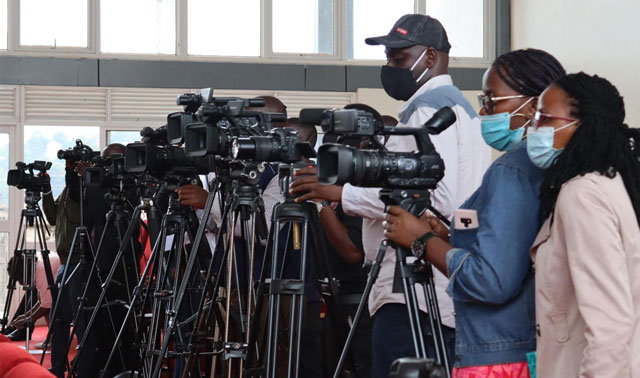
Soon, the sheep were separated from the goats. Some papers which got no saleable news and survived on lies and speculations were eventually boycotted. When they couldn’t break even, they quietly left the stands. Others were hopelessly sub-standard in content, language and layout. For some time, they survived on artificial respiration but lapsed into coma. Others simply disappeared after paying damages for libel.
Today, the fittest have survived, notable among them the Ghanaian Chronicle, Independent, Free Press, Ghana Palaver, Democrat, Public Agenda, Statesman, P & P and Insight. They are slugging it out on the stands and only time will tell which of them would survive the beginning of the next millennium.
On the electronic front, radio stations have come operating Frequency Modulation (FM) units. Short Wave (SW) being too expensive to venture into, the result is JOY 99.7 FM, GOLD, ATLANTIC, CHOICE FM and other private regional, town and cottage FM stations that dot various parts of the country.
These have brought about variety and jobs. So have the television stations. Ghana Television (GTV) is facing competition from TV3 and Metro TV. Competition brings about in efficiency, and for once we can all see that GTV is performing better after being divested of the monopoly it enjoyed.
Journalists who man the newspapers, radio and television stations together form the Ghana Journalists Association (GJA), an association which, until recent years, existed only in name. It is now feverishly preparing to celebrate its Golden Jubilee, an occasion I believe will give more meaning to the Association and anchor it firmly for good as a closely-knit union of Ghanaian media practitioners.
PRINT MEDIA
Print journalism has really come a long way, plodding on like the proverbial snail, hoping to achieve the ultimate. It has had to contend with vicissitudes of fortunes as one political era succeeded another.
Of interest is also the fact that from the cut-and-paste method, press outfits now employ desktop publishing techniques with PageMaker components, making the job easy and speedy. From for four-page newspapers we can now boast of are 30 pages and more, radio stations are on air 24 hours a day.
The development of the media is one thing people have taken note of, and in years to come, the fourth estate of the realm will be well-equipped to collect and dispense information more efficiently, more accurately, and more speedily.
There is another side to it. The media is likely to develop into a monster, the way it has developed to harass Lady Diana, the Princess of Wales, to her death; the way it has made Bill Clinton very uncomfortable by making a showpiece of his private sex life, and hundreds of others.
Indeed, until her death, the Princess had no privacy. She couldn’t sneeze without it being reported somewhere in a newspaper, complete with pictures in colour. At one stage, she lamented being a celebrity and asked the press to leave her alone to lead her life without world attention. She died while speeding away from pressmen who were furiously chasing her (and her boyfriend) on motorcycles.
If the press develops in Sikaman to the extent that it can in future drive someone to his or her death, cause heart attacks, and destroy families and leaders, can be tolerated as it has been in the United States and Europe?
Some of us think that becoming copycats of alien values and foreign systems is causing more harm than good to our society. For instance, it would be very unfortunate if the Ghanaian media developed to the negative extent that it can publish pictures nude girls as some British tabloids do.
The African culture is a decent one and should not be tainted with the wholesale acceptance of everything western. In Europe there are magazines for homosexuals and lesbians, glorifying their acts and promoting their perverted ideals.
The homosexual culture is gradually seeping into African countries, Sikaman inclusive. Should we, therefore, expect to see a homosexual magazine on our newsstands one day?
If the European and American press can harass celebrities, presidents and top shots to the point of discomfort and even death, should the African press copy same if our culture is palpably different in form and orientation, history and tradition?
What I would like to see of a future Ghanaian media is a development-oriented press system seeking to promote the ideals of societal progress, economic growth, agricultural development, political unity, social cohesion and technological advancement.
And what I’d hate to see is the kind of media that is overly interested in wanting to know what the president eats for breakfast, which women he has spoken to of late, and when he is likely to sneeze without covering his nose with a handkerchief.
What I’d also hate to see is a media that seeks to play one tribe against the other, take to pornography or pry into the private lives of people not for any other purpose than to sell newspapers that only thrive on the obscene.
I’ve heard some editors say, “If you don’t write and insult Rawlings your paper won’t sell.” What kind of mentality is that?
The African press must develop, but it must do so in a positive way and not in the negative and destructive sense.
This article was first published on Saturday August 29, 1998
It is unbelievable, the way people placed in authority to serve us, neglect their duties with careless abandon and turn round to blame the people they are to serve as the cause of the problem.
There are a few questions that needs urgent answers. How do you expect the pedestrian to keep the city clean when there are no trash bins along the streets?
How many people will be disciplined enough to keep a biscuit wrapper in his or her bag or pocket and dispose of it when he or she gets home? How many will willingly observe this reasonable behaviour if there are no consequences to their flouting this observance of cleanliness etiquette.
The Buzstopboys, the group of young people dedicated to bringing sanitation awareness issues to the government and people of Ghana, posted a video of the filth at Tema Newtown and it was horrible to say the least.
Aside of the fact that the area is not fit for human habitation, the people were openly defecating along the beach and another sad thing is that, fish that will eventually land on dining tables at people’s homes as part of their meals, were being dried amid this filth.
The gentleman in the video highlighting the unhygienic conditions made a very profound statement concerning lack of beds in our hospitals. He said that if we continue to live like this, a lot of people will fall sick and there will never be enough beds at the hospitals to accommodate the sick.
There is an urgent need to put in mobile toilets as a stop gap measure as authorities grapple with how to transform the Tema Newtown into a livable place. There are some people who are so used to the idea of open defecation at the beach, to the extent that even if you provide the mobile toilets, they will still not use them.
With such people, the law must deal harshly with, to serve as a deterrent to others. The punishment should not be prison term but be made to clear the beach from every trace of human excreta.
In the video, a woman was squatting at the beach together with her little girl, relieving themselves in real time despite the presence of people watching them from a distance and videoing the insanitary act as well as unlawful act.
The other thing that worried me was the fact that she was teaching her child to become a law breaker and also an environmental terrorist.
The Bible says that teach the child the way she should go and when she grows, she would not depart from it and she was teaching her wrong values, to become an environmental terrorist.
Under normal circumstances, women are very shy people and so with people watching, would not have done what she did but it tells a story of indoctrination to do the wrong thing.
Apparently, just as she was teaching her daughter, it might have been passed on from her mother so it has become a generational thing. It reminds me of a soap advert but this behaviour is of a negative generational transfer of values.
The Municipal Chief Executive (MCE) in charge of Tema Newtown must put personnel there to guard the beach to prevent anybody from even dreaming about going there to do the unthinkable.
Mobile toilets must also be provided immediately so that residents in that enclave, will have no excuse whatsoever to engage in this despicable behaviour at the beach. The refuse that has piled up there must be dealt with as a matter of national emergency.
Otherwise should an epidemic breakout, I guess there will not be enough beds in all the hospitals in Tema combined, to take care of the sick. It is the responsibility of MCEs and District Chief Executives (DCEs) and therefore the Assemblies, to ensure that the communities under their jurisdiction are environmentally sound. God bless.
By Laud Kissi-Mensah