Features
The crazy life on Sikaman


Half the number of drivers plying the streets of Accra are, taflatse, either mental patients or on the verge of becoming psychotic. If the driver is a taxi cab driver, then believe me, he is not normal.
I have never encountered an Accra taxi driver who has behaved like a human being who cares for himself, much more for others. In any case some trotro drivers are worse.
The typical Accra taxi driver is half the time so excited you’d think he is having an orgasm. Excited about what? Excited about making more money in a very short span of time. In the process, he carelessly overtakes any moving thing including stray dogs.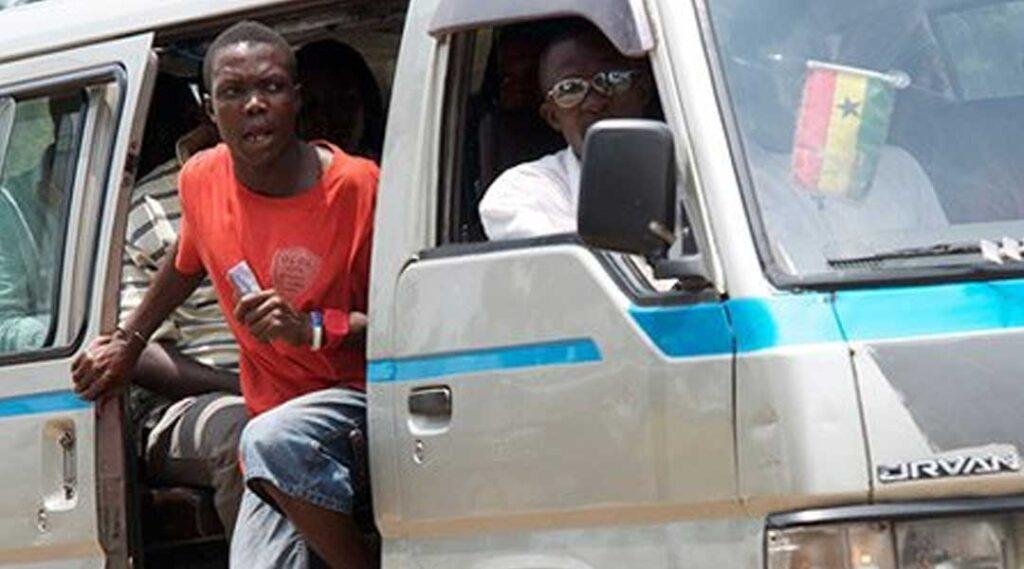
If a dog will not allow itself to be overtaken, it is promptly knocked down and ran over to teach it a lesson in traffic lawlessness. After all, what is the worth of foolish dog which exhibits the characteristics of a dead cockroach.
Meet the Accra trotro driver. He behaves like a ball of kenkey. He specialises in crossing other vehicles whether or not they are on top speed. He does so because he can afford to endanger the lives of others. After all, isn’t his pocket economy more important than a few lousy lives? And who says “all die no be die?”
What is more terrible on the roads in Accrą is the role of drivers’ mates in the perennial nonsense. The typical driver’s mate of a century-old trotro is a boy or man who has no patience for himself. He doesn’t smile, unless you leave him a large tip. That is when he’ll grin like an idiot.
The mate is someone who is likely to speak and understand seven local languages, most probably Asante-Twi, Bukom-Ga, Ada-Krobo Ewe, Fante, wrong Hausa and pidgin Frafra. Maybe he has ten years’ experience on the job, beginning with a stint at Kejetia, before moving to Bolgatanga in voluntary exile. He’d finally dash south to Ada Foah, Ho Bankoe, Gomoa Washington before winding up at Kokomlemle in pullover as part-time bookman, part-time mate.
In Accra, life is fast, just like in Lagos, so the mate must live like a smart rat on the run. Armed with seven local languages in addition to pidgin English and broken French, he can do any mate’s job satisfactorily.
A mate’s job is not only to collect money from passengers and hide some in his “supporter” for – personal use. He is also the driver’s unofficial bodyguard and also doubles as the vehicles on- board traffic controller. But his main role is to insult drivers of other vehicles when those drivers dare insult his master or refuse to permit him space to misbehave.
A typical insult usually takes the form of obscenity, and is sexual in nature. “Your face is like that of a he-goat on heat.” Or “Onyaa ye…, a typical Ga insult. If the mate is forced to speak French because his victim isn’t responding to English or Ga, he’d alter the metre-band and explode in incomprehensible French. “Il est tojours aimable avec e!”
Verbal missiles
The roads in Accra are indeed ruled by these mates who can really deliver verbal missiles. If a female driver annoys them, they can fire back. “Your body is fine, but as for your face, God no gree. Kwasia like that!”
When the driver is tired, it is sometimes the duty of the mate to take over power. When that happens, the car is bound for the mortuary. Fact is, the mate can be inexperienced and may mistake the accelerator for the brake, whereupon the vehicle becomes obituaristic in character.
I side with the man who keeps on saying that on the roads of Accra, everybody is a mad person, and he is the only wise man.
Of course, private car owners cannot also escape blame. In fact, some of them drive exactly like taxi drivers. Actually, they are taxi drivers in form and mentality; the only difference is that they appear in coat and tie.
Some private car owners do silly things especially when ladies are perched in the front seat. It is like they are in heaven they’d be busy talking, gesticulating, whining, crooning and ignoring traffic signs. You’d see them laughing, moaning and dancing behind the wheel. If the mobile phone rings the situation can be tragic.
Some people can be driving and be on the phone for 30 minutes. A man was on the phone for close to 30 minutes and when he finished talking, he realised that he was no longer in his car but lying naked at the mortuary gate, ready to be hauled into the cold-room.
Mr J.M. Y. Amegashie, Acting Chief Executive of the Vehicle Examination and Licensing Division (VELD) is doing a great job on Radio GAR, giving tit-bits on safe driving almost every morning. Among other things, he gives reasons why you must undergo a driving test and present your vehicle for test examination.
The problem with people is that they think when they can move a vehicle, then they are entitled to a licence. The other day, a learner was undergoing a driving test and when he was asked to reverse the car, it was almost a disaster.
The man reversed the car alright. But before he realised it, the car was breaking down trees in a nearby bush. The man obviously mistook the accelerator for the brake and pumped it hard.
Mr Amegashie doesn’t like that.
This article was first published on July 18, 1998


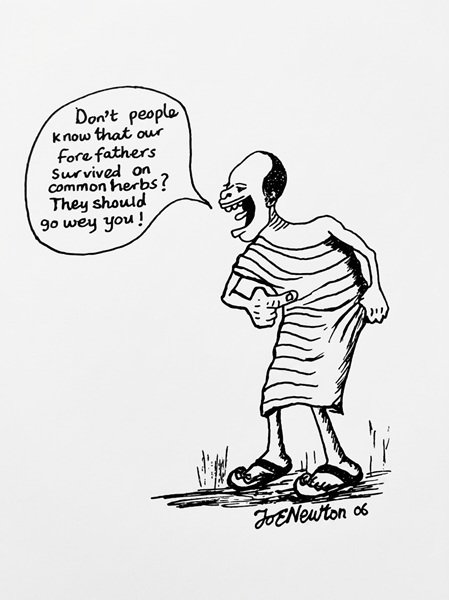
THE typical itinerant salesman in Sikaman is a herbalist. He is normally a slim macho with the capacity to perambulate the expanse of area covering the triangle of Accra-Tema-Ashiaman. In short, he can walk a total of 60 miles a day, marketing a product that cures every disease, including poverty.
The door-to-door herbal pharmacist advertises his product by word of mouth. He has nothing to do with the Food and Drugs Board (FDB). After all, his concoctions do not feature on FM stations.
Those herbalists who cannot walk to propagate the herbal gospel, liaise with drivers of mass transportation and their mates. They are, therefore, given the chance to sell their products on Benz buses that ply the routes.
Normally, the herbalist starts his sales message with a prayer and Bible study. He asks the passengers to bow down their heads in supplication to God the father, the son, the Holy Spirit.
When a herbalist asks the passengers to close their eyes and bow their heads, Moslems on board naturally feel offended. They feel that the herbalist has no right to assume that every passenger is a Christian. They think such an assumption is an affront to Islam.
So a Moslem on board will raise the hand for a point of order. He’ll remind the herbalist that it would be in his own interest to mind his language.
“Be careful the way you address people in a public place. Not every person here is a Christian,” he’d state assertively.
Of course, the herbalist will promptly ignore him, but would all the same “watch” his tongue. Who knows whether or not the Moslem brother is inspired by Quoranic zeal to defend the tenets of Islam to the hilt?
When he starts saying, “Wallahi!” and “Inshallah!” it could be the beginning of proclaiming Islam as supreme, a point which must be driven home with talibanic precision.
So the herbalist must tread carefully lest he steps on fire.
The herbalist could even add a measure of mirth to it all, by announcing that Christians on board today have very interesting company on the journey, but that should not detract from the business of the day.
The Moslem brother will weigh the words carefully and offer a wry smile.
He must be careful the occasion does not degenerate into the use of semantics and proverbial oration to deride his conviction that public utterances must be mindful of religious sensibilities. He has made his point very clear and expects that it is taken in good faith in the interest of a peaceful journey.
The herbalist will now open the New Testament and preach salvation, stating clearly that salvation can come only through Jesus Christ and NOBODY else.
The Moslem brother will now start twitching his moustache. The visible and almost revolutionary reflexes of his upper lip can be an indication that sentiments have begun superseding reason, and the outcome could well be tragic now shift uneasily in his seat.
The time has come for him to also express his right to the religion of his fore-bears. He’ll put his hand into his pocket and rise to his feet. The time has indeed come!
This article was first published on Saturday, September 9, 2006
When the cause of a particular problem like sickness, disease, sudden illness, a social issue etc. are not known, it stands to reason that resolving it becomes a huge challenge.
Citizens would understand the government when public announcements are made to the effect that government is trying to find a solution to the issue, even though it is taking a while for it to be resolved because citizens are rational beings.
On the other hand, if the solution to a particular issue is known to everybody but the government for whatever reason, is dragging its feet in resolving it, citizens become frustrated and begin to lose trust in their leaders.
One such issue is the heavy traffic along a section of the Kasoa – Odokor road. A short stretch of bad road between the traffic light at the Weija Government Hospital and the entrance to the entrance of the overhead that leads to the N1, is the cause of the problem but nothing is being done about it, day after day, week after week, month after month. Thus is clearly unacceptable.
Another issue that requires urgent attention is the lack of pavements along a lot of streets in parts of the various Municipal Assemblies. Exercise is a prerequisite for long life and healthy living and for those of us who it has become a way of life, this issue of people putting up structures right to the edge of the drains beside the roads, are making life difficult for us.
We are compelled to walk along the roads, putting our lives at serious risk. Pedestrians should never be compelled to compete with vehicles on our streets and roads. Roads and streets are made for vehicles and pavements are made for pedestrians. That is the norm. Any attempt to normalise a situation where pedestrians are mingling with vehicles is insanity.
It is the road regulations that makes it so and therefore district or municipal assemblies are to take responsibility and ensure that spaces for pavements are not encroached upon. Citizens have rights that must be protected by their leaders and making pavements available to pedestrians, is one of them.
When we hear of teachers having sex with students, it appears it is something recent. It is not a new phenomenon. It has been there since Adam. Perhaps this issue is getting much attention due to the proliferation of social media. It was an open secret in times past when Teachers were in relationships with female students and some married them immediately after completion of school.
Some teachers were also known to be having unholy interactions with female pupils but due to the times that these acts occurred, human rights issues and the awareness around it, allowed such unscrupulous teachers to get away with their crimes.
Now we are in a different era and so a Headmaster is now in hot waters. He is alleged to have raped about 19 female students and as usual, some officials tried to cover it up and are also in hot waters and their actions or inactions in the matter are under investigation.
Why the man has been allowed to roam freely without being arrested is simply mind boggling. It appears that the law applies differently, depending on who you are. This issue came to public attention sometime in August this year, yet the police had not arrested or invited this man for question regarding the rape allegation.
It has come out that he is a Constituency Secretary of the ruling party and the question in the public domain is that, is it because he is a political figure that is why he is still walking around without questioning? I believe in the rule of law so let us hold our breadth and let the proper thing be done.
The police must however be seen to be active in this matter. God bless.
SKIP THE QUEUE, TAP THE NEWS
You can now read the Ghanaian Times and The Spectator newspapers from the comfort of your device via TimesNewsPlus.
Join our WhatsApp Channel: https://whatsapp.com/channel/0029VbBElzjInlqHhl1aTU27