News
Righting Historical Wrongs: President Akufo-Addo calls for Reparative Justice at UN Assembly”

- /home/u249204778/domains/spectator.com.gh/public_html/wp-content/plugins/mvp-social-buttons/mvp-social-buttons.php on line 27
https://spectator.com.gh/wp-content/uploads/2024/09/IMG-20240926-WA0003-1000x600.jpg&description=Righting Historical Wrongs: President Akufo-Addo calls for Reparative Justice at UN Assembly”', 'pinterestShare', 'width=750,height=350'); return false;" title="Pin This Post">
- Share
- Tweet /home/u249204778/domains/spectator.com.gh/public_html/wp-content/plugins/mvp-social-buttons/mvp-social-buttons.php on line 72
https://spectator.com.gh/wp-content/uploads/2024/09/IMG-20240926-WA0003-1000x600.jpg&description=Righting Historical Wrongs: President Akufo-Addo calls for Reparative Justice at UN Assembly”', 'pinterestShare', 'width=750,height=350'); return false;" title="Pin This Post">
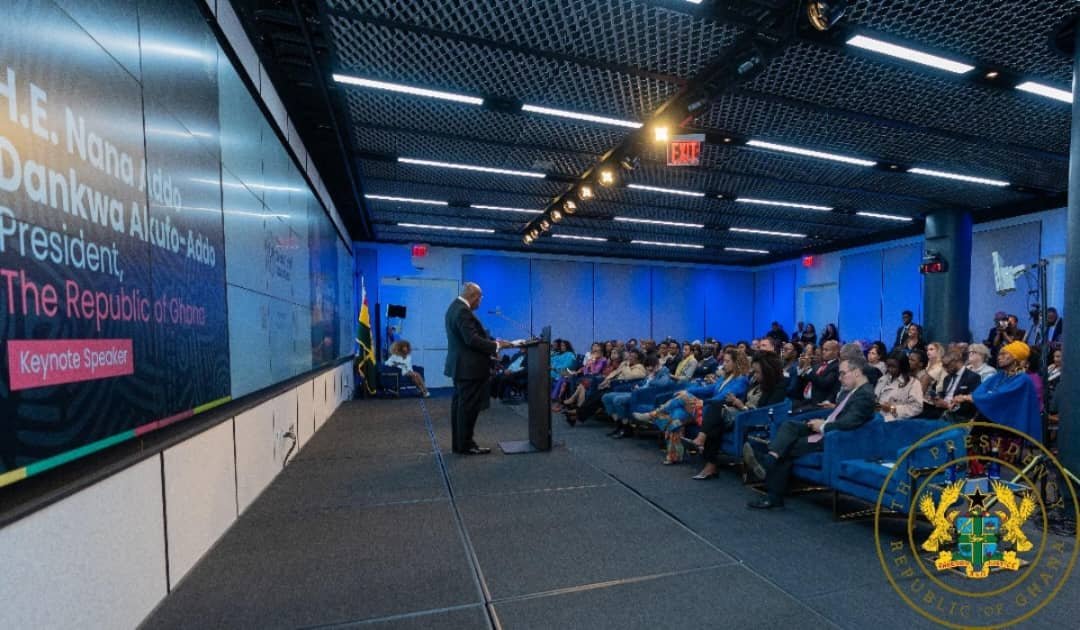
At a significant side event during the 2024 UN General Assembly in New York, President Nana Addo Dankwa Akufo-Addo of Ghana delivered a compelling address on reparations, calling for a global reckoning with the historic injustices inflicted on people of African descent.
In his passionate speech, the President outlined the importance of reparative justice, while stressing that this moment in history is not merely about reflecting on past wrongs but about forging a path toward a just and equitable future.
“We are not convening this evening to share words, nor are we merely reflecting on history,” President Akufo-Addo began.
He said, “No, my friends, we are here to envision a new future—a future that corrects the injustices of the past and ensures that our children, and their children, are born into a world that embraces their dignity and humanity.”
In addressing the gathered dignitaries, diplomats, and representatives of African nations and the African diaspora, the President underscored the brutal legacy of slavery, colonialism, and systemic racism that continues to reverberate in the lives of people of African descent.
He emphasized that reparations are not just about compensation but about rebuilding the dignity and future of a people whose humanity was denied for centuries.
Akufo-Addo highlighted the historical examples of Haiti and the United States, where former enslaved peoples were further burdened instead of compensated.
He recounted the harrowing case of Haiti, a nation that was forced to pay reparations to France for the audacity of gaining its independence from colonial rule in 1804.
Haiti was shackled with an unjust debt of $21 billion that crippled its economy and prospects for generations.
“Haiti’s example illustrates a fundamental truth: reparations, when wrongly administered, do not serve justice. Rather, they can reinforce the very power structures that perpetuate dominion and inequality,” President Akufo-Addo asserted.
He added, “It was the enslaved who paid their former slave masters, a story that still resonates across the Global South.”
Akufo-Addo’s address also recounted the injustices perpetrated in the United States and the United Kingdom, where compensation for the abolition of slavery was perversely awarded to the slave masters, rather than to those who had endured years of forced labor and inhumane treatment.
In the United States, $300 was paid to slave owners for each enslaved person they lost, while the enslaved were left with nothing but their hard-won freedom. Similarly, in the UK, £20 million—a figure now equivalent to £20 billion—was paid to former slave owners, but not a penny was awarded to those who had suffered under slavery.
“This was a perverse inversion of justice, one that allowed the structures of inequality to endure long after the formal end of slavery,” Akufo-Addo said, noting the enduring economic disparities and systemic racism that continue to afflict people of African descent to this day.
“But, as Akufo-Addo reiterated, this event was not only about reflecting on these injustices. It was about taking active steps towards creating a future where reparations can be a meaningful part of healing and building sustainable livelihoods for those whose ancestors were wronged,” he said.
At the recent Reparations Conference in Accra, held in November 2023, the groundwork was laid for defining reparative justice for Africa and the African diaspora.
The President outlined several key actions agreed upon at the conference, including the establishment of a global reparations commission, the return of stolen cultural artifacts, and investments in African nations and communities worldwide.
“This is the vision of reparations that we must hold onto—one that looks not only at compensation for past injustices but also at the creation of sustainable, just futures for our people,” the President declared.
The concept of Afro-diplomacy was also central to the President’s speech. Akufo-Addo called on African nations and their diaspora to be the architects of their future, pushing for reparations through global diplomacy, partnerships, and solidarity with other oppressed peoples.
“Reparations will not be handed to us freely—we must actively seek them,” he said, urging the world to see Africans as equals on the global stage, not beggars.
Concluding his remarks, President Akufo-Addo expressed confidence in the youth of today, whom he believes will be the ones to transform global systems and build a future of justice, equality, and empowerment for all Africans.
“My friends, we stand at the threshold of a new world—a world that we must imagine, design, and build. This is the world of reparative futures, a world where the wrongs of the past are righted, and where African nations are free to define their own destinies,” he said.
As the address drew to a close, it was clear that President Akufo-Addo’s vision for reparations is about far more than financial compensation—it is about transforming the very foundations of global justice, ensuring that the descendants of the enslaved can thrive in a future where dignity, respect, and equality are their birthrights.

Minister for Education Haruna Iddrisu has questioned why Ghana continues to import toothpicks despite having the resources to produce them locally.
Speaking in Parliament, Mr. Iddrisu, who previously served as Minister for Trade and Industry, said he feels ashamed that the country still depends on imports for such a basic product.
“I have been Minister for Trade and Industry before and I carry the shame. How come that in Ghana we cannot produce toothpicks and we have to import them?” he asked.
According to him, Ghana has enough resources to support local businesses to manufacture products such as toothpicks instead of relying on imports. He said the country should encourage private sector investment in manufacturing to create jobs and reduce dependence on foreign goods.
Mr. Iddrisu alleged that some people who received government support under private sector initiatives failed to use the funds for their intended purpose.
“If you want, Honorable Kojo, because you… I can’t go there. There are people who took money in the name of the private sector and said they were going to farm. That money never went to their farms. You know that,” he told Parliament.
On job creation, the Education Minister said he agreed with the views expressed by a colleague on the need to create more employment opportunities. However, he argued that the One District, One Factory (1D1F) programme did not provide the solution to Ghana’s employment challenges.
Mr. Iddrisu made the remarks during parliamentary proceedings while contributing to discussions on job creation and the country’s industrial development.
By: Jacob Aggrey

New Patriotic Party (NPP) communications officer, Dennis Miracles Aboagye, has dismissed reports linking him to an alleged GH¢55 million case, insisting that no such issue was raised during his detention by the Economic and Organised Crime Office (EOCO).
In a Facebook post after his release from EOCO custody, Mr Aboagye stated that at no point during his detention was he questioned about any GH¢55 million.
“For the records: There was no discussion of any GH¢55 million with me by EOCO. None,” he wrote.
According to him, he was detained for four days, a day after announcing his intention to contest for the position of National Communications Director of the New Patriotic Party.
Mr Aboagye alleged that false narratives were circulated about his arrest but expressed confidence that the truth would eventually prevail.
He thanked NPP supporters who demonstrated and called for his release, saying news of the protests reached him while he was in detention and encouraged him.
Mr Aboagye indicated that the support shown by party faithful strengthened his resolve and reaffirmed his commitment to serve the NPP.
He maintained that his detention had not discouraged him from pursuing his political ambition.
“If the intention was to break me, it has failed. If the intention was to scare me, it has failed spectacularly,” he stated.
Mr Aboagye expressed appreciation to his legal team, the leadership of the NPP and all supporters who stood by him throughout his detention.
He reiterated his determination to lead the party’s Communications Directorate, declaring that he remained “ready to win” and committed to what he described as the party’s mission to “command the narrative.”
By: Jacob Aggrey