News
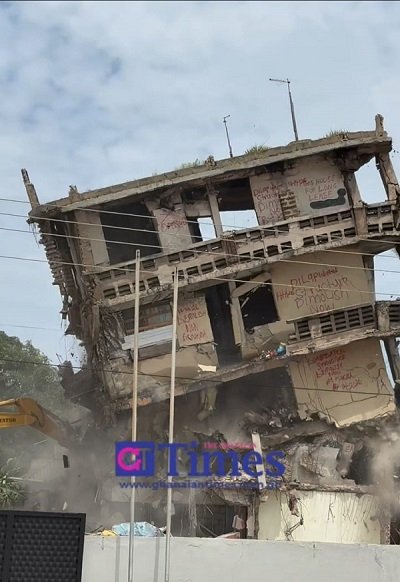
Korle Klottey Municipal Assembly demolishes 70-Year-old dilapidated building at Osu

- /home/u249204778/domains/spectator.com.gh/public_html/wp-content/plugins/mvp-social-buttons/mvp-social-buttons.php on line 27
https://spectator.com.gh/wp-content/uploads/2026/06/WhatsApp-Image-2026-06-08-at-14.53.59.jpeg&description=Korle Klottey Municipal Assembly demolishes 70-Year-old dilapidated building at Osu', 'pinterestShare', 'width=750,height=350'); return false;" title="Pin This Post">
- Share
- Tweet /home/u249204778/domains/spectator.com.gh/public_html/wp-content/plugins/mvp-social-buttons/mvp-social-buttons.php on line 72
https://spectator.com.gh/wp-content/uploads/2026/06/WhatsApp-Image-2026-06-08-at-14.53.59.jpeg&description=Korle Klottey Municipal Assembly demolishes 70-Year-old dilapidated building at Osu', 'pinterestShare', 'width=750,height=350'); return false;" title="Pin This Post">
The Korle Klottey Municipal Assembly (KOKMA) has demolished a dilapidated building at Osu that has remained in a deteriorated state for nearly 70 years.
The demolition of the structure followed several engagements between the Assembly, the police and the occupants of the property to ensure the exercise was carried out safely.
The action comes days after a similar building collapsed at Avenor, killing one person and leaving others injured, raising concerns about the safety of ageing structures across the capital.
The demolition, which took place on Monday, June 8, 2026, was carried out peacefully without any confrontation from residents or occupants of the area.
Speaking to the media, the Municipal Chief Executive for the Korle Klottey Municipal Assembly, Alfred Allotey-Gaisie, said the assembly had repeatedly warned occupants of the building to vacate the premises due to the danger it posed.
He explained that the assembly had earlier forced the occupants to move out to enable officials to carry out the demolition safely.
He noted that there was a slight delay in the exercise because power had to be disconnected by the Electricity Company of Ghana, while telecommunications operators were also engaged to protect fibre cables in the area.
Mr. Allotey-Gaisie said no casualties had been recorded, adding that nearby buildings were also evacuated as a precautionary measure.
He stated that the structure was believed to be more than 70 years old and had deteriorated over time, making it unsafe for continued occupation.
He further explained that the assembly’s building permit and inspection systems were intended to ensure proper supervision of construction projects and prevent such situations in the future.
According to him, any new development on the site would be expected to meet current building standards.
Meanwhile, one of the owners of the demolished property, Walter Hammond, explained that the family had already planned to pull down the building because of its age and poor condition before the assembly intervened.
He said although the family did not directly invite the assembly to undertake the demolition, officials had earlier marked the building and recommended its removal.
He described the assembly’s intervention as a step in the right direction and disclosed that all family members supported the exercise.
Mr. Hammond advised owners of weak and ageing structures to demolish them before assemblies are compelled to intervene, warning that delays could lead to legal disputes and other complications.
He added that following the demolition, the family intended to either lease or sell the property to interested investors.
Korle Klottey Municipal Assembly Engineer, Davor Wonder, mentioned that the assembly had identified about three weak structures within the municipality for possible demolition.
He explained that buildings are not demolished solely based on their appearance, stressing that structural integrity assessments must first be conducted to determine whether a structure is unsafe.
Mr. Wonder said the assembly follows due process before carrying out demolitions to avoid disputes and ensure decisions are based on professional assessments.
On preparations for the rainy season, he revealed that the assembly had intensified the desilting of drains across parts of the municipality to improve the flow of stormwater and reduce flooding.
A resident in the area revealed that he was pleased with the demolition because the building posed a serious threat to lives and property.
The resident noted that the structure was located at a busy junction used by motorists and pedestrians, adding that its poor condition was obvious and that its demolition would help prevent a possible tragedy.
By: Jacob Aggrey










Veteran Nigerian actor and African screen legend, Pete Edochie, has paid a courtesy call on the Chief Executive Officer of the Ghana Gold Board (GoldBod), Sammy Gyamfi, during his visit to Ghana.
Edochie is in Ghana to launch the African Legacy Project, which includes a book, documentary film and an African Youth Mentorship Initiative targeting about 500,000 young people across the continent.
Mr. Gyamfi welcomed the opportunity for GoldBod to support the mentorship initiative, noting that it aligns with the Board’s Special Intervention Programme and its focus on social impact and economic empowerment.
GoldBod’s work is also referenced in Pete Edochie’s new book, which highlights Ghana’s efforts to ensure its gold resources contribute to national development.
By Edem Mensah-Tsotorme

The Ministry of Foreign Affairs has warned Ghanaians seeking employment in Zambia to be cautious of fraudulent job offers that could expose them to human trafficking and forced involvement in cybercrime.
The warning follows the arrest of six Ghanaians in Lusaka, Zambia, during a joint operation by the Zambia Police Service, the Drug Enforcement Commission and the Department of Immigration on August 23, 2026.
According to the Ministry, the operation targeted a facility suspected of being involved in organised cybercrime activities and led to the arrest of 79 people, including 10 Zambians and 69 foreign nationals.
The Ministry said six of the foreign nationals arrested were Ghanaians.
It explained that reports received by the Ghana High Commission in Lusaka indicated that some of those arrested had been recruited through what appeared to be legitimate employment opportunities, including online data entry jobs.
However, the Ministry said some were allegedly forced into online scam activities after their passports were confiscated by their employers.
It warned that the situation highlights how human trafficking groups are using fake employment opportunities to lure unsuspecting job seekers into illegal activities.
The Ministry has therefore advised Ghanaians travelling to Zambia or seeking employment there to thoroughly verify job offers, recruitment agencies and prospective employers before travelling.
Ghanaians living in Zambia have also been urged to remain vigilant when responding to online job opportunities and maintain regular contact with the Ghana High Commission in Lusaka for consular assistance when necessary.
The Ministry said the government remains committed to protecting the welfare and interests of Ghanaians travelling to or living outside the country.
By: Jacob Aggrey