Features
Is scrapping of workers’ ESB best option for a state enterprise?

End-of-Service Benefit (ESB) is usually, a cash benefit that is paid to workers by their employers upon their compulsory retirement or when their services are abruptly terminated by their hiring institutions. This is calculated on the basis of last wage which the worker was entitled to namely the basic salary. Hence, it will not include allowances such as housing, conveyance, utilities, furniture among others. Also, a worker who has spent one year or more in continuous service shall be entitled to an ESB gratuity upon the termination of his service.
WHAT THE LAW STATES ABOUT ESB
The Labour Law makes it clear that if the term of service is less than one year, there is no eligibility for gratuity compensation. However, for service of more than one year, but less than five years, the entire gratuity compensation would be equivalent to 21 days of salary each year of service. For instance, if you have worked for a company for four years, your ESB gratuity would equal 21 days’ wage multiplied by four. Employees who have worked for more than five years, will get ESB gratuity of 30 days salary for each year worked beyond the five- year service.
The payment of ESB to workers which was restored by the National Tripartite Committee (NTC), representing the government, organised labour and employers in 2002, to supplement the Social Security and National Insurance Trust (SSNIT) Pension Scheme after it was frozen in 1990, was aimed at providing an enhanced financial security for the worker in retirement as a means of promoting equity, higher productivity and loyalty within the establishment or an organisation.
THE RELEVANCE OF ESB
This means that the ESB in its entirety is so relevant and beneficial to workers as they start their new lives during retirement from active service. It is, therefore, a scheme which needs protection and sustenance because life after retirement is very difficult and hectic. It is during retirement after 60 years of active service that you will realise that you need some form of financial support to tackle health issues, particularly medications and other medical issues and the only means of support especially when you do not have any dependant to supplement your meagre pension allowance, would be your ESB.
The framers of the Labour Laws were conscious of that shortcoming and the burden it would pose to pensioners, hence the fixation of the ESB into the law to cater for some of these problems and, therefore, need to be commended for their foresight. Any attempt by any state-owned establishment to on its own volition suspend or cancel the ESB, means it is insensitive to the plight of its workers and, therefore, acting callously and wickedly.
SUSTENANCE OF THE ESB SCHEME
What state-owned enterprises should do to sustain the scheme, is to ensure that funds accruing should be managed separately and independent of their enterprises. They should make sure that employees should as much as practicable have access to the benefits only when leaving the service of their employer. They must encourage parties at the enterprise level to explore the possibilities of modifying the operations of existing supplementary schemes to emphasise their terminal character.
It is important to state that the termination of the ESB scheme in 1990, attracted mixed feelings and agitations from workers especially those that were deemed disqualified by their enterprises and, therefore, received no benefits at all from their employers. It was on that premise that workers welcomed the announcement by government to restore the scheme in 2002.
NTC AT THE PUBLIC ACCOUNT COMMITTEE
When the Managing Director of the New Times Corporation (NTC), Mr. Martin Adu-Owusu, appeared before the Public Accounts Committee (PAC) of Parliament recently, he painted a gloomy picture of the corporation, especially the lack of inflow of the needed funds to sustain and keep the operations of the NTC active.
The Auditor General in its 2020 report on Public Boards and Corporations noted that debtors of the state-owned media organisation have become numbed in redeeming their indebtedness to the NTC. Customers’ balances recorded by head office showed GHc196, 603.73 and GHc185, 935.76 in respect of stopped subscriptions and vendors as against GHc151, 932.93 and GHc 124,807.19.
The managing director told the committee that, though some of the debtors had started responding following a February 1, 2023, deadline, the NTC would be exploring legal action against recalcitrant ones. Hear the MD in part: “We have made several efforts including the Minister of Information writing to our debtors to do the needful. What we have done since last year, was to serve notices in our newspapers so that those who owe us will come and pay. The deadline was February 1, 2023. I have started receiving letters from the debtors coming to arrange for payments. From this stage, we will move a step further by taking legal action against the debtors because we have done all that we could but the situation is not improving”.
SAM NARTEY GEORGE’S ADVICE TO NTC DEBTORS
Indeed, one remarkable feature that needs commendation was the call by Sam Nartey George, Member of Parliament for Ningo Prampram to individuals and organisations that are indebted to the NTC to redeem their indebtedness to enable the corporation to function effectively. He said the locked- up funds with the debtors go into running of the publisher and that their failure could run the corporation aground.
SUSPENSION OF ESB
Definitely, the New Times Corporation is confronted with huge financial problem to keep the corporation running. However, that should not give room for the managing director to announce an intention of either suspending or cancelling the workers ESB in the near future because the corporation is not in a healthy financial position to continue with the scheme. That to this writer who happened to be a former Editor of the Ghanaian Times newspaper and other well-meaning Ghanaians, will not be the best path to follow. Has the MD weighed the magnitude of his statement? He must realise that such a statement will automatically lower the morale of the workers and eventually affect productivity, knowing very well that they are not entitled to ESB when they retire from the corporation.
PAYING LIP-SERVICE TO NTC
It is sad that governments upon governments both in the past and present have always relied or depended on the New Times Corporation newspapers, especially The Ghanaian Times to prosecute their political agenda and other selfish interests yet they have failed to see to it that the corporation stood on its feet in terms of financial recapitalisation. Politicians see the NTC as a dumping ground for all kind of propagandist and other campaign materials and that to me in particular, had branded the corporation’s products as government newspapers and, therefore, people continue to feel reluctant to patronise them. Otherwise, how can a big corporation like the NTC print their newspapers at Graphic Corporation and Daily Guide for barely two years now without government’s intervention? Is it an intention to kill the fortunes of the corporation and turn around to acquire the NTC for selfish reason?
Indeed, the New Times Corporation, which is a state-owned media, arguably, has the Graphic Corporation as its major competitor in the newspaper industry. Today, Graphic is making it just because it has continued to set its priorities right by doing what it takes to rake in the needed revenue to support its operations and keep the corporation going. I sincerely believe that, Times can do same by identifying its problems and other shortcomings which include, chasing of its debtors by resorting to the law courts to recover the huge debt owed to the corporation by its creditors as well as repositioning and rebranding its products to attract readers and other patrons.
HELPING NTC TO DELIVER ON MANDATE
THE Information Minister, Mr Kojo Oppong Nkrumah, recently promised that his ministry was doing everything possible to help the New Times Corporation to come out from its present predicament and to make the place viable. It is the hope of many especially, workers and management of the NTC that this assurance will not be in futility.
Indeed, it was time the government and other well-meaning Ghanaians went to the aid of the NTC and help them out of their present challenges. The corporation has nurtured good talents in the past and still has a crop of journalists and other staff who should be supported to expand their horizon.
Contact email/WhatsApp of author:
HYPERLINK “mailto:ataani2000@ yahoo.com”ataani2000@yahoo.com
0277753946/0248933366
By Charles Neequaye


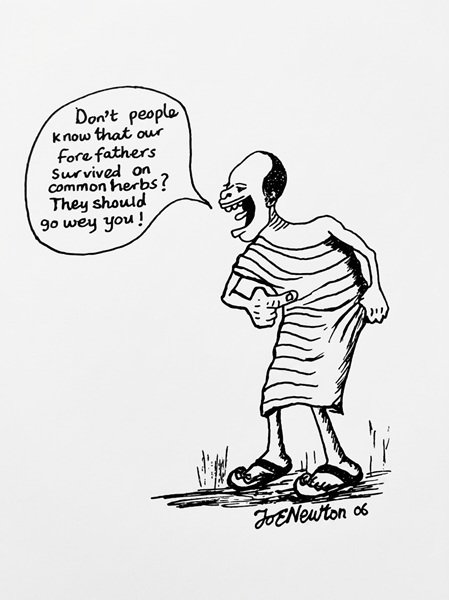
THE typical itinerant salesman in Sikaman is a herbalist. He is normally a slim macho with the capacity to perambulate the expanse of area covering the triangle of Accra-Tema-Ashiaman. In short, he can walk a total of 60 miles a day, marketing a product that cures every disease, including poverty. 
The door-to-door herbal pharmacist advertises his product by word of mouth. He has nothing to do with the Food and Drugs Board (FDB). After all, his concoctions do not feature on FM stations.
Those herbalists who cannot walk to propagate the herbal gospel, liaise with drivers of mass transportation and their mates. They are, therefore, given the chance to sell their products on Benz buses that ply the routes.
Normally, the herbalist starts his sales message with a prayer and Bible study. He asks the passengers to bow down their heads in supplication to God the father, the son, the Holy Spirit.
When a herbalist asks the passengers to close their eyes and bow their heads, Moslems on board naturally feel offended. They feel that the herbalist has no right to assume that every passenger is a Christian. They think such an assumption is an affront to Islam.
So a Moslem on board will raise the hand for a point of order. He’ll remind the herbalist that it would be in his own interest to mind his language.
“Be careful the way you address people in a public place. Not every person here is a Christian,” he’d state assertively.
Of course, the herbalist will promptly ignore him, but would all the same “watch” his tongue. Who knows whether or not the Moslem brother is inspired by Quoranic zeal to defend the tenets of Islam to the hilt?
When he starts saying, “Wallahi!” and “Inshallah!” it could be the beginning of proclaiming Islam as supreme, a point which must be driven home with talibanic precision.
So the herbalist must tread carefully lest he steps on fire.
The herbalist could even add a measure of mirth to it all, by announcing that Christians on board today have very interesting company on the journey, but that should not detract from the business of the day.
The Moslem brother will weigh the words carefully and offer a wry smile.
He must be careful the occasion does not degenerate into the use of semantics and proverbial oration to deride his conviction that public utterances must be mindful of religious sensibilities. He has made his point very clear and expects that it is taken in good faith in the interest of a peaceful journey.
The herbalist will now open the New Testament and preach salvation, stating clearly that salvation can come only through Jesus Christ and NOBODY else.
The Moslem brother will now start twitching his moustache. The visible and almost revolutionary reflexes of his upper lip can be an indication that sentiments have begun superseding reason, and the outcome could well be tragic now shift uneasily in his seat.
The time has come for him to also express his right to the religion of his fore-bears. He’ll put his hand into his pocket and rise to his feet. The time has indeed come!
This article was first published on Saturday, September 9, 2006
When the cause of a particular problem like sickness, disease, sudden illness, a social issue etc. are not known, it stands to reason that resolving it becomes a huge challenge.
Citizens would understand the government when public announcements are made to the effect that government is trying to find a solution to the issue, even though it is taking a while for it to be resolved because citizens are rational beings.
On the other hand, if the solution to a particular issue is known to everybody but the government for whatever reason, is dragging its feet in resolving it, citizens become frustrated and begin to lose trust in their leaders.
One such issue is the heavy traffic along a section of the Kasoa – Odokor road. A short stretch of bad road between the traffic light at the Weija Government Hospital and the entrance to the entrance of the overhead that leads to the N1, is the cause of the problem but nothing is being done about it, day after day, week after week, month after month. Thus is clearly unacceptable.
Another issue that requires urgent attention is the lack of pavements along a lot of streets in parts of the various Municipal Assemblies. Exercise is a prerequisite for long life and healthy living and for those of us who it has become a way of life, this issue of people putting up structures right to the edge of the drains beside the roads, are making life difficult for us.
We are compelled to walk along the roads, putting our lives at serious risk. Pedestrians should never be compelled to compete with vehicles on our streets and roads. Roads and streets are made for vehicles and pavements are made for pedestrians. That is the norm. Any attempt to normalise a situation where pedestrians are mingling with vehicles is insanity.
It is the road regulations that makes it so and therefore district or municipal assemblies are to take responsibility and ensure that spaces for pavements are not encroached upon. Citizens have rights that must be protected by their leaders and making pavements available to pedestrians, is one of them.
When we hear of teachers having sex with students, it appears it is something recent. It is not a new phenomenon. It has been there since Adam. Perhaps this issue is getting much attention due to the proliferation of social media. It was an open secret in times past when Teachers were in relationships with female students and some married them immediately after completion of school.
Some teachers were also known to be having unholy interactions with female pupils but due to the times that these acts occurred, human rights issues and the awareness around it, allowed such unscrupulous teachers to get away with their crimes.
Now we are in a different era and so a Headmaster is now in hot waters. He is alleged to have raped about 19 female students and as usual, some officials tried to cover it up and are also in hot waters and their actions or inactions in the matter are under investigation.
Why the man has been allowed to roam freely without being arrested is simply mind boggling. It appears that the law applies differently, depending on who you are. This issue came to public attention sometime in August this year, yet the police had not arrested or invited this man for question regarding the rape allegation.
It has come out that he is a Constituency Secretary of the ruling party and the question in the public domain is that, is it because he is a political figure that is why he is still walking around without questioning? I believe in the rule of law so let us hold our breadth and let the proper thing be done.
The police must however be seen to be active in this matter. God bless.
SKIP THE QUEUE, TAP THE NEWS
You can now read the Ghanaian Times and The Spectator newspapers from the comfort of your device via TimesNewsPlus.
Join our WhatsApp Channel: https://whatsapp.com/channel/0029VbBElzjInlqHhl1aTU27