Features
If I were the President…

There are several pertinent issues that must be prioritised if we are to move forward as a nation and therefore if I were the President of the Republic of Ghana…
I would prioritise Town Planning and ensure that, an effective monitoring system of town planning officials are in place. Most of the problems associated with disasters in our country are linked to the haphazard manner structures are sited in the towns and cities across the country.
Flooding in some areas are attributed to the structures that are built on water ways so that when it rains, the flow of water is impeded and it builds up and start entering peoples’ homes, destroying property worth thousands of cedis. Roads also get flooded and occasionally lives are lost.
Stretches of highways get flooded and economic activities are affected due to long queues of vehicles that are generated because the roads becomes impassable for a long time till the level of the flood goes down.
In other instances, the vehicles are restricted to only one lane. The major cause of these floods along the highways are due to filling of wetlands along the highways that are supposed to trap the excess water from the communities, but have been sold to developers and have been filled up and structures built, something that could have been prevented if town planning officials had done their job.
The reported incidents of fire tenders not being able to quench fires, due to lack of access to the place where the fire occurred are countless. This is something that should not happen if efficient town planning is in place and the responsibility falls squarely at the doorsteps of the Town and Country Planning Department.
If I were the President, I would ensure that there would not be anything called ‘kayaye’ in this country. Why should young girls be deprived of the opportunity of pursuing their dreams by obtaining adequate education, in order to unleash their God given talents for their own benefit and the benefit of society at large?
When you go to places where these young girls and women sleep, they are basically condemned to a life of misery. There are numerous cases of attempted rape and teenage pregnancy and a whole lot that happen to these ‘kayaye’ which is clearly a blot on our drive as a country to promote the rights of the girl child.
A deliberate policy should be adopted to address this issue by enforcing the law that makes it compulsory for every child to be in school and also create the enabling environment up north, to motivate people to stay in their communities instead of moving down south for non-existent opportunities.
I would relocate the residents of Old Fadama and Agbogbloshie Market to enable work on the Odaw river beautification project to go on. The Accra Beautification Project which was to have happened by end of 2008 is still in limbo due to lack of political will.
Relocating residents and the market to Adjen Kotoku area, would help in decongesting the central business district of Accra and more importantly be a source of income generation for Accra Metropolitan Assembly.
The perennial challenge of how to resolve the budget deficit would be tackled by initiating an entrepreneurial drive through a closer collaboration between industry and the universities.
There are numerous research projects that have the potential to greatly impact our industrialisation drive but are gathering dust on the shelves in our universities.
The setting up of a system of collaboration between industry and academia, that will sieve through these projects, to identify those with potential for implementation, must be prioritised.
The need for regulating activities of religious leaders, to curtail a lot of anti-social behaviour that has characterised the activities of some so called Men of God, would be prioritised. An acceptable way of licensing must be introduced by a regulatory body, made up of the leaders of the established Orthodox Churches and the Charismatic Churches.
They would determine the promotion and therefore who qualifies to be called a Pastor,Bishop etc. instead of the current situation where people in what is known as one-man churches, ascribe titles to themselves. Such a regulatory body should be clothed with the powers to sanction pastors, whose behaviour goes contrary to sound doctrine.
A system that would reduce the discretionary power of the judiciary as much as possible, would be put in place. Legislation would be crafted such that sentencing of say drug offenders, would be made based on the amount of drugs in terms of weight found on the offender.
I would also ensure that there are undercover auditors who would attend court hearings to monitor the rulings of the judiciary to ensure that justice is served.
The cry for affirmative action would be prioritised and implemented. Legislation would be enacted to compel political parties to reserve most of their safe seats for women as the first step in ensuring enough representation of constituencies by women in parliament.
The positive impact of this on both the social and economic life of the country, cannot be quantified. Shelters for abused children and women would also be prioritised to help protect our women and children.
The funding of the NHIS must be prioritised to ensure a healthy nation to prevent the issue of service providers always threatening to withhold their services due to government defaulting on payment for services rendered. Infrastructure to enable implementation of Telemedicine would also be prioritised to ensure an effective health delivery system and also facilitate the acquisition of cutting-edge knowledge by our health practitioners.
The issue of accidents caused by vehicles left on the roads, would be a thing of the past. Furthermore, heavy trucks that are usually parked on the shoulders of highways, with mechanics working on them, spilling fuel and oil that gradually causes the roads to deteriorate, would also not be tolerated.
In fact, such negligence would be criminalised and offenders would be severely punished. I would ensure provision of rest areas so that such trucks can park off the road for the drivers to rest and also to fix mechanical problems they have so they would not have any excuse to use the main road for such activities.
Laud Kissi-Mensah


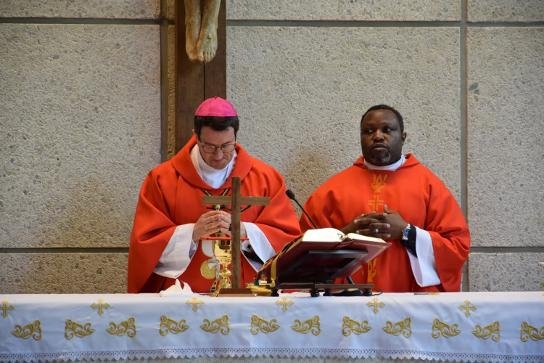
On Sunday, October 11, 2026, it was the turn of Ghanaian Catholics in Finland to lead the singing in the church service of the African Catholic Chaplaincy in Finland (ACCF).
It was indeed a spirit-filled feeling for worshippers present. And for the Ghanaian migrants, the occasion also brought back to them memories of church services in their home country, Ghana.
The ACCF has a roster for each country/community to sing from time to time. Next Sunday will be the turn of the Nigerian community. Other communities that usually sing are the Kenyan/Tanzanian community, the Cameroonian, the Ugandan, group, etc.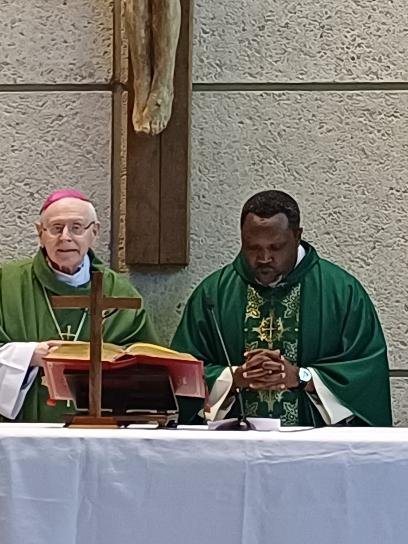
A powerful religious experience
The mass services of the Chaplaincy usually give a powerful religious experience and a display of cultural diversity, especially in occasions such as when the Bishop of Helsinki, Bishop Raimo Goyarrola, celebrated mass with the Chaplaincy on Pentecost Day, May 24, 2026.
There was a similar time of spiritual joy last month (September 27, 2026) when Emeritus Bishop Teemu Sippo, former Bishop of Helsinki, visited the Chaplaincy. Bishop Teemu was the main celebrant, assisted by the Chaplain, Reverend Father Thomas Otieno.
Last Sunday, Reverend Father Bernard Sor, a Ghanaian Catholic priest based in Austria, was the main celebrant in the mass service where he performed a rite of baptism. Fr Bernard had celebrated mass a few months ago when he visited his sister and her husband in Helsinki. 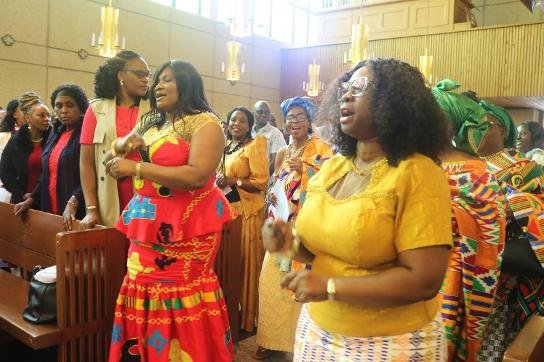
All these well-attended religious occasions indeed leave lasting memories. The homilies (peaching) by the priests usually emphasize religious tenets such as the importance of loving and serving God in truth, existing in peace with our fellow humans to promote unity in diversity, etc.
Unity in diversity and a colourful display of cultures
The African Chaplaincy church services usually produce impressive displays of diverse cultures from different parts of Africa and elsewhere. The events are often spiced by rich cultural displays of dances and colourful attires which are a delight to watch.
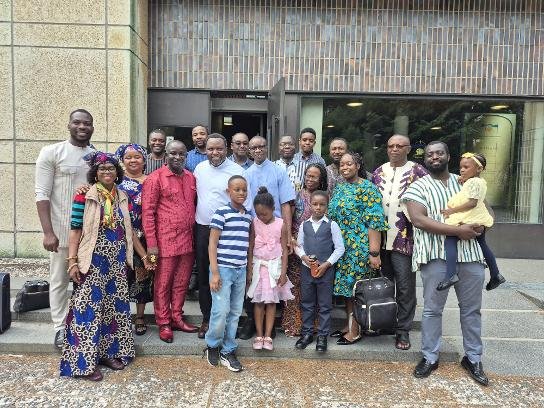
On special occasions, members of the Ghanaian Catholic community, in their gay and colourful kente attire and with adowa dance and music, usually lead the procession into the church. Other communities such as the Cameroonian, Nigerian, Kenyan and Tanzanian as well as Sudanese/South Sudanese groups also put up well-choreographed performances from their cultures.
The African Catholic Chaplaincy in Finland
The African Chaplaincy was founded on June 4, 2017, which was a Pentecost Sunday, in a Pontifical High Mass celebrated by Monsignor Emeritus Sippo S.C.I., the then Bishop of Helsinki, at the St. Mary’s Catholic Parish Church in Helsinki.
The Chaplaincy was created by Bishop Teemu in collaboration with the Diocesan body when they detected a great flocking of African immigrants to Finland, the majority of whom were Catholics. This was to give the immigrants a possibility to integrate into the Finnish society by worshiping as Catholics and in their African cultural identity.
The responsibility of the Chaplaincy was given by Bishop Teemu to Father Dr Leonard Wobilla Shwei, who is thus the first Chaplain and ably led the Chaplaincy. He was succeeded a few years ago by Father Thomas Otieno, who continues to move the Chaplaincy forward. Thank you!
GHANA MATTERS column appears fortnightly. Written in simple, layman’s terms, it concentrates on matters about Ghana and beyond. It focuses on everyday life issues relating to the social, cultural, economic, religious, political, health, sports, youth, gender, etc. It strives to remind us all that Ghana comes first. The column also takes a candid look at the meanings and repercussions of our actions, especially those things we take for granted or even ignore. There are key Ghanaian values we should uphold rather than disregard with impunity. We should not overlook the obvious. We need to search for the hidden or deeply embedded values and try to project them.
With Dr Perpetual Crentsil
SKIP THE QUEUE, TAP THE NEWS

You can now read the Ghanaian Times and The Spectator newspapers from the comfort of your device via TimesNewsPlus.
Join our WhatsApp Channel: https://whatsapp.com/channel/0029VbBElzjInlqHhl1aTU27
She did not find out he was cheating. She found out he was drowning.
It was two weeks after their beautiful wedding. The jollof was still in the fridge. A loan officer called her number-not his-and politely asked, “Madam, please tell your husband to pay his overdue loan. We have been calling him.”
That was how she discovered her new husband had entered their marriage with a hidden debt of over GH¢ 40,000. No cheating. No other woman. Just a financial secret.
And that is how many Ghanaian marriages begin to die. Not with a shout, but with a secret alert on a phone.
We prepare for the wedding. We do not prepare for the wallet.
What is money honesty?
Let me define it simply. Money honesty is not that you both earn the same. It is that you both know the same. It is the ability to sit down and say without fear:
“This is how much I earn.”
“This is how much I owe.”
“This is how I was raised to see money.”
“This is what scares me about money.”
Financial transparency is not about control. It is about clarity. You cannot build trust on top of secrets.
Many couples tell me, “Counsellor, we love each other, love will handle money.” I always answer, “Love is the car, but money honesty is the fuel. Love without honesty cannot move.”
How To Buy Your Marriage Insurance Today – My 5-Step Protocol
If you are engaged, newly married, or even 20 years in marriage, you can still fix this. At Counsellor Prince & Associates Consult—CPAC, this is what I give couples:
Step 1: The 90-Minute Money Naked Session.
No phones, no blame. Each partner writes down on paper: Monthly income, monthly debts, monthly family obligations, savings, and your biggest money fear. Then you exchange papers. Read it. Don’t react for 24 hours. Just absorb.
Step 2: Create OUR Money, YOUR Money, My Money.
You need three pots. OUR money for rent, food, school fees, utilities, properties, and the like— joint contribution. YOUR money and MY money—a small agreed allowance no one questions. This stops the feeling of being controlled.
Step 3: The No-Secret Debt Rule.
Agree from today: No new loan, no new hire purchase, no new family financial commitment above GHS 500 without telling each other first. Not permission, but information.
Step 4: Talk About Your Money Personality.
Are you a Spender or a Saver? Are you Risky or Safe? Most Ghanaian marriages are a Spender married to a Saver. Neither is wrong. But if you don’t understand your partner’s personality, you will call his saving “stinginess” and her spending “wastefulness.”
Step 5: Do a Monthly 30-Minute Money Date
Not an argument date. Light, with tea. “How did we do this month? What worried you? What should we plan for next month?” Couples who do this divorce far less.
My Final Word
Before you say “I Do” at the altar, have pre-marital counselling and also have the money talk on the sofa.
Ask your partner:
“If I lost my job today, how long can we survive?”
“What debt are you bringing into this marriage?”
“How much do you send to your family monthly and will that continue?”
If he or she gets angry that you asked, don’t get married yet. A person who is angry about accountability will be abusive about money.
Marriage insurance is not bought at Star Assurance or Enterprise. It is bought in honest conversations when no one is watching.
The wedding costs one day. The marriage costs a lifetime. Don’t enter a lifetime contract and covenant with hidden costs.
You can still insure your marriage today.
Source:
Counselor Prince Offei, CPAC’s founder, is a leading Mental Health Professional, Marriage Counsellor, Author, ADR Expert/Arbitrator, and Spectator Newspaper Columnist. He writes on relationships, marriage, parenting, special needs support, and their connection to mental health. For therapy, counselling, or enquiries, contact Counselor Prince & Associates Consult (CPAC) in Accra on 0559850604 / 0551428486.
SKIP THE QUEUE, TAP THE NEWS
You can now read the Ghanaian Times and The Spectator newspapers from the comfort of your device via TimesNewsPlus.
Join our WhatsApp Channel: https://whatsapp.com/channel/0029VbBElzjInlqHhl1aTU27