Features
‘I survived a kidnapping but part of me died that day’


- /home/u249204778/domains/spectator.com.gh/public_html/wp-content/plugins/mvp-social-buttons/mvp-social-buttons.php on line 27
https://spectator.com.gh/wp-content/uploads/2022/05/Daniela-Casetti-754x424-1-e1652174748632.jpg&description=‘I survived a kidnapping but part of me died that day’', 'pinterestShare', 'width=750,height=350'); return false;" title="Pin This Post">
- Share
- Tweet /home/u249204778/domains/spectator.com.gh/public_html/wp-content/plugins/mvp-social-buttons/mvp-social-buttons.php on line 72
https://spectator.com.gh/wp-content/uploads/2022/05/Daniela-Casetti-754x424-1-e1652174748632.jpg&description=‘I survived a kidnapping but part of me died that day’', 'pinterestShare', 'width=750,height=350'); return false;" title="Pin This Post">
After a surge in the number of abductions in recent years, South Africa has one of the highest rates of kidnapping in the world, as Mpho Lakaje reports from Johannesburg.
Lesego Tau did not panic at first when a stranger opened the back door of her grey Mercedes C-Class and climbed in.
She had parked outside a shopping mall in Johannesburg and was focused on texting a friend before going in to grab a few items for a get-together that evening.
“In my rear view mirror, I was looking and still thinking: ‘This person is going to be so embarrassed when they realise they are in the wrong car’,” she told the BBC, recounting the events of last June.
But this was not an innocent mistake.
“Our gazes locked and I realised what was happening.”
This was a kidnapping.
Six months earlier, businessman Yasin Bhiku was grabbed in the driveway of his home, near Johannesburg, just after returning from the mosque.
CCTV footage that was widely seen on social media shows Mr Bhiku dressed in a blue T-shirt and black trousers calmly chatting to a friend.
Two men can be seen getting out of the car parked opposite. At first they stroll towards him, but then rush at him after Mr Bhiku realises what is going on and tries to flee.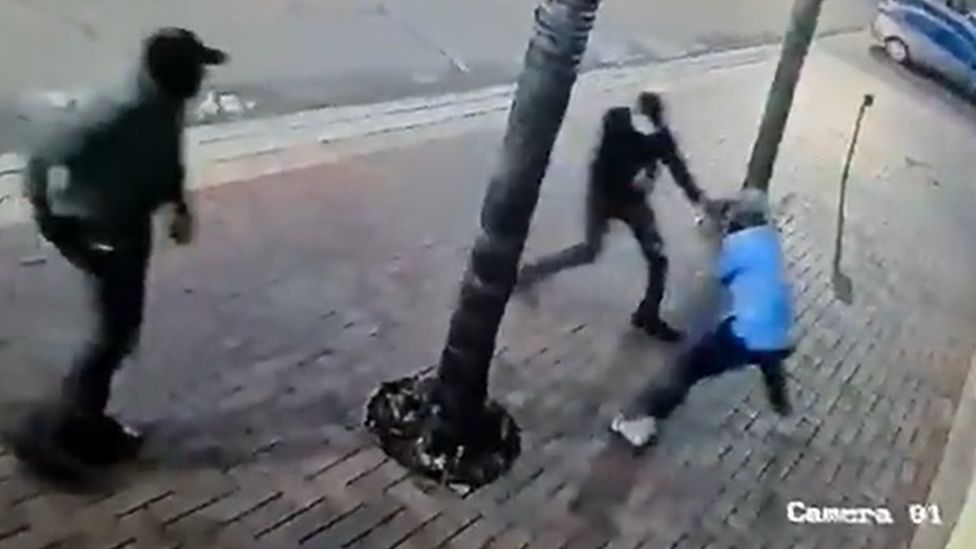
He was overpowered and forced into the vehicle at gunpoint. The businessman was later found unharmed and rescued by the police.
Ms Tau, who runs her own cleaning company in Pretoria, also tried to flee once she had figured out that she was about to be abducted.
She said she tried opening the door of her car, but another man, dressed as a parking attendant in a hi-vis jacket, blocked the door.
The man in the back seat showed that he had a gun and ordered Ms Tau to drive out of the shopping complex.
Along the way, she was told to stop and someone else jumped into her car.
Four-hour ordeal
Once in the countryside, about 15km (nine miles) into the terrifying journey, the kidnappers ordered Ms Tau to stop.
A red car then arrived at the scene and someone got out, took her bank cards and forced her to reveal her security codes.
“The other people from the car… started going through all my different cards. They were withdrawing [money].”
At the same time, her captors were repeatedly hitting her on the head with the gun, ordering her to increase her withdrawal limit.
The ordeal went on for over four hours.
At one point she heard someone on the other end of a phone call say: “Just finish her off. We are done.”
“I made peace that they were going to kill me, but I thought, I need to fight. I have to fight. If they are going to kill me, I might as well fight,” Ms Tau said.
She fought her way out of the car, but the kidnappers grabbed her and started hitting and scratching her. She got away and ran across the road into the oncoming traffic.
This story and that of Mr Bhiku are not isolated.
In February, Police Minister Bheki Cele revealed that 2,605 kidnapping cases had been reported to the authorities in the last three months of 2021.
In the decade from 2010, kidnapping more than doubled in South Africa and there are now 10 kidnappings per 100,000 people, according to the South African think-tank the Institute for Security Studies. This is one of the highest rates in the world.
In 2018, Mr Cele promised to make dealing with kidnapping a priority.
Victims have been kept against their will either for a ransom, to have their bank accounts cleaned out or be sexually assaulted.
Some did not make it out alive, though it is not clear how frequent this outcome is.
In an attempt to deal with these kind of crimes, the police launched a kidnapping task team, combining intelligence gathering with tactical response.
Crime syndicates target South Africa
One thing that has been established is that kidnappers tend to work in teams and the abductions follow a pattern with each gang member having a set role, police spokesperson Col Athlenda Mathe told the BBC.
“The spotters are those that would follow the target. The pickers are those who move in to kidnap the victim.”
The kidnappers often drive high-performance vehicles and are usually heavily armed.
“Then we have the guards that would take over and keep the victim… until a ransom is paid.”
But in the background, there is a mastermind who does thorough research and pulls the strings.
“The kingpin would be someone who lives a high-end life and wouldn’t do the dirty job,” Col Mathe says.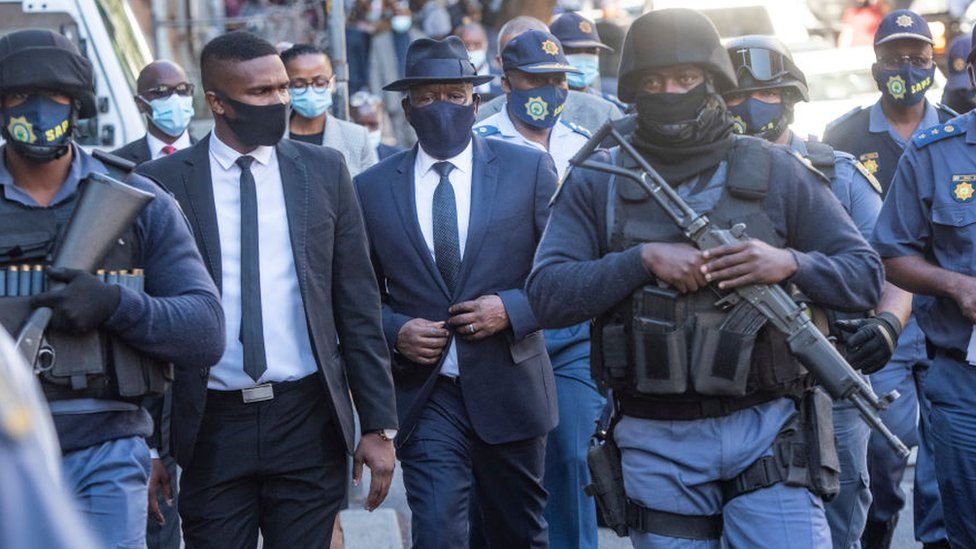
These criminal syndicates have tentacles in countries like neighbouring Mozambique and as far afield as Pakistan.
They tend to mostly target wealthy business people with the means to pay a ransom, but some victims have been from low-income areas and children are not spared.
Private hostage negotiator Gérard Labuschagne says there has been an increase in very high-value cases. Ransoms can be set at up to $3m (£2.3m)
“Organised groups operating in Mozambique and other parts of Africa have now decided, for whatever reason, that South Africa is ripe for this type of crime and they’ve been committing it very successfully,” Mr Labuschagne says.
Some social commentators believe general lawlessness has made South Africa attractive to organised criminals from around the world.
In the face of public anger, the police acknowledge that more work needs to be done but Col Mathe says they have made progress.
“Since the identification of these syndicates, we have arrested 115 suspects, consisting of Pakistanis, Mozambicans as well as South Africans.”
One of the suspects is 43-year-old Faizel Charloos, who was taken into custody in March.
He is believed to be the mastermind behind a spate of recent kidnappings.
During police raids in several Johannesburg properties linked to him, drugs, cash and a high-powered vehicle were recovered.
Mr Charloos recently appeared in court, along with several others, on kidnapping charges. He has made no comment.
It emerged that he has dual citizenship in South Africa and Mozambique.
‘Police don’t rescue victims’
In a separate case in April, police successfully rescued a four-year-old girl who was snatched at a school in Johannesburg, by a woman pretending to be her childminder.
Her kidnappers had earlier demanded thousands of dollars for her safe return.
But four people were arrested when they arrived outside a shopping centre to collect the ransom.
Despite such breakthroughs, Mr Labuschagne is not convinced the police are winning.
“We have had one or two arrests. But in the overwhelming majority of these cases, the police don’t rescue the kidnapped victims from where they’ve been kept. They are released after a payment.”
Ms Tau was lucky that she managed to get away, but her kidnappers took $1,400 (£1,100).
The ordeal has damaged her psychologically and left her family distressed.
“My father is not a man who cries, but he got teary. He kept on feeling like he could have protected me.
“There’s still a part of me that actually died on that day.”
Source: bbc

On Sunday, August 13, 2026, the Church of Pentecost (COP) International, Finland, held an impressive church service in Helsinki in honour of and to welcome Prophet Benjamin Arthur as the new National Head.
The well-attended service formally ushered in Prophet Arthur who takes over from Apostle Francis Owusu Kwaah, who has been the National Head since November 2020 and whose tenure as the National Head ended last month.
Prophet Arthur arrived in Finland from the UK where he has held many positions in the church to replace Apostle Owusu Kwaah who moves back to the UK.
A touching welcome and powerful ministration
The church service was officiated by Apostle Seth Samuel Asante, the National Head of the Church of Pentecost, USA.
It was a touching welcome church service and ministration at a well-attended event. In attendance were many religious leaders from other churches or missions, as well as dignitaries.
Apostle Asante had the honour to introduce Prophet Arthur to the whole congregation as the new National Head in Finland. He was joined by other church leaders and officers from UK, USA, and Finland to pray for Prophet Arthur and handed him over to COP Finland as their new National Head to a huge applause.
Earlier, Apostle Asante delivered a powerful and touching sermon that highlighted a message of salvation and the importance of knowing, loving and serving God with one’s whole heart. He entreated the audience to love God and do His work to glorify his name.
Stirring up understandings from the hymns: “My faith has found a resting place…” and “Guide me O Thou great Jehovah…,” as well as a number of quotations from the Bible, the Apostle gave a powerful preaching on the need to build one’s faith in God.
Response from the new National Head
In response, Prophet Benjamin Arthur preached the power of prophecies and God’s plan for redemption. He entreated all to believe in God’s power especially through prophecies to save mankind. The glory of the Lord shall be revealed, he noted and add: “The blood of Jesus is not shed in vain”.
Surrounded by his beloved wife, Mrs Eugenia Arthur, and their three children, Prophet Arthur expressed gratitude to the members of the church for the resounding welcome they have accorded him as he starts to embark on his role and duty as the National Head.
He recognised the exploits and excellent leadership roles of his predecessors, Apostle Edmund Appiah (who was the first National Head) and Apostle Francis Owusu Kwaah.
COP’s future and growth in Finland
The Church of Pentecost in Finland was established over 25 years ago. It started in September 2000 as a prayer group with a small number of devoted persons in Helsinki (see www.copfinland.fi).
The group grew fast and there was the need to secure a new place of worship in the Helsinki area. The Church has grown and spread to other towns and cities in Finland.
Today, in Helsinki alone there are two branches of the Church. There is the Akan Assembly where worship is done mostly in the Twi language. The other branch is the English Assembly (or the PIWC) which is attended by other nationalities and African immigrants aside Ghanaian immigrants.
The COP Finland has become very formidable in the religious space in the Ghanaian community in Finland.
It has thus played a prominent role in the religious or spiritual existence of its members, as well as in people’s social lives as a key aspect of integration into the Finnish society.
The church continues to grow and, for example, it has been one of the major channels through which the Ghana Union Finland (GUF), an association for Ghanaian immigrants in Finland, has made more contacts with members of the Ghanaian immigrant community.
With Dr Perpetual Crentsil
SKIP THE QUEUE, TAP THE NEWS
You can now read the Ghanaian Times and The Spectator newspapers from the comfort of your device via TimesNewsPlus.
Join our WhatsApp Channel: https://whatsapp.com/channel/0029VbBElzjInlqHhl1aTU27
Features
Responding to religious insults with faith, wisdom and restraint …The Prophetic Model for Muslim–Christian Peace and Coexistence(Part 1)
All praise belongs to Allah, Lord of the worlds. We praise Him, seek His help and forgiveness, and seek refuge in Him from the evil within ourselves and from our evil deeds.
May His Peace and Blessings be Upon the Noble Prophet Mohammed, his household, companions and all righteous people till the Last Day. Ameen
GHANA, WE MUST NOT ALLOW A MOMENT OF ANGER TO DESTROY DECADES OF PEACE
My dear brothers and sisters in Ghana.
Today I speak about something that should concern every Muslim, every Christian and every responsible Ghanaian.
Recent events involving controversial statements about Prophet Muhammad (pbuh), the arrest of an Islamic cleric accused of making statements advocating violence, and the arrest of a Christian preacher over alleged derogatory comments concerning the Prophet (pbuh) have generated considerable national concern. The Ghana Police Service has said the matters are under investigation and that due process will apply.
And now, reports of an alleged assault on a detained pastor have added another troubling dimension to the matter.
Let us be very clear:
Ghana is not at war.
Muslims are not at war with Christians.
2 | P a g e
Christians are not at war with Muslims.
For generations, we have lived together, traded together, worked together, attended the same schools, built communities together and, in many Ghanaian families, even married across religious lines.
Therefore, we must not allow the reckless words or actions of a few individuals to destroy the peace built by generations.
WHEN SOMEONE INSULTS THE PROPHET (PBUH), WHAT DOES ISLAM EXPECT
FROM ME?
This is the question we must answer.
Not: “How angry am I?”
But: “What does Allah require from me?”
Not: “What can I do to my enemy?”
But: “What did Prophet Muhammad (pbuh) do when his enemies hurt him?”
This distinction is crucial.
Islam does not teach us to abandon our faith when we are provoked.
Islam teaches us how to behave because we have faith.
Allah says:
“Do not let the hatred of a people cause you to depart from justice. Be just; that is nearer to righteousness.” (Qur’an 5:8).
Notice the greatness of Islam.
Allah does not say, “Be just when people respect you.”
He says, be just even when you hate what they have done.
Therefore: An insult does not give me permission to become unjust.
The author is the Chief Imam of Katamanso Municipal and Certified Counsellor and Governance Expert
By Imam Alhaji Saeed Abdulai