Features
From waste to wealth: A practical plan for a circular Ghana


After a heavy rain in Accra, the story Ghana repeats itself is easy to see. Drains overflow, streets turn into streams, and families are forced to wade through waist-deep, dirty water. When the floods finally recede, they leave behind more than just mud; they leave a tangled net of sachet wrappers, takeaway packs, and plastic bags that trap our neighbourhoods.
At the same time, in our homes and markets, piles of cassava peels and spoiled fruits rot in open bins, attracting pests and emitting foul odours. This is not just a nuisance; it is a national economic failure. The plastic blocking our drains and the organic matter that could restore our soils are both being treated as rubbish when they should be treated as resources.
Ghana is at a crossroads. We can continue the “take–make–waste” culture that floods our neighbourhoods, damages public health, and drains local government budgets. Or we can choose a practical, Ghana-ready circular approach: reduce plastics at the source, collect what remains efficiently, and separate organic waste so it becomes compost and bio fertiliser for farming. If Ghana harmonises plastic reduction with urban nutrient cycling, we can solve two national problems with one coordinated system cleaner cities and stronger food security.
The unseen link between plastics, floods, and food prices
Plastic pollution is often framed as an environmental issue. But in Ghana, it is also an infrastructure and public health problem. When drains are choked, flooding damages property, disrupts business, spreads disease, and increases the cost of city management. Assemblies spend scarce resources on emergency desilting and clean-up money that could have improved sanitation systems permanently. But the link does not end there. Our waste crisis is now feeding our food crisis.
Most of what Ghana throws away is not plastic. A large fraction is organic waste biodegradable material that should never be mixed with plastics in the first place. When organics and plastics are mixed in the same bins and the same trucks, everything becomes “dirty”: plastics are harder to recycle and organic matter becomes contaminated and unusable for compost. The result is a lose–lose system where nothing returns to productive use.
This matters because Ghana’s soils are tired. Farmers across the country complain about declining fertility and rising fertiliser costs. If our cities were capturing organic waste cleanly and converting it into high-quality compost or bio fertiliser, that material could return to farms as soil amendment improving yields, reducing dependence on imported inputs, and strengthening resilience. In other words, the waste we bury today is the fertility we import tomorrow.
Why the current approach keeps failing
Ghana’s waste system is still largely designed for “collection and disposal,” not “collection and recovery.” That is why, even when clean-up campaigns happen, the problem returns quickly. We are treating symptoms, not the system. Three structural failures keep recycling and composting from scaling:
1) We do not separate waste at the source: once plastics, food waste, and other refuse are mixed together, it is expensive and often unsafe to sort
2) We have weak accountability for packaging; plastic producers and major distributors profit from packaging, but the cost of cleanup is left mostly to assemblies and taxpayers. That imbalance is unsustainable.
3) We don’t link waste recovery to strong end-markets: recycling and composting only survive when there is steady demand: manufacturers buying recycled plastics and farmers or institutions buying compost. Without guaranteed markets, recovery systems collapse.
The good news is that these failures are not destiny. They are policy choices and can be corrected. To make this real, Ghana must adopt a practical two-stream approach:
- Stream 1: Dry recyclables (plastics, metals, cartons)
- Stream 2: Organic waste (food and green waste for composting)
This separation is the bridge that connects plastic reduction to nutrient cycling. When organics are kept separate, compost becomes cleaner and safer. When dry recyclables are not soaked in rot and liquids, recycling capture becomes easier and more profitable.
A Five-Point Policy Package
1. Make Extended Producer Responsibility (EPR) real
Producers and major importers of plastic packaging must help fund its collection and recovery. This is not punishment; it is responsibility. EPR should require: registration of major packaging producers/importers, clear recovery targets, audited reporting, and a ring-fenced fund that supports collection, sorting, and recycling infrastructure. When producers share the cost, assemblies are less overwhelmed and recovery systems become financially viable.
2. Launch citywide source separation starting with pilots that actually scale.
Assemblies should begin with high-impact zones: markets, institutions, and dense neighbourhoods. Keep it simple: two bins (dry recyclables and organics), predictable collection days, community education in local languages, enforcement that is fair and gradual (warnings first, then penalties). The aim is not to punish households; it is to create a new normal that makes sorting easy and consistent.
3. Build composting and bio fertiliser capacity and guarantee offtake to agriculture.
Separation only matters if there is a destination. Ghana should invest in: municipal composting hubs, private compost enterprises, and quality standards to protect farmers from contaminated products. Most importantly, link compost to demand. Government agriculture programmes, district assemblies, and farmer cooperatives can create an offtake market so compost plants do not die from lack of buyers. This is where waste policy and food policy meet.
4. Integrate the informal sector properly because they are already doing the work.
Waste pickers and informal collectors are not a problem; they are part of the solution. Any serious circular strategy must include: contracts or cooperative arrangements, PPE and basic health protections, fair pricing systems at sorting centres, and training on safe handling. If we ignore the informal sector, we lose capacity. If we formalise them without respect, we create conflict. Integration must be practical and dignified.
5. Use public procurement and incentives to grow circular markets.
Circular systems need buyers. Government can help by: prioritising products made with recycled content where feasible, supporting local manufacturing of recycled plastic items (pipes, bins, furniture), providing tax incentives or concessional financing for recycling/composting businesses, and rewarding compliance and innovation instead of only punishing failure.
Final Statement
Ghana’s waste crisis is not only about litter; it is about lost opportunity. Plastic can be recovered. Organic waste can be composted. Jobs can be created across collection, sorting, processing, logistics, and retail. Assemblies can spend less on emergency clean-up and more on permanent sanitation. Farmers can access local soil amendments and reduce vulnerability to imported input shocks. But none of this happens by accident. It requires alignment: environmental regulation, local government action, private sector investment, and agricultural offtake all moving in the same direction. We do not need more sympathy speeches after floods. We need systems that prevent the next flood, reduce the next disease outbreak, and rebuild the next harvest. A circular Ghana is not a dream. It is a decision.
By Lawrencia Yeboah-Duah

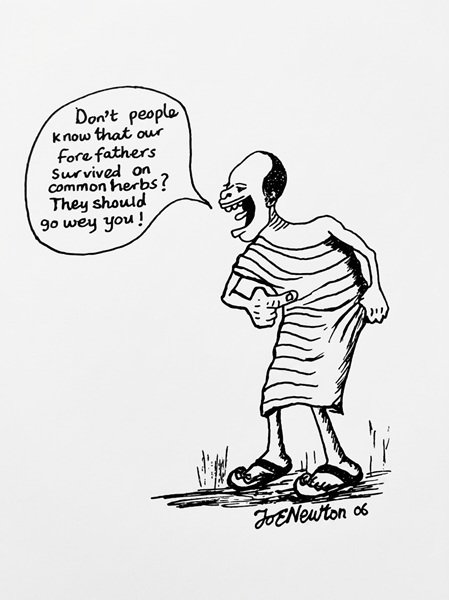
THE typical itinerant salesman in Sikaman is a herbalist. He is normally a slim macho with the capacity to perambulate the expanse of area covering the triangle of Accra-Tema-Ashiaman. In short, he can walk a total of 60 miles a day, marketing a product that cures every disease, including poverty. 
The door-to-door herbal pharmacist advertises his product by word of mouth. He has nothing to do with the Food and Drugs Board (FDB). After all, his concoctions do not feature on FM stations.
Those herbalists who cannot walk to propagate the herbal gospel, liaise with drivers of mass transportation and their mates. They are, therefore, given the chance to sell their products on Benz buses that ply the routes.
Normally, the herbalist starts his sales message with a prayer and Bible study. He asks the passengers to bow down their heads in supplication to God the father, the son, the Holy Spirit.
When a herbalist asks the passengers to close their eyes and bow their heads, Moslems on board naturally feel offended. They feel that the herbalist has no right to assume that every passenger is a Christian. They think such an assumption is an affront to Islam.
So a Moslem on board will raise the hand for a point of order. He’ll remind the herbalist that it would be in his own interest to mind his language.
“Be careful the way you address people in a public place. Not every person here is a Christian,” he’d state assertively.
Of course, the herbalist will promptly ignore him, but would all the same “watch” his tongue. Who knows whether or not the Moslem brother is inspired by Quoranic zeal to defend the tenets of Islam to the hilt?
When he starts saying, “Wallahi!” and “Inshallah!” it could be the beginning of proclaiming Islam as supreme, a point which must be driven home with talibanic precision.
So the herbalist must tread carefully lest he steps on fire.
The herbalist could even add a measure of mirth to it all, by announcing that Christians on board today have very interesting company on the journey, but that should not detract from the business of the day.
The Moslem brother will weigh the words carefully and offer a wry smile.
He must be careful the occasion does not degenerate into the use of semantics and proverbial oration to deride his conviction that public utterances must be mindful of religious sensibilities. He has made his point very clear and expects that it is taken in good faith in the interest of a peaceful journey.
The herbalist will now open the New Testament and preach salvation, stating clearly that salvation can come only through Jesus Christ and NOBODY else.
The Moslem brother will now start twitching his moustache. The visible and almost revolutionary reflexes of his upper lip can be an indication that sentiments have begun superseding reason, and the outcome could well be tragic now shift uneasily in his seat.
The time has come for him to also express his right to the religion of his fore-bears. He’ll put his hand into his pocket and rise to his feet. The time has indeed come!
This article was first published on Saturday, September 9, 2006
When the cause of a particular problem like sickness, disease, sudden illness, a social issue etc. are not known, it stands to reason that resolving it becomes a huge challenge.
Citizens would understand the government when public announcements are made to the effect that government is trying to find a solution to the issue, even though it is taking a while for it to be resolved because citizens are rational beings.
On the other hand, if the solution to a particular issue is known to everybody but the government for whatever reason, is dragging its feet in resolving it, citizens become frustrated and begin to lose trust in their leaders.
One such issue is the heavy traffic along a section of the Kasoa – Odokor road. A short stretch of bad road between the traffic light at the Weija Government Hospital and the entrance to the entrance of the overhead that leads to the N1, is the cause of the problem but nothing is being done about it, day after day, week after week, month after month. Thus is clearly unacceptable.
Another issue that requires urgent attention is the lack of pavements along a lot of streets in parts of the various Municipal Assemblies. Exercise is a prerequisite for long life and healthy living and for those of us who it has become a way of life, this issue of people putting up structures right to the edge of the drains beside the roads, are making life difficult for us.
We are compelled to walk along the roads, putting our lives at serious risk. Pedestrians should never be compelled to compete with vehicles on our streets and roads. Roads and streets are made for vehicles and pavements are made for pedestrians. That is the norm. Any attempt to normalise a situation where pedestrians are mingling with vehicles is insanity.
It is the road regulations that makes it so and therefore district or municipal assemblies are to take responsibility and ensure that spaces for pavements are not encroached upon. Citizens have rights that must be protected by their leaders and making pavements available to pedestrians, is one of them.
When we hear of teachers having sex with students, it appears it is something recent. It is not a new phenomenon. It has been there since Adam. Perhaps this issue is getting much attention due to the proliferation of social media. It was an open secret in times past when Teachers were in relationships with female students and some married them immediately after completion of school.
Some teachers were also known to be having unholy interactions with female pupils but due to the times that these acts occurred, human rights issues and the awareness around it, allowed such unscrupulous teachers to get away with their crimes.
Now we are in a different era and so a Headmaster is now in hot waters. He is alleged to have raped about 19 female students and as usual, some officials tried to cover it up and are also in hot waters and their actions or inactions in the matter are under investigation.
Why the man has been allowed to roam freely without being arrested is simply mind boggling. It appears that the law applies differently, depending on who you are. This issue came to public attention sometime in August this year, yet the police had not arrested or invited this man for question regarding the rape allegation.
It has come out that he is a Constituency Secretary of the ruling party and the question in the public domain is that, is it because he is a political figure that is why he is still walking around without questioning? I believe in the rule of law so let us hold our breadth and let the proper thing be done.
The police must however be seen to be active in this matter. God bless.
SKIP THE QUEUE, TAP THE NEWS
You can now read the Ghanaian Times and The Spectator newspapers from the comfort of your device via TimesNewsPlus.
Join our WhatsApp Channel: https://whatsapp.com/channel/0029VbBElzjInlqHhl1aTU27