Features
Promoting our local dishes: The cultural cost of the ‘Continental’ diet


The landscape of the Ghanaian palate is shifting, and not necessarily for the better. In our bustling urban centres, from the streets of Accra to the suburbs of Kumasi, a quiet culinary revolution is taking place; one where the mortar and pestle are being replaced by the pizza oven and the deep fryer. This transition from traditional staple foods like fufu, banku, akple, kenkey, tuo zaafi, and ampesi toward “continental” dishes is more than just a change in appetite; it is a reflection of a deeper social struggle with identity and prestige.
The illusion of modernity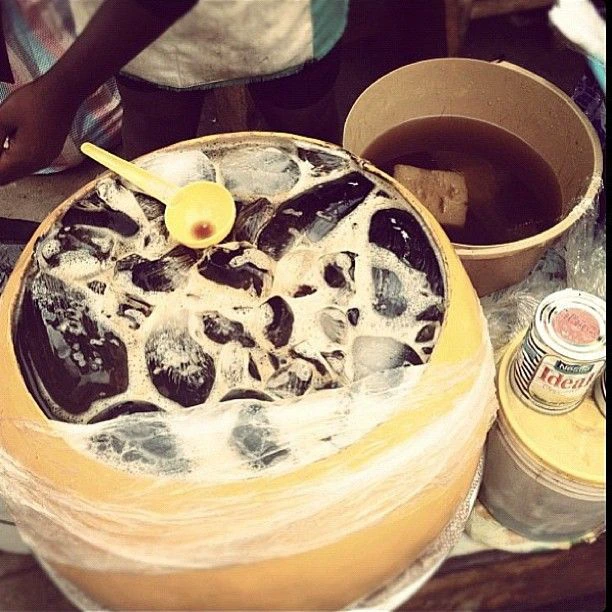
For many, “stepping out” for a meal has become synonymous with consuming foreign cuisine. There is an unspoken social hierarchy where a bowl of Abunuabunu is relegated to the village category, while burgers, pizzas are branded as prestigious choices. We have reached a stage where we equate foreign with modern and local with primitive.
This perception is a dangerous illusion. Our traditional dishes are marvels of culinary engineering complex, nutrient-dense, and deeply rooted in our history. When we choose a processed foreign import over a meal made from local tubers or fermented maize, we are not just changing our lunch; we are eroding the indigenous knowledge attached to our local ingredients and foods.
We need to turn the consumption of indigenous grains and tubers like millet, sorghum, and plantain into a statement of self-worth and national pride.
The cultural and health erosion
Every time a local dish disappears from a restaurant menu to make room for foreign fast food, we lose a piece of our cultural fabric. Traditional Ghanaian cooking is an art that requires patience and skill. By choosing the convenience of foreign fast food, we are raising a generation that may know the taste of a pepperoni pizza but cannot identify the rich, earthy profile of Prekese or the subtle tang of well-fermented dough dishes like corn porridge, banku, etew, abolo, agidi or kamfa, and kenkey.
Furthermore, we are at the crossroads of a nutrition transition. Replacing high-fiber, indigenous crops with calorie-dense but nutrient-poor foreign fast foods is driving a rise in lifestyle diseases such as obesity, hypertension, diabetes, stroke, cancer, and liver disease. We are trading our longevity for 15-minutes convenience or unhealthy diet.
A call for culinary patriotism
It is time for us to appreciate, preserve, and promote our indigenous foods and culinary traditions. We need to be proud of our local dishes, ingredients and cooking methods, rather than relying heavily on foreign or imported foods. We must stop viewing our local delicacies as low-class and start treating our culinary heritage as the high-end gastronomy it truly is.
True sophistication does not come from imitating Western fast food; it comes from innovation and adding values to our own resources. We see glimpses of this potential in the rise of branded Sobolo and the creative use of gluten-free plantain flour in modern baking of flour-based dishes such as bread, cakes, biscuits and others. This is the path forward. We must elevate our local dishes, making them as accessible, affordable, presentable and trendy as any foreign alternative.
To the hospitality industry: Innovate or stagnate
Our hotels and high-end restaurants must lead the charge. They must stop relegating local dishes to the “traditional corner” of the buffet, and apply the same culinary finesse given to imported dishes to our Fante Fante, apapransa, aborbi tadi, fetritoto, akple, abolo, yakayeke, fufu, ampesi, kokonte, wasawasa, tubani, apapransa, mpotompoto, kelewele, aliha, brukutu, pito, and other local dishes. The industry must enhance customer experiences making eating local dishes the ultimate luxury experience for both tourists and residents alike. We must elevate the presentation of our foods by using modern plating techniques to show that a bowl of light soup can be as visually stunning as a French consommé. We need to reclaim our Ghanaian plate before it is too late.
To the policy makers: Let us encourage buying of local ingredients to promote the local food industry and economy. There should be educational programmes and talks about the nutritional and cultural benefits of local foods so that people understand their value.
We need to encourage serving traditional dishes at school programmes, parties, and celebrations instead of only fast foods,
To the Youth: Let us value and appreciate our traditional dishes instead of always choosing foreign foods. There must be balance in our choice of local and foreign dishes. Confidence in our culture encourages others to respect it too. Our local dishes can also be promoted by sharing pictures, recipes, and videos on platforms such as Instagram, TikTok, and WhatsApp to make them attractive and trendy.
Young citizens must learn from their parents and elders how to prepare local meals to keep the knowledge and cultural relevance alive. Local dishes can be modernised to appeal to younger generations and tourists.
Conclusion
We cannot afford to trade our heritage for foreign cuisines which are gaining grounds across the country at an alarming rate. We must disabuse our minds of the perception that anything foreign or imported is better than those locally made. Our health, economy, and identity are tied to the soil. It is time to stop apologising for our local flavours and start celebrating them. It is possible to embrace modernity without losing ourselves and our cultural identity. Let us make the Ghanaian kitchen the heart of our modern identity once again.
By: Marilyn Gadogbe

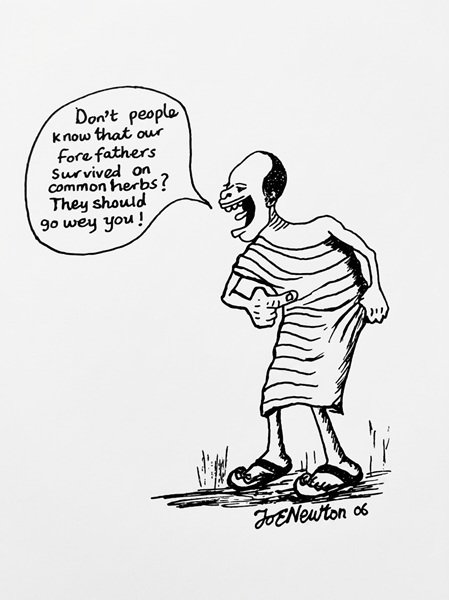
THE typical itinerant salesman in Sikaman is a herbalist. He is normally a slim macho with the capacity to perambulate the expanse of area covering the triangle of Accra-Tema-Ashiaman. In short, he can walk a total of 60 miles a day, marketing a product that cures every disease, including poverty. 
The door-to-door herbal pharmacist advertises his product by word of mouth. He has nothing to do with the Food and Drugs Board (FDB). After all, his concoctions do not feature on FM stations.
Those herbalists who cannot walk to propagate the herbal gospel, liaise with drivers of mass transportation and their mates. They are, therefore, given the chance to sell their products on Benz buses that ply the routes.
Normally, the herbalist starts his sales message with a prayer and Bible study. He asks the passengers to bow down their heads in supplication to God the father, the son, the Holy Spirit.
When a herbalist asks the passengers to close their eyes and bow their heads, Moslems on board naturally feel offended. They feel that the herbalist has no right to assume that every passenger is a Christian. They think such an assumption is an affront to Islam.
So a Moslem on board will raise the hand for a point of order. He’ll remind the herbalist that it would be in his own interest to mind his language.
“Be careful the way you address people in a public place. Not every person here is a Christian,” he’d state assertively.
Of course, the herbalist will promptly ignore him, but would all the same “watch” his tongue. Who knows whether or not the Moslem brother is inspired by Quoranic zeal to defend the tenets of Islam to the hilt?
When he starts saying, “Wallahi!” and “Inshallah!” it could be the beginning of proclaiming Islam as supreme, a point which must be driven home with talibanic precision.
So the herbalist must tread carefully lest he steps on fire.
The herbalist could even add a measure of mirth to it all, by announcing that Christians on board today have very interesting company on the journey, but that should not detract from the business of the day.
The Moslem brother will weigh the words carefully and offer a wry smile.
He must be careful the occasion does not degenerate into the use of semantics and proverbial oration to deride his conviction that public utterances must be mindful of religious sensibilities. He has made his point very clear and expects that it is taken in good faith in the interest of a peaceful journey.
The herbalist will now open the New Testament and preach salvation, stating clearly that salvation can come only through Jesus Christ and NOBODY else.
The Moslem brother will now start twitching his moustache. The visible and almost revolutionary reflexes of his upper lip can be an indication that sentiments have begun superseding reason, and the outcome could well be tragic now shift uneasily in his seat.
The time has come for him to also express his right to the religion of his fore-bears. He’ll put his hand into his pocket and rise to his feet. The time has indeed come!
This article was first published on Saturday, September 9, 2006
When the cause of a particular problem like sickness, disease, sudden illness, a social issue etc. are not known, it stands to reason that resolving it becomes a huge challenge.
Citizens would understand the government when public announcements are made to the effect that government is trying to find a solution to the issue, even though it is taking a while for it to be resolved because citizens are rational beings.
On the other hand, if the solution to a particular issue is known to everybody but the government for whatever reason, is dragging its feet in resolving it, citizens become frustrated and begin to lose trust in their leaders.
One such issue is the heavy traffic along a section of the Kasoa – Odokor road. A short stretch of bad road between the traffic light at the Weija Government Hospital and the entrance to the entrance of the overhead that leads to the N1, is the cause of the problem but nothing is being done about it, day after day, week after week, month after month. Thus is clearly unacceptable.
Another issue that requires urgent attention is the lack of pavements along a lot of streets in parts of the various Municipal Assemblies. Exercise is a prerequisite for long life and healthy living and for those of us who it has become a way of life, this issue of people putting up structures right to the edge of the drains beside the roads, are making life difficult for us.
We are compelled to walk along the roads, putting our lives at serious risk. Pedestrians should never be compelled to compete with vehicles on our streets and roads. Roads and streets are made for vehicles and pavements are made for pedestrians. That is the norm. Any attempt to normalise a situation where pedestrians are mingling with vehicles is insanity.
It is the road regulations that makes it so and therefore district or municipal assemblies are to take responsibility and ensure that spaces for pavements are not encroached upon. Citizens have rights that must be protected by their leaders and making pavements available to pedestrians, is one of them.
When we hear of teachers having sex with students, it appears it is something recent. It is not a new phenomenon. It has been there since Adam. Perhaps this issue is getting much attention due to the proliferation of social media. It was an open secret in times past when Teachers were in relationships with female students and some married them immediately after completion of school.
Some teachers were also known to be having unholy interactions with female pupils but due to the times that these acts occurred, human rights issues and the awareness around it, allowed such unscrupulous teachers to get away with their crimes.
Now we are in a different era and so a Headmaster is now in hot waters. He is alleged to have raped about 19 female students and as usual, some officials tried to cover it up and are also in hot waters and their actions or inactions in the matter are under investigation.
Why the man has been allowed to roam freely without being arrested is simply mind boggling. It appears that the law applies differently, depending on who you are. This issue came to public attention sometime in August this year, yet the police had not arrested or invited this man for question regarding the rape allegation.
It has come out that he is a Constituency Secretary of the ruling party and the question in the public domain is that, is it because he is a political figure that is why he is still walking around without questioning? I believe in the rule of law so let us hold our breadth and let the proper thing be done.
The police must however be seen to be active in this matter. God bless.
SKIP THE QUEUE, TAP THE NEWS
You can now read the Ghanaian Times and The Spectator newspapers from the comfort of your device via TimesNewsPlus.
Join our WhatsApp Channel: https://whatsapp.com/channel/0029VbBElzjInlqHhl1aTU27