Hot!
Hughton needs our full backing to succeed


• Hughton (centre) and some of his Black Stars players
On Monday – March 20, 2023, Chief Coach of the Black Stars – Chris Hughton, was officially unveiled to Ghanaians at the SC Mall in Kumasi in the Ashanti Region.
The outdooring took place three days ahead of the coach’s first official assignment at the Baba Yara Sports Stadium in Kumasi where he led the Stars to pip Angola 1-0 on a nervy Nations Cup qualifying afternoon.
Many commentaries have been made about the near-dawdling performance in that home game, the first by the Ghana team since their ill-fated World Cup in Qatar 2022.
But whilst many had their eye on the game, others too were concerned about the absence of the Ghana Football Association (GFA) boss and his deputy during the unveiling of the 64-year-old coach.
“We are utterly surprised not to see the GFA president Kurt Okraku and his vice Mark Addo at the introduction of the coach, and that sends a lot of signals,” was the voice of one of the many fans who called on a radio sports programme.
Even though the GFA Communications Director Henry Asante Tsum was fully represented, the fans think “it was dolefully not enough.”
The impression that is being bandied around is that the FA failed to be around to ‘grace’ the occasion because Hughton was not their choice but that of the government.
It might not exactly be the truth, but the multi-million-dollar question on the lips of Ghanaians is that when was the last time the GFA top brass – right from the halcyon days of Kwesi Nyantakyi, failed to attend the unveiling of a new Black Stars coach?
Some assert that the FA would have loved to have a coach other than Hughton for the Stars’ job – reason for which it opened applications for that purpose. However, following successful negotiations with the Ministry of Youth and Sports and the FA – the man who has been in charge of the team since the exit of Otto Addo – was fully endorsed.
Whatever the case, what is needed now is giving Hughton the all-embracing support and backing to succeed. The FA, clearly, must not lose sight of the fact that when Hughton succeeds, the FA succeeds too; when he fails, they fails as well.
Having served as Technical Advisor of the Black Stars through to the Qatar World Cup, the Ghanaian-Irish should have an appreciable amount of knowledge about the players and what could be done to improve on their performance and ultimately revive the dwindling fortunes of Ghana football at the international level.
The performance of the team in their reverse fixture in Luanda against Angola strappingly suggested a brighter future awaits the nation’s football with Hughton in charge.
Unlike what we were getting accustomed to by his predecessors, the coach did not tarry at all and made quick changes when the team was down to a Lucas Joao 50th minute strike.
Nippily – and in order to get the right response, Hughton introduced Joseph Paintsil, Osman Bukari and Inaki Williams for Semenyo and Sulemana, and Mohammed Kudus.
The substitution was scrumptiously deadly as it did not take long for them to make an impact, as Paintsil set up Bukari to rap home a dazzling redeemer.
Painstil, who was strangely overlooked for the Qatar World Cup, nearly snatched a late winner after latching onto a pass from Salis Samed, but his shot was blocked to the relief of the home crowd.
Upshot of the entertaining game left Ghana at the top of Group E – and just a point ahead of second-placed Central African Republic (CAR) who beat Madagascar 2-0.
As things stand now, the Stars need just a win in their next assignment at the Baba Yara Sports Stadium in Kumasi – somewhere in June, to book a place in the Cote d’Ivoire African Cup of Nations tournament.
Slowly but surely, Coach Hughton appears to be on course to building a formidable squad – capable of taking on the rest of the world – and he must be accorded all the needed backing to executing this mission.
By John Vigah

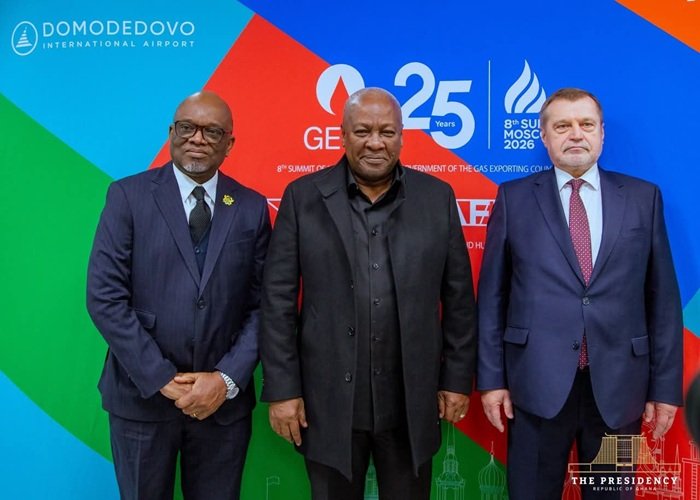
President John Mahama has arrived in Moscow, Russia, from Ethiopia to participate in the 3rd Russia-Africa Summit.
The summit is being hosted by Russian President Vladimir Putin.
During the visit, President Mahama will join fellow African leaders at the Economic and Humanitarian Forum and summit plenary sessions.
He is also scheduled to hold high-level bilateral talks with President Putin and attend a Kente exhibition organised by the Russia-Ghana Parliamentary Forum.
As part of the visit, the President will receive honorary doctorate degrees from the Russian University of Transport and the Peoples’ Friendship University of Russia.
He will also engage Russian businesses and state institutions to advance bilateral cooperation between Ghana and Russia.
By Edem Mensah-Tsotorme
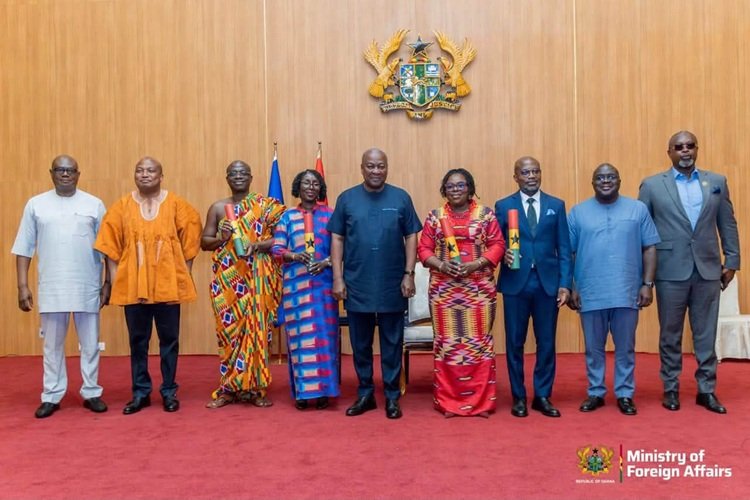
President John Dramani Mahama has commissioned four career diplomats as ambassador-designates to represent Ghana in four countries.
The commissioning ceremony took place on Friday, October 16, 2026.
The new envoys are Her Excellency Nana Antwiwaa Dodoo, Ambassador-Designate to Angola; His Excellency Louis Kwame Obeng, Ambassador-Designate to Qatar; Her Excellency Evelyn Korantemaa Ofosu-Amable, Ambassador-Designate to Israel; and His Excellency Jedidiah Reuben Adogla, Permanent Representative-Designate to Switzerland.
President Mahama charged them to advance Ghana’s national interests through strategic partnerships, economic diplomacy, investment mobilization, and expanded access to international markets.
He said Ghana’s diplomatic engagements must deliver tangible economic benefits, create jobs, and strengthen the country’s standing on the international stage.
The four envoys are career diplomats with over 27 years of experience.
On behalf of her colleagues, Her Excellency Nana Antwiwaa Dodoo thanked the President for the confidence reposed in them and pledged their commitment to emulate his leadership and deliver on the mandate given to them.
By Edem Mensah-Tsotorme