Features
Ghanaian/African migrants in Finland, mental health

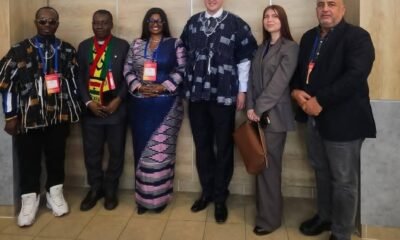
Today, I focus on Ghanaian/African migrants in Finland and their mental health. Mental health is an important subject and a huge problem in the world.
According to the World Health Organisation (WHO), brain health is the state of brain functioning across cognitive, sensory, social-emotional, behavioural and motor domains, allowing a person to realise their full potential over the life course, irrespective of the presence or absence of disorders.
Studies have shown that maternal and paternal distress are associated with reduced linear growth of their children. I recently participated in a seminar on mental health among (African) migrants in Finland. We all wondered about the prevalence or incidence of mental illness among migrants in Finland. It will be interesting to know the statistics about mental illness among migrants in Finland.
Mental health in Finland
In Finland, studies have examined how behavioural risk factors mediate the effects of childhood disadvantage on adult psychological distress. A correlation is shown between parent and infant psychotherapy on maternal mental health and psychological functioning and children’s welfare.
There are also research and other reports of social child welfare interventions where at times children are even taken away (child removals) from the parent or parents for safe keeping.
Experts say it is important how parents plan their leaves in order to renew or rebuild their mental strength to be able to take good care of their kids.
Anyway, studies are limited about parent-child psychological distress and situations where children are taken away from their parents among minorities, such as African migrants. It will be interesting to know the figures and other aspects of mental health issues among the migrant group(s) in Finland.
Health and migrant vulnerability
Health experts point out that migrant communities can be highly vulnerable to diseases, especially certain infectious diseases. Experts say those who came to Finland as refugees or asylum seekers and their family members are often in a more vulnerable position in terms of their health (see www.thl.fi).
Research and media reports have shown in many countries that there are structural or societal/cultural factors that result in quite high rates of infection or ill-health among migrants, when compared to the majority population.
It is suggested that for example language barrier, lack of information, the nature of the work of migrants in professions where working from home is not possible (for example during the Covid-19 pandemic), not accessing healthcare, etc. can present some of the factors for migrants’ vulnerability to diseases and infections.
Childhood disadvantage
Information about the issue. Such a situation was much evidenced to reduce stress and anxiety during the coronavirus situation.
Thus, these associations and institutions become networks that create an important social capital as well as outlets for sharing and gaining information or knowledge.
Finland is committed to the integration of migrants into the Finnish society, as I keep pointing out. A number of research studies from surveys and other in-depth enquiries have shown a trend of increasing efforts to integrate African and other migrants into the Finnish society.
As the Finnish Institute for Health and Welfare (THL) has pointed out, health and wellbeing are an important part of integration of immigrants in Finland (see www.thl.fi).
There have been studies on whether behavioural risk factors mediate the effects of childhood disadvantage on adult psychological distress and child welfare intervention by social services. Unhealthy behaviours and their associations with subsequent sickness among Finnish young and early midlife employees have been studied.
When it comes to this subject and/or the effect of adult psychological distress on children’s wellbeing among African migrants in Finland, there is limited knowledge.
We should hope for more information to augment understandings about adult psychological distress and effect on children’s wellbeing among African migrants in order to inform policy directions.
Such studies will help to create awareness among migrants in Finland about their mental health, its effect on them and their children’s wellbeing, as well as where to seek therapy.
Migrant associations, social networks, and information
Migrants associations are already doing much to help in education on mental health and have become important points for securing. Public agencies, migrant associations and other non-governmental organisations (NGOs) in Finland have been publishing information to help educate people about their health and wellbeing.
Generally, migrant associations formally create awareness among their members and other migrants usually in collaboration with some Finnish institutions, and are thus an important tool for several migrants to be positively active and to get their interests and claims heard.
As I wrote previously, the role of migrant associations acting as bridge-builders for the integration and inclusion of migrants through participation in the decision making process and by acting as a representative voice is highly appreciated in Finland. Thank you!
By Perpetual Crentsil
Join our WhatsApp Channel now!
https://whatsapp.com/channel/0029VbBElzjInlqHhl1aTU27


THE state of feeling rejected, could be a terrifying experience especially for those who have become used to fame. If not properly addressed, it could lead to depression and the consequences, could be disastrous.
When you are on top of your game in whatever profession you find yourself such that you become famous, a lot of people try to associate with you. The phone never ceases to ring and one is tempted to feel loved and very important.
When a disaster strikes and the fame or the money which was the source of the attraction fades away, the circle of friends and fans begin to shrink and the phone will start to stop ringing until the call stops voting completely.
You will be shocked at how people you considered friends, will no longer be calling you or pay casual visits as they used to. You will begin to notice that messages you leave after calling them and not getting a response are not replied to and that is when you begin to know who your true friends are.
One of the most popular movie stars was an actress called Sharon Stone. In an interview with one of the media houses that was published, she spoke about how people who should have come around to encourage her in her moment of depression, shunned her. The calls stopped coming.
This is what the Bible admonishes that the arm of flesh will fail you and therefore we should put our trust in God. It could be a very frightening experience and can easily lead to depression.
Human nature being what it is, people will want to get close if things are okay. Everybody wants to associate themselves with interesting things, famous people, rich people etc for mainly selfish reasons.
We need to develop the habit of putting our trust in God and relying less on human beings. The lesson we have to take along in life is that, no one marries his or her enemy so how come people who took vows that they will love each other become so hostile to each other that they want to go their separate ways in life? Such is the reality of life.
It is therefore prudent for people to recognise that, life is full of uncertainties and so there is the need to prepare your mind for uncertainties so that when they occur, they do not disorganise your mental sanity.
A lot of people have experienced situations where people who they could have sworn will never betray their trust have disappointed them when they were through challenging moments.
If there is one thing famous people should desire, it should be the ability to identify who are true friends are. Countless stories abound regarding incidence of celebrities who have lost their shine and their wives divorcing them soon after.
It is sometimes useful as a famous or rich person to sign a prenuptial agreement before marriage to safeguard or protect yourself from any future unpleasant surprises.
People can be very pretentious these days, it goes both ways. There is this real life story where a man married a divorced wealthy woman and convinced her to sell her house so they could build a new one together, with the excuse that people are gossiping that he is being housed by a woman.
The woman agreed and they put up a new building. After a few years the man asked for a divorce, only for the woman to realise that the land on which the building was situated, was bought in the man’s name.
This can drive a person insane, if you are not mentally tough and this happens to you. When people hear that you are homeless, a lot of your so-called friends will stop calling, so that you do not become a burden on them.
By Laud Kissi-Mensah
Join our WhatsApp Channel now!
https://whatsapp.com/channel/0029VbBElzjInlqHhl1aTU27
‘But, er …. I don’t even know your name’.
‘Paul. Paul Allotey. I’m Sarah, by the way. Paul, why don’t you leave me here, since this is the last important thing I’m doing today’.
‘Okay. Now Sarah. I was just thinking. You will be here at the cafe for about an hour. By then it will be about twelve thirty. Then, you would be thinking of buying yourself some lunch, to eat here or to take home. So if you would please allow me, I will take you to one of the nicest eating places in town, and after you have sorted that one out, then I can drop you home. Just that one errand, then I won’t bother you again’.
‘You are not bothering me at all. You are being very kind to me. And I just realised you are a mind reader too. The last item on my agenda was lunch’.
‘I’m so glad I appeared at your doorstep, just in time’.
‘Okay. Now Paul, since you say the cafe is a comfortable place, let’s go in together, and you can do your work while I get my application done’.
‘Okay, Sarah. Thanks. Let’s go’.
We got back in the car at eleven forty-five.
‘So where are we going, Paul?’
‘To Royalty restaurant. It’s a twenty minute drive away’.
‘So, do you enjoy your job?’
‘Most certainly. I won’t change it, not even to be President. And am I right to say that you are preparing to enter the university?’
‘That’s my plan. I hope it works’.
‘It will, if you are determined, and disciplined. You look very much like a disciplined person’.
‘Thank you very much’.
We arrived at Royalty in twenty-five minutes, ‘You are joining me for lunch, Paul’.
‘Thanks for the honour, Sarah. But the bill is on me’.
‘Aren’t you taking on too much for one day?’
‘I never do anything that is bigger than me, Sarah’.
Over the next hour and a half, we discussed fashion, local and international politics, and sports, as we ate and relaxed. Finally, he drove me to the shop.
‘I will never forget you, Paul’.
‘I’m glad to have been helpful. But if you don’t mind, I’ll say it again, your husband is extremely lucky. You are really beautiful’.
‘Thanks again. But do you mind if I call you sometime in the future?’
‘Certainly not. Let me write it here. I will not ask for your number, for obvious reasons. But I will be looking forward to hearing from you. And hopefully, I will see you next month, when I call to drop your bill’.
‘Okay Paul. See you then’. What a lovely day, I said to myself as I opened the front door. I closed the shop and got home by seven. I went straight to the bedroom, stood in the mirror and took a good look at myself. ‘You are a very beautiful woman, Sarah. Never forget that’. I will not forget that, again.
Over the next several weeks, Martin and I had very little to do with each other. In the morning he ate his breakfast and after a shabby ‘I’m going’, he left. He came home around eight at the earliest, ate his dinner and, already soaked in beer, went off to sleep.
He spent the greater part of the weekends at the club house with his friends, playing tennis and partying. My mind was focused on furthering my education, so I didn’t complain to him, and didn’t bother to inform my parents about what was happening. I had decided that I would only take action if he lifted his hand against me again. I spent my free time reading all manner of interesting stuff on the internet, and chatting with my sister on WhatsApp.
One evening, he came home at about eight, rushed to the bedroom and rushed out. An envelope, obviously containing money, dropped out of his pocket, and I picked it up and followed him. I was going to call him and give it to him, but I noticed that there was a young woman in the car, so I went back in, counted it and put it in a drawer in the hall. He came back after some ten minutes.
‘Excuse me, I dropped an envelope containing money. You must have seen it’.
‘Yes, I saw it. Actually, I followed you, and was about to call you and hand it over to you when I realised that there was a woman in the car, so I came back in. I counted it. One thousand cedis.
‘Well let me have it. I have to be going’.
‘I will let you have it if you will tell me who the woman in the car is, and why you are going to give her that amount of money’.
‘Listen, if you waste my time, I will teach you a lesson you will never forget. Give me the money now!’
‘Here’s what we will do, Martin. I know you will give money to her anyway, so I will give it to you, if you will withdraw the threat you just issued. But I want you to know that I will be taking some steps from tomorrow. Things are getting out of hand’.
‘Okay, I’m sorry I threatened you. Can you please give me the money’. I handed it over to him, and he ran out’.
The following morning, I waited for him to finish having breakfast, and told him I wanted to have a word with him urgently.
‘You better be quick. You know I’m going to work’.
‘Well, I want to inform you that I will inform my parents, and your parents, about the situation in this house. As I said yesterday, things are getting out of hand. You spend most of your time drinking. You get drunk every evening, and through the weekend. And you are also spending your time and money on a prostitute’.
‘How dare you? One more stupid word from you …’
‘Am I lying, Martin? You have just started life, yet you are behaving like a rich, elderly man who has already seen his children through university, and can afford a life of fun. As I said, I’m going to inform our parents. Maybe your parents can straighten you out before it is too late’.
‘Look, we can talk this evening. It’s nothing like what you are saying’. He walked away, shocked.
That evening, I was expecting to have a meaningful discussion with him, but his mother called early in the evening to offer me some ‘advice’. Her son had called to say that certain developments at home were disturbing him so much that they were beginning to affect his work.
And, ‘as a loving mother to her daughter’, she was advising me to submit to my husband, and support him in prayer, and not ‘drive him from home’. Men would always be men, and she was telling me ‘from experience’ that no matter how much time Martin stayed away from home, he would always come home to me.
She had been a young wife before, so she understood the challenges I was facing. So I could be assured that if I followed her advice, all would be well. And, of course, she didn’t allow me to tell my side of the story.
Martin came home very late, and very drunk. And from the next morning, he carried on as before. With some hesitation, I called my dad and told him all that had gone on.
‘Well, my daughter. I’m not going to say “I told you so”. I was only trying to protect you. So here’s what we’ll do. Continue doing the best you can, and try not to give him any excuse to harm you, but if things continue to deteriorate, I will take you back.
A couple of days later, my cousin Dinah arrived in Accra from Brussels, having completed her medical course. With Martin’s agreement, I went to Koforidua and spent a couple of days. I spent most of the time chatting about her experiences in the US, but we also discussed my relationship with Martin, and she endorsed Dad’s decision to take action if Martin’s behaviour did not change after two weeks Elaine informed Mom and Dad. We endorsed Dad’s decision to take action if there was no change in two weeks.
Dinah returned with me to Takoradi. Her plan was to spend a couple of weeks, and return to Accra to be posted. I called Paul Allotey, and asked if he would meet her for lunch and, if possible, show her some interesting spots. Delighted, he suggested that we meet at Royalty the next day.
I told Martin about it, to remove any possibility of future disagreement over ‘going out with men’.
‘It’s fine with me’, he said, ‘if, of all the people who could show your sister round this town, you chose a borla man. Doesn’t that indicate the kind of person you are?’
‘ First of all, Martin’, I’ve spoken to him a few times, and he comes across as a decent guy, so I think it is rather unfortunate that you are writing him off when you don’t know him’.
By Ekow de Heer
Join our WhatsApp Channel now!
https://whatsapp.com/channel/0029VbBElzjInlqHhl1aTU27