News
‘Flood issues must be shared responsibility, not govt alone’


The Executive Director of DAD Micro-Credit Limited (MCL), Mrs Christiana S. Dzitse-Awuku, has called for urgent and collective action to prevent the recurring loss of lives and destruction caused by flooding during the rainy season.
Reacting to the devastating effects of last Monday’s heavy rainfall in parts of the country, she expressed condolences to families who lost loved ones and sympathised with residents whose homes, businesses and livelihoods were affected.
In a statement signed by Mrs Dzitse-Awuku and copied to The Spectator in Accra on Friday, she said although rainfall was a natural occurrence, the destruction associated with it was largely preventable.
According to her, DAD Micro-Credit Limited provides financial support to owners of small and medium scale enterprises, the majority of whom are women.
She noted that the recent heavy rains have significantly affected these businesses, resulting in many clients losing their capital and facing challenges rebuilding their livelihoods.
She noted that clogged drains, indiscriminate dumping of refuse, poor drainage infrastructure, and buildings constructed on waterways, and disregard for environmental and planning regulations had worsened the impact of heavy rains over the years.
“This is a wake-up call to all of us. The responsibility does not rest solely on government institutions. It is a shared duty,” she stated.
Ms Dzitse-Awuku urged citizens to desist from dumping waste into drains, maintain clean surroundings, and comply with environmental and planning regulations to reduce the risk of flooding.
She also called on the relevant authorities to intensify efforts to desilt drains regularly, remove unauthorised structures obstructing waterways without fear or favour, and strictly enforce city planning laws.
According to her, investing in preventive measures would save lives and reduce the enormous cost of rebuilding communities after disasters.
She appealed to government, local authorities, traditional leaders, civil society organisations and all Ghanaians to work together to build safer, cleaner and more resilient communities.
Ms Dzitse-Awuku stressed that the country must not wait for another rainy season to revisit the same challenges, emphasising that every life lost to flooding was one too many.
She offered prayers for bereaved families and those who had lost their homes and property, expressing hope that the nation would be spared further tragedies.
“The Ghana we develop today will be our safe haven tomorrow,” she stated.
By Esinam Jemima Kuatsinu






News
GES directs Ashanti Regional, Obuasi Municipal Education Directors to step aside over Obuasi SHTS scandal


The Management of the Ghana Education Service (GES) has directed the Ashanti Regional Director of Education, Dr. William Amankrah Appiah, and the Obuasi Municipal Director of Education, Mr. Kwamena Owusu-Nketiah, to step aside with immediate effect.
The directive forms part of ongoing investigations into allegations of sexual misconduct involving the headmaster of Obuasi Senior High Technical School (SHTS), Mr. Zakaria Abdulai.
According to GES, the decision is intended to ensure that the investigations proceed without potential interference, nor the perception of it.
The two directors are to hand over their offices and all state property in their possession to the Deputy Ashanti Regional Director of Education, Mr. Thomas Kwame Boateng.
Management added that the headmaster, Mr. Zakaria Abdulai, also remains interdicted and therefore urged the public to ignore any news circulating that he has been cleared.
Management is calling for calm, support and cooperation as thorough investigations into the matter continue.
By Edem Mensah-Tsotorme
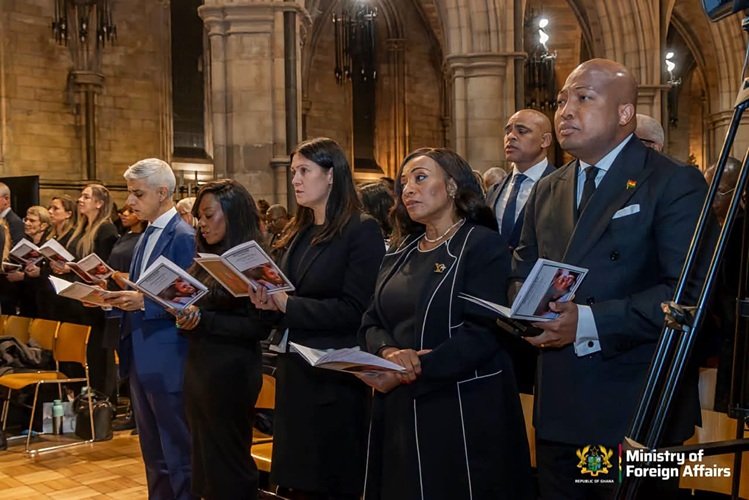
The Minister for Foreign Affairs, Samuel Okudzeto Ablakwa, has joined the family of the late Professor Jason Atta Kwei Arday, the Ghanaian community in the UK, and other dignitaries for a memorial service in Southwark, UK.
In a post, Mr. Ablakwa described the service as deeply moving and unforgettable, held in honour of the late professor’s memory.
According to him, in keeping with the government’s pledge, he joined the family, Ghana’s High Commissioner to London, British MPs, Ministers, the Mayor of London, Cambridge scholars, Prof. Arday’s students and loved ones to pay respects and honour his inspiring legacy.
Mr. Ablakwa noted that Prof. Arday’s accomplishments as the youngest Black professor appointed at the University of Cambridge and his widely appreciated charitable contributions will continue to inspire generations.
“The Government and People of Ghana will continue to stand by our compatriots everywhere they are in the world. As we do so, we profess our commitment to justice, equality and the creation of a new world,” he said.
He prayed for fortitude for the family in what he described as an extraordinarily difficult time.
“We shall always remember Prof. Arday for his response when asked what he will wish to do to change the world: ‘I would take a thread and a needle, and I’d interweave love into our society’,” Mr. Ablakwa added.
By Edem Mensah-Tsotorme