News
Family planning an economic intervention – NPC boss


Dr Leticia Adelaide Appiah, Executive Director of the National Population Council, has advised Ghanaians to see family planning as an economic intervention to societal hardship.
She gave this advice exclusively to The Spectator in an interview last week in her office in Accra.
She indicated that, the well-being of a society and a nation as a whole stemmed from family planning, which was the reliable way to get rid of unwanted pregnancies and pre-term babies.
According to the Medical Doctor, unwanted pregnancies which mostly resulted in pre-term babies incurred additional costs to cater for such babies by the state.
These babies, she said, mostly grew up to become deviants in the society since they never had good parental guidance to help them accomplish their dreams.
She added that society survived on “relevant education”, hence there was the need for quality formal education for every child, and “when such child is deprived of that, it breeds the grounds for a dangerous community”.
“If you keep children out of school, they do not harness their God-given talents and are full of ignorance, where ignorance is a disease which breeds poverty,” she noted.
Dr Adelaide Appiah stated that “giving birth is not a talent” and asked the young girls to focus on their education than becoming mothers at their tender age.
On her part, the growth and development of a nation hinge on family planning which is a progress for individual’s to have a harmonious living.
“In fact, good parenting helps children develop their social, emotional and academic skills, as these qualities are needed for sustainable individual, community, national and global development,” she stressed.
Dr Appiah said if individuals accepted family planning as an economic intervention, the community also became resilient leading to a resilient nation as well.
Occupying a statutory obligation as the Chief Advisor to the Government of Ghana on well and effective population management for the betterment of Ghanaians, Dr Appiah promised to deepen her commitments in tackling population issues in the country.
“National Population Council (NPC) would continue to educate and sensitise policy makers, policy implementers and the general public on the importance of effective population management; and to appreciate the need for improved and sustained quality of life,” the Executive Director reiterated.
According to her, “NPC constantly advocates and orchestrates effective population management that meets the socio-economic development of all, and this conscious effort starts with planning the family as the unit of societal progress.”
She further stated that, the success story of any nation hinged on good, responsible, disciplined, kind and stable parents.
By Alfred Nii Arday Ankrah



A 30-year-old man has been sentenced to 25 years imprisonment with hard labour by the Bekwai Circuit Court for his role in a 2022 robbery at a mining site at Manso Akwasiso in the Ashanti South Region.
The convict, Dominic Ofori, also known as Fanta, was arrested on 16th February 2026 after years on the run. He pleaded guilty before the Bekwai Circuit Court to robbery contrary to Section 149 of the Criminal Offences Act, 1960 Act 29, and was accordingly sentenced to 25 years imprisonment with hard labour.
On March 20, 2022, the Manso Adubia District Police received intelligence that a group of armed men from Manso Abodom were planning to attack a mining site at Manso Akwasiso to rob the owner of gold concentrate. Acting on the information, police mounted a coordinated operation and laid an ambush at the site.
At about 5:30 pm the same day, four-armed men arrived at the site, fired indiscriminately, and robbed the miners of their gold concentrate. The police team on surveillance intervened, resulting in an exchange of gunfire.
Three of the suspects, Abu Abubakar, Musah Latif, and Gideon Takyi, sustained gunshot wounds and were pronounced dead on arrival at St Martins Catholic Hospital at Agroyesum. Dominic Ofori escaped at the time but was later arrested and put before the court.
The Ashanti South Regional Police Command has assured the public of its continued commitment to combating violent crimes and bringing offenders to justice.
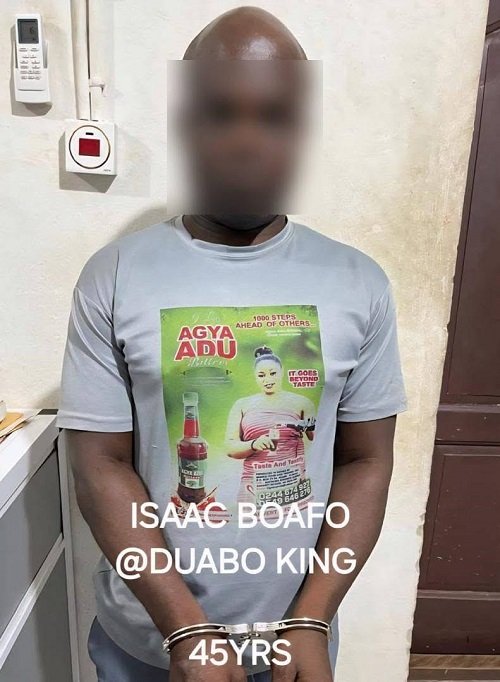
The Ashanti Regional Police Command has arrested 45-year-old Isaac Boafo, also known as “Duabo King,” for allegedly publishing false news intended to cause fear and panic.
Police said the arrest follows a viral TikTok video in which Boafo claimed that four officers at the Central Police Station in Kumasi engaged in inappropriate conduct with commercial sex workers during night patrols in Asafo.
Officers from the Police Intelligence Directorate (Ashanti Region) apprehended Boafo after receiving intelligence about the video.
During questioning, he admitted to creating the video to attract views and engagement online, and acknowledged that he could not prove the allegations.
Boafo also admitted making comments about the President of the Republic for content purposes and could not defend those statements.
He has been formally charged and is in detention as investigations continue.
The Ashanti Regional Police have warned the public against publishing or sharing false information on social media, noting that such acts can cause fear, panic, and damage reputations.
They said anyone found engaging in similar conduct will face legal action.
By: Jacob Aggrey