Fruitful Living
Eucharistic celebration in honour of Very Rev Fr Kyei

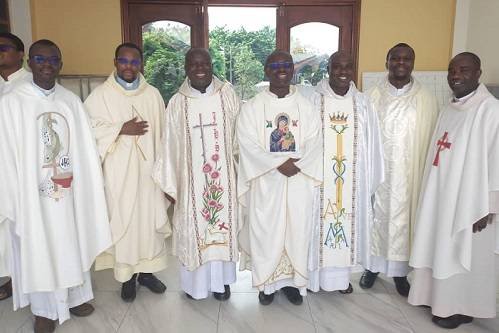
Very Rev Fr Bernard Kyei in the middle
Very Rev Fr Bernard Kyei, the Priest in-charge of the St John of God Catholic Church, Amrahia, in the Adentan Municipality, has commemorated his 15th priestly ordination with a Eucharistic celebration in gratitude to God.
The celebrant, who was joined by six other priests, said he would forever remain grateful to God who has found him worthy to serve in his vineyard.
Very Rev Fr Edmund Donkor- Banie, the Parish Priest of St John the Evangelist Catholic Church, Adentan, in his homily, said though Fr Kyei had the desire to become an engineer, God, the arbiter of our lives, chose him to preach the gospel to all the ends of the world.
He said just as Jesus Christ commissioned his disciples to preach the word of God, so has God chosen the celebrant to work for the salvation of souls.
He described the priesthood vocation as an enjoyable one which has offered the ministers of God the opportunity to raise the cup of salvation and call on the name of God.
He reminded Fr Bernard Kyei that irrespective of the challenges and the difficulties in his ministry, he should remember that Jesus had gone through myriad of sufferings, pains, humiliation and eventually death on the cross for our salvation.
He called on Christians to persevere in prayer and also pray for the priest to enable them to carry out their pastoral work on earth.
He prayed that God would continue to bless, protect and direct the ministers of the gospel to work according to his purpose.
By Raymond Kyekye

4. Correct the falsehood
If someone misrepresents Muhammad (pbuh), teach people who Muhammad (pbuh) really was.
Tell them about his mercy.
Tell them about his justice.
Tell them about his patience.
Tell them about his forgiveness.
5. Report genuine offences
Use lawful channels.
The Muslim does not become the police, prosecutor, judge and executioner.
6. Protect the innocent
If one Christian insults Islam, do not attack another Christian who knows nothing about it.
If one Muslim makes an offensive statement, do not blame all Muslims.
7. Restore peace
After the controversy, bring responsible Muslim and Christian leaders together.
Talk.
11 | P a g e
Clarify.
Forgive where forgiveness is appropriate.
And rebuild trust.
Ghana must not become a battlefield of religious provocation
My dear brothers and sisters in Islam,
Let us look around Ghana.
Muslims and Christians have lived together for generations.
We have Muslim fathers with Christian in-laws.
Christian mothers with Muslim sons-in-law.
Muslim and Christian business partners.
Muslim and Christian neighbours.
Muslim and Christian classmates.
Muslims and Christians serving together in the military, police, public service, universities, hospitals, markets and businesses.
This is Ghana.
We must protect this peace.
Religious freedom is precious.
But religious freedom comes with religious responsibility.
A microphone is not a weapon.
A pulpit is not a battlefield.
A smartphone is not a licence to spread hatred.
A viral video is not a fatwa (religious decree).
And anger is not evidence.
12 | P a g e
A word to Muslim scholars
To my fellow Imams and Islamic scholars:
Allah has placed a trust upon our shoulders. You are the best of generations selected for the guidance of mankind. Quran chapter 3:110.
When people are angry, we must calm them.
When people are confused, we must educate them.
When people want revenge, we must teach justice.
When people want violence, we must remind them of Allah.
Our microphone should extinguish fire—not pour petrol upon it.
The Prophet said:ِ
لَيْس َ الشَّدِيد ُ بِالصُّرَعَةِ، إِنَّمَا الشَّدِيد ُ الَّذِي يَمْلِك ُ نَفْسَه ُ عِنْد َ الْغَضَب
“The strong man is not the one who can overpower others; rather, the strong man is the one who controls himself when angry.” (Sahih al-Bukhari, 6114; Sahih Muslim, 2609)
This is strength.
Self-control is strength.
Restraint is strength.
Wisdom is strength.
Justice is strength.
A word to Christian preachers
And to our Christian brothers and sisters, especially those who preach:
We Muslims deeply revere Jesus (peace be upon him)
He is not an ordinary man in Islam.
He is ʿĪsā ibn Maryam عليه السالم, a mighty Messenger of Allah.
The author is the Chief Imam of Katamanso Municipal and Certified Counsellor and Governance Expert.
SKIP THE QUEUE, TAP THE NEWS
You can now read the Ghanaian Times and The Spectator newspapers from the comfort of your device via TimesNewsPlus.
Join our WhatsApp Channel: https://whatsapp.com/channel/0029VbBElzjInlqHhl1aTU27
When Paul tells us that our “attitude should be the same as that of Christ Jesus,” he had summarized in the previous two verses what such an attitude was: selflessness, humility, and service. “Do nothing out of selfish ambition or vain conceit, but in humility consider others better than yourselves. Each of you should look not only to your own interests, but also to the interests of others” – Philippians 2:3-4.
In other words, the attitude a Christian should reflect is one that focuses on the needs and interests of others. Without question, that does not come naturally to us. When Christ came into the world, He established a whole new attitude to relationships with others. One day when His disciples were arguing among themselves regarding who was to be greatest in His kingdom, Jesus said, “You know that the rulers of the Gentiles lord it over them, and their high officials exercise authority over them. Not so with you.
Instead, whoever wants to become great among you must be your servant, and whoever wants to be first must be your slave – just as the Son of Man did not come to be served, but to serve, and to give his life as a ransom for many” – Matthew 20:25-28. Jesus is teaching us that, when we become preoccupied with our own things, it can cause conflicts and other problems with people we know. Instead, God wants us to have an attitude of serious, caring involvement in the concerns of others.
Paul speaks more about this Christ-like attitude in his letter to the church in Ephesus: “that you put off, concerning your former conduct, the old man which grows corrupt according to the deceitful lusts, and be renewed in the spirit of your mind, and that you put on the new man which was created according to God, in true righteousness and holiness.– Ephesians 4:22-24. Many religions of today, including the New Age philosophies, promote the old lie that we are divine or that we can become gods. But the truth of the matter is that we will never become God, or even a god. Satan’s oldest lie was promising Adam and Eve that, if they followed his advice, “- and you will be like God, knowing good and evil.” Genesis 3:5, NKJV.
Each time we try to control our circumstances, our future, and the people around us, we’re only demonstrating that we want to be a god. But we must understand that, as creatures, we will never be the Creator. God doesn’t want us to try to become gods. Instead, He wants us to become like Him, taking on His values, His attitudes, and His character. We are meant to “be made new in the attitude of your minds; and to put on the new self, created to be like God in true righteousness and holiness” – Ephesians 4:23-24.
Finally, we must always keep in mind that God’s ultimate goal for His children is not our comfort, but the transformation of our minds into the attitude of godliness. He wants us to grow spiritually, to become like Christ. This doesn’t mean losing our personalities or becoming mindless clones. Christlikeness is all about transforming our minds. Again, Paul tells us, “Do not conform any longer to the pattern of this world, but be transformed by the renewing of your mind. Then you will be able to test and approve what God’s will is—his good, pleasing and perfect will” – Romans 12:2.
It is God’s will that we develop the kind of mindset described in the Beatitudes of Jesus – Matthew 5:1-12, that we exhibit the fruit of the Spirit – Galatians 5:22-23, that we emulate the principles in Paul’s great chapter on love – 1 Corinthians 13, and that we strive to pattern our lives after Peter’s characteristics of an effective and productive life – 2 Peter 1:5-8.
Establishing our actions in righteousness
Every person is commanded to live up to divine standards.
a. In the words of Jesus
“ For I say to you, that unless your righteousness exceeds the righteousness of the scribes and Pharisees, you will by no means enter the kingdom of heaven. Be ye, therefore, perfect, even as your Father, who is in heaven, is perfect” – Mt. 5:20, 48.
Every person in the world is required to live up to that standard. You say, “You’ve got to be kidding!” No, I’m not. You are obligated to live up to that standard with a pure inside as well as a right outside. But you say, “I can’t!” You are absolutely right. That’s why we are given the solution…
b. In the words of Paul
As it is written: “There is none righteous, no, not one; But now the righteousness of God apart from the law is revealed, being witnessed by the Law and the Prophets, even the righteousness of God, through faith in Jesus Christ, to all and on all who believe. For there is no difference;– Rom. 3:10, 21-22a.
Though you can’t obtain on your own the righteous standard Christ set, you can receive His righteousness if you are one of those who believe. Isn’t that great? God set the holy standard. And when you acknowledge that you can’t live up to it, He says, “My Son is not only the Lawgiver, but He is the Redeemer as well, who makes it possible for you to live on that level.” Beloved, it’s a fantastic thing! The standard is so high we can’t obtain it. But Christ met that standard and imputes to us His righteousness. Oh, what a blessed thing!
SKIP THE QUEUE, TAP THE NEWS
You can now read the Ghanaian Times and The Spectator newspapers from the comfort of your device via TimesNewsPlus.
Join our WhatsApp Channel: https://whatsapp.com/channel/0029VbBElzjInlqHhl1aTU27