News
‘Empower women, build resilient healthcare systems, across Africa’

- /home/u249204778/domains/spectator.com.gh/public_html/wp-content/plugins/mvp-social-buttons/mvp-social-buttons.php on line 27
https://spectator.com.gh/wp-content/uploads/2025/10/A-group-photo-of-first-ladies-Dr-Stangenberg-Haverkamp-and-dr-Rasha-Kelejfourth-from-right.jpg&description=‘Empower women, build resilient healthcare systems, across Africa’', 'pinterestShare', 'width=750,height=350'); return false;" title="Pin This Post">
- Share
- Tweet /home/u249204778/domains/spectator.com.gh/public_html/wp-content/plugins/mvp-social-buttons/mvp-social-buttons.php on line 72
https://spectator.com.gh/wp-content/uploads/2025/10/A-group-photo-of-first-ladies-Dr-Stangenberg-Haverkamp-and-dr-Rasha-Kelejfourth-from-right.jpg&description=‘Empower women, build resilient healthcare systems, across Africa’', 'pinterestShare', 'width=750,height=350'); return false;" title="Pin This Post">
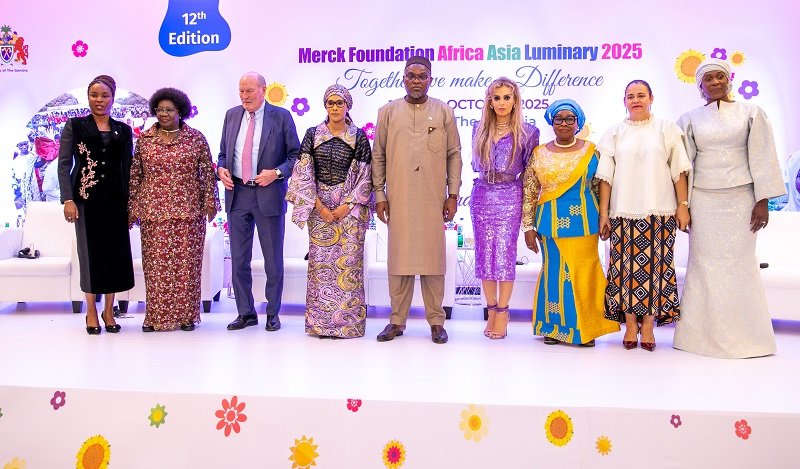
The First Lady of The Gambia, Mrs Fatoumatta Bah-Barrow, and the Chairman of the Executive Board of E. Merck KG and Board of Trustees of the Merck Foundation, Prof. Dr Frank Stangenberg-Haverkamp, have called for stronger partnerships to, empower women, build resilient healthcare systems and promote responsible health journalism across Africa.
They made the call at the 12th Edition of the Merck Foundation Africa Asia Luminary, held at the Sir Dawda Kairaba Jawara International Conference Centre in Banjul.
The event, hosted under the patronage of President Adama Barrow and Mrs Bah-Barrow, brought together First Ladies, health ministers, and stakeholders from more than 50 countries.
Mrs Bah-Barrow urged participants to remain united in strengthening health systems and improving lives, saying health was not merely the absence of illness, but the presence of opportunity.
Mrs Bah-Barrow also emphasised the role of the media in shaping public perception and behaviour, stressing that responsible health reporting saves lives.
“Journalists have the power to inform, educate, and inspire action, but they must be well-equipped to do so ethically and accurately. We have seen how misinformation can cost lives,” she cautioned.
In his remarks, Prof. Dr Frank Stangenberg-Haverkamp revealed that since 2012, the Merck Foundation has provided over 2,400 scholarships to healthcare professionals from 52 countries to specialise in 44 critical fields to address Africa’s shortage of medical experts.
“Africa bears 24 per cent of the global disease burden but has only 2.9 per cent healthcare workers per 1,000 people. Through training and education, we are closing that gap,” he said.
The Chief Executive Officer of Merck Foundation, Dr Rasha Kalej said the foundation was supporting over 1,000 girls under the ‘educating Linda’ programme to finish their high school education and enable them fulfill their dreams.
She said with the support of the First Ladies “we are providing annually 40 scholarships for high performing but underprivileged girls until they finish their education.”
By Esinam Jemima Kuatsinu
Join our WhatsApp Channel now!
https://whatsapp.com/channel/0029VbBElzjInlqHhl1aTU27



The Ghana Police Service, through the Motor Traffic and Transport Department (MTTD), will commence full implementation of its automated traffic law enforcement programme, TRAFFITECH-GH, from October 1, 2026.
According to the Service, the programme forms part of efforts to address indiscipline on Ghana’s roads and improve compliance with road traffic laws and regulations.
TRAFFITECH-GH will use cameras and Personal Data Assistant (PDA) devices to detect traffic offences and support the enforcement of road traffic regulations.
Under the programme, detected offences will be reviewed and Electronic Notices of Violation (ENV) issued to vehicle owners or drivers through SMS. The notice will indicate the offence committed and the prescribed fine.
The Service has therefore urged all motorists, drivers and vehicle owners to comply with road traffic regulations and support the implementation of TRAFFITECH-GH to promote safer roads and reduce road traffic crashes and casualties.
By Edem Mensah-Tsotorme

Entrepreneur, Henry Brew Gardner has officially declared his intention to contest for the position of Agona West Constituency Youth Organizer of the National Democratic Congress (NDC) in the upcoming constituency elections.
In a declaration statement, Mr. Gardner said he is stepping forward with humility, courage and commitment to the progress of the constituency.
“I am stepping forward because Agona West deserves a Youth Wing that is active, united, organized, visible, disciplined, and ready to work,” he stated.
According to him, his decision to serve the NDC in Agona West is not for personal glory but a call to service, to unite the youth, strengthen the grassroots and build a formidable youth front capable of winning elections.
“Our youth are not merely the future — we are the energy, strength, voice, and engine of our party today. We must therefore create a youth wing where every young person feels valued, heard, represented, and empowered to contribute,” he added.
Mr. Gardner said he believes in leadership that listens, engages, builds bridges and puts collective interest above personal ambition.
He outlined his vision to organize the grassroots, mobilize the youth, strengthen structures, promote unity, identify opportunities, support young people and build a stronger political force in every branch and ward of Agona West.
“I am not coming to divide. I am coming to unite. I am not coming to compete with our youth. I am coming to work with them. I am not coming for a title. I am coming to serve,” he declared.
He called for prayers, support and guidance, rallying the youth with the message: “Agona West Youth, Our Time Is Now!”
By Edem Mensah-Tsotorme

 Entertainment1 week ago
Sarkodie to SarkNation: You don’t have to tear someone down to prove your loyalty
- Entertainment1 week ago
“Without principle, advice is just an opinion” – Stonebwoy replies Sarkodie
- Entertainment4 days ago
Fiifi Coleman Productions adapt ‘I Told You So’ stage play into feature film