Features
Do something before you die


I am an avid reader. I read anything I can lay my hands on. But above all, I love biographies and their auto forms. History as a subject was not my strong point in school but I developed a keen interest in historical narratives when I went to train as a teacher. Apart from textbooks, it was in the early sixties that I first read a book titled, “Beyond Pardon” by Bertha M. Clay. I was so enchanted by the narrative, which kick started the desire for reading in me. And I have never looked back.
I have kept asking myself why people write, why people read and why people do not read or write. The answers, I believe, can be a volume by itself. My focus today is on our politicians, captains of industry and public office holders.
In the United States, for example, it has become a self-imposition for public office holders to write their memoires once they leave office. These memoires become a source of knowledge for up and coming students in leadership, a source of reference for all and they also tell the true stories of the characters that have run affairs of their people.
I have read Bill Clinton’s autobiography, that of his wife, Hillary, and Magdalene Albright who was once a Secretary of State. I have read Barack Obama’s books before he became President of the US.
I have read Nelson Mandela. Lee Kwan Yu and many others I cannot readily recall. They all had great stories to tell.
General Colin Powell, who died just a few days ago, has books to his name after leaving office as the first Black to serve as Chairman of the Joint Chiefs and also as the first Black Secretary of State of the United States.
I have also read books by some African leaders. Leopold Senghor of Senegal, Kenneth Kaunda of Zambia
and Jomo Kenyatta of Kenya readily come to mind. These were men who won independence for their respective countries.
Only last week, Mr. Enoch Teye Mensah, a member of the Council of State, launched Volume One of a book he has authored. On June 14 this year, my classmate and good brother, Ken Dzirasa, who was a Deputy Speaker of Ghana’s Parliament, also launched his memoires.
These are very good signs that our history as a people has a chance of not getting lost. At the launch, the current Speaker of Parliament, the Rt. Honourable Alban Sumana Bagbin, who did the honours, stated the importance of public figures to write their memoires for posterity to be their judge. Mr. Speaker pledged to complete his own before this year ends.
It is difficult to understand why public office holders in our parts have not cultivated the habit of writing. Only a few have bothered to do so. Dr. Kwame Nkrumah comes readily to mind. He wrote very extensively while he was even President of this country. I recollect President John Mahama’s “My First Coup d’état.”
Dr. Obed Asamoah has authored a book after he left office. Mr. Sylvester Mensah, who had been a Member of Parliament, also has a publication to his name. Professor Kwamina Ahwoi has one that generated a storm before the death of President Rawlings.
I have spoken to a few people who tell me writing would bring no financial benefits to them because Ghanaians and, for that matter, Africans have not cultivated the habit of reading.
This might be largely true, but if every writer wants economic returns I wonder if knowledge can be shared at all. There is a saying that if you want to hide anything from the black man, put it inside a book; he will never find it. It is about time we disabused our minds of this.
I recollect asking my elder brother, the late Squadron Leader Abraham Armstrong Segbefia, who was enlisted in the Air Force the same day as Jerry Rawlings to consider writing his memoires as one of the people involved in the June Four and 31st December eras. He promised he would, but before he could finish the second chapter, he died.
When I went to announce his death to Rawlings in November of 2007, I impressed upon him to give it a thought as well. He appeared nonplussed, though a few years later he called to inform me he was considering writing. I reminded him he was not growing younger.
Another couple of years later, President Rawlings invited me for a chat and told me he wanted the launch of what he was writing to coincide with his 70th birthday.
The last time I met with him before his sudden passing, he said he needed to review a chapter or two to clear the air on some of the things Professor Ahwoi had alleged in his book.
I am unaware if Rawlings did that before his passing. If he had that project, I will humbly appeal to his family to have whatever the man had done published. Whatever it is will be a best seller.
The man I consider to have the richest recollection of historical facts and whose memoires will be the greatest source of reference for politicians and students of governance in this country is Captain Kojo Tsikata.
I don’t easily recollect the last time I met and spoke with him, but I have impressed upon Dr. Obed Asamoah and Captain Joel Kwami Sowu to convince Kojo Tsikata to write his memoires. Dr. Asamoah told me he had on many occasions asked Capt. Tsikata to write, but Tsikata has made up his mind that he would not put one letter of the alphabet down to his name.
People who know Captain Kojo Tsikata well are not surprised by his stand on writing a memoire. First, they say whatever he writes will be very explosive and, secondly, he is too private a person to want to write anything down.
It is sad for this country. Many prominent Ghanaians have died without leaving any written legacy for generations to appreciate what they lived and stood for. Oral historical narratives are fraught with inconsistencies and embellishments that leave so much to be desired.
I doff my hat to those who have taken the bold step of putting down their own narratives for us to chew on. The question now is what the rest intend to do or are doing. Not only those in the lime light. Captains of industry, retired military officers, medical officers, engineers, journalists and a host of others have their stories to tell. How did they fare in their fields of professional endeavour? What challenges did they face in their line of duty? We want to be enlightened on these. The coming generation will learn to skirt these challenges.
Let us not die with our store of knowledge and experiences. It is to humanity that this must be done. Do it for your children. Do it for the future of this country. Do it for mankind as a whole. Let us not run away from sharing our knowledge. Do something before you die!
By Dr. Akofa K. Segbefia


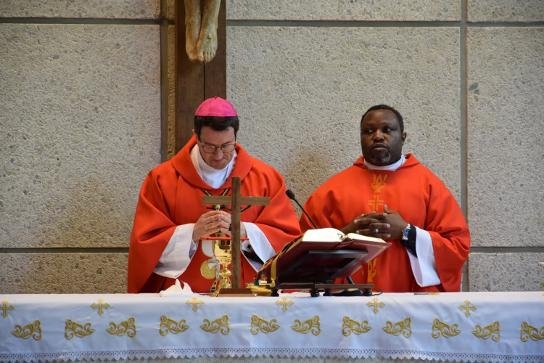
On Sunday, October 11, 2026, it was the turn of Ghanaian Catholics in Finland to lead the singing in the church service of the African Catholic Chaplaincy in Finland (ACCF).
It was indeed a spirit-filled feeling for worshippers present. And for the Ghanaian migrants, the occasion also brought back to them memories of church services in their home country, Ghana.
The ACCF has a roster for each country/community to sing from time to time. Next Sunday will be the turn of the Nigerian community. Other communities that usually sing are the Kenyan/Tanzanian community, the Cameroonian, the Ugandan, group, etc.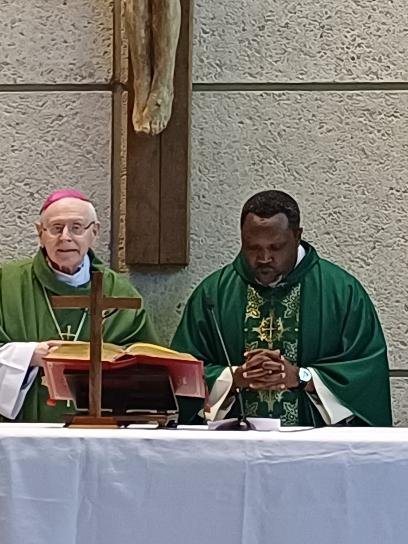
A powerful religious experience
The mass services of the Chaplaincy usually give a powerful religious experience and a display of cultural diversity, especially in occasions such as when the Bishop of Helsinki, Bishop Raimo Goyarrola, celebrated mass with the Chaplaincy on Pentecost Day, May 24, 2026.
There was a similar time of spiritual joy last month (September 27, 2026) when Emeritus Bishop Teemu Sippo, former Bishop of Helsinki, visited the Chaplaincy. Bishop Teemu was the main celebrant, assisted by the Chaplain, Reverend Father Thomas Otieno.
Last Sunday, Reverend Father Bernard Sor, a Ghanaian Catholic priest based in Austria, was the main celebrant in the mass service where he performed a rite of baptism. Fr Bernard had celebrated mass a few months ago when he visited his sister and her husband in Helsinki. 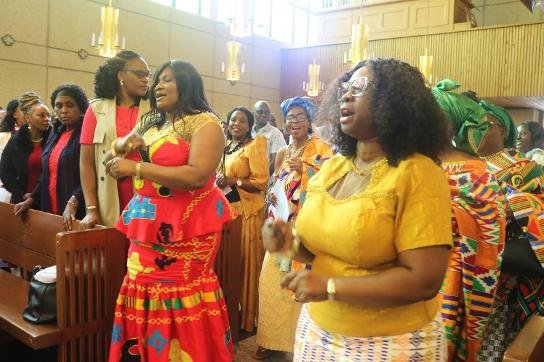
All these well-attended religious occasions indeed leave lasting memories. The homilies (peaching) by the priests usually emphasize religious tenets such as the importance of loving and serving God in truth, existing in peace with our fellow humans to promote unity in diversity, etc.
Unity in diversity and a colourful display of cultures
The African Chaplaincy church services usually produce impressive displays of diverse cultures from different parts of Africa and elsewhere. The events are often spiced by rich cultural displays of dances and colourful attires which are a delight to watch.
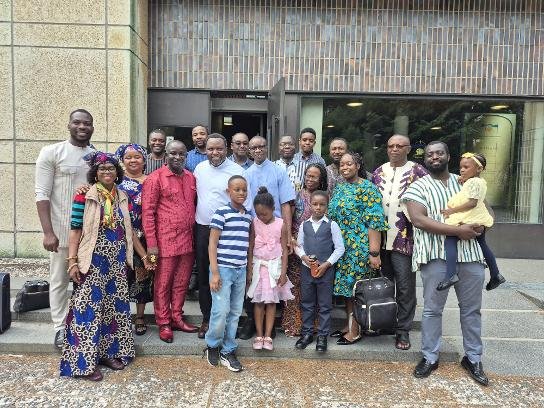
On special occasions, members of the Ghanaian Catholic community, in their gay and colourful kente attire and with adowa dance and music, usually lead the procession into the church. Other communities such as the Cameroonian, Nigerian, Kenyan and Tanzanian as well as Sudanese/South Sudanese groups also put up well-choreographed performances from their cultures.
The African Catholic Chaplaincy in Finland
The African Chaplaincy was founded on June 4, 2017, which was a Pentecost Sunday, in a Pontifical High Mass celebrated by Monsignor Emeritus Sippo S.C.I., the then Bishop of Helsinki, at the St. Mary’s Catholic Parish Church in Helsinki.
The Chaplaincy was created by Bishop Teemu in collaboration with the Diocesan body when they detected a great flocking of African immigrants to Finland, the majority of whom were Catholics. This was to give the immigrants a possibility to integrate into the Finnish society by worshiping as Catholics and in their African cultural identity.
The responsibility of the Chaplaincy was given by Bishop Teemu to Father Dr Leonard Wobilla Shwei, who is thus the first Chaplain and ably led the Chaplaincy. He was succeeded a few years ago by Father Thomas Otieno, who continues to move the Chaplaincy forward. Thank you!
GHANA MATTERS column appears fortnightly. Written in simple, layman’s terms, it concentrates on matters about Ghana and beyond. It focuses on everyday life issues relating to the social, cultural, economic, religious, political, health, sports, youth, gender, etc. It strives to remind us all that Ghana comes first. The column also takes a candid look at the meanings and repercussions of our actions, especially those things we take for granted or even ignore. There are key Ghanaian values we should uphold rather than disregard with impunity. We should not overlook the obvious. We need to search for the hidden or deeply embedded values and try to project them.
With Dr Perpetual Crentsil
SKIP THE QUEUE, TAP THE NEWS

You can now read the Ghanaian Times and The Spectator newspapers from the comfort of your device via TimesNewsPlus.
Join our WhatsApp Channel: https://whatsapp.com/channel/0029VbBElzjInlqHhl1aTU27
She did not find out he was cheating. She found out he was drowning.
It was two weeks after their beautiful wedding. The jollof was still in the fridge. A loan officer called her number-not his-and politely asked, “Madam, please tell your husband to pay his overdue loan. We have been calling him.”
That was how she discovered her new husband had entered their marriage with a hidden debt of over GH¢ 40,000. No cheating. No other woman. Just a financial secret.
And that is how many Ghanaian marriages begin to die. Not with a shout, but with a secret alert on a phone.
We prepare for the wedding. We do not prepare for the wallet.
What is money honesty?
Let me define it simply. Money honesty is not that you both earn the same. It is that you both know the same. It is the ability to sit down and say without fear:
“This is how much I earn.”
“This is how much I owe.”
“This is how I was raised to see money.”
“This is what scares me about money.”
Financial transparency is not about control. It is about clarity. You cannot build trust on top of secrets.
Many couples tell me, “Counsellor, we love each other, love will handle money.” I always answer, “Love is the car, but money honesty is the fuel. Love without honesty cannot move.”
How To Buy Your Marriage Insurance Today – My 5-Step Protocol
If you are engaged, newly married, or even 20 years in marriage, you can still fix this. At Counsellor Prince & Associates Consult—CPAC, this is what I give couples:
Step 1: The 90-Minute Money Naked Session.
No phones, no blame. Each partner writes down on paper: Monthly income, monthly debts, monthly family obligations, savings, and your biggest money fear. Then you exchange papers. Read it. Don’t react for 24 hours. Just absorb.
Step 2: Create OUR Money, YOUR Money, My Money.
You need three pots. OUR money for rent, food, school fees, utilities, properties, and the like— joint contribution. YOUR money and MY money—a small agreed allowance no one questions. This stops the feeling of being controlled.
Step 3: The No-Secret Debt Rule.
Agree from today: No new loan, no new hire purchase, no new family financial commitment above GHS 500 without telling each other first. Not permission, but information.
Step 4: Talk About Your Money Personality.
Are you a Spender or a Saver? Are you Risky or Safe? Most Ghanaian marriages are a Spender married to a Saver. Neither is wrong. But if you don’t understand your partner’s personality, you will call his saving “stinginess” and her spending “wastefulness.”
Step 5: Do a Monthly 30-Minute Money Date
Not an argument date. Light, with tea. “How did we do this month? What worried you? What should we plan for next month?” Couples who do this divorce far less.
My Final Word
Before you say “I Do” at the altar, have pre-marital counselling and also have the money talk on the sofa.
Ask your partner:
“If I lost my job today, how long can we survive?”
“What debt are you bringing into this marriage?”
“How much do you send to your family monthly and will that continue?”
If he or she gets angry that you asked, don’t get married yet. A person who is angry about accountability will be abusive about money.
Marriage insurance is not bought at Star Assurance or Enterprise. It is bought in honest conversations when no one is watching.
The wedding costs one day. The marriage costs a lifetime. Don’t enter a lifetime contract and covenant with hidden costs.
You can still insure your marriage today.
Source:
Counselor Prince Offei, CPAC’s founder, is a leading Mental Health Professional, Marriage Counsellor, Author, ADR Expert/Arbitrator, and Spectator Newspaper Columnist. He writes on relationships, marriage, parenting, special needs support, and their connection to mental health. For therapy, counselling, or enquiries, contact Counselor Prince & Associates Consult (CPAC) in Accra on 0559850604 / 0551428486.
SKIP THE QUEUE, TAP THE NEWS
You can now read the Ghanaian Times and The Spectator newspapers from the comfort of your device via TimesNewsPlus.
Join our WhatsApp Channel: https://whatsapp.com/channel/0029VbBElzjInlqHhl1aTU27