News
GTDC CEO Prof. Kobby Mensah Named Among Top 12 global leaders reshaping ‘Place Branding’


- /home/u249204778/domains/spectator.com.gh/public_html/wp-content/plugins/mvp-social-buttons/mvp-social-buttons.php on line 27
https://spectator.com.gh/wp-content/uploads/2026/05/WhatsApp-Image-2026-05-04-at-14.08.11.jpeg&description=GTDC CEO Prof. Kobby Mensah Named Among Top 12 global leaders reshaping ‘Place Branding’', 'pinterestShare', 'width=750,height=350'); return false;" title="Pin This Post">
- Share
- Tweet /home/u249204778/domains/spectator.com.gh/public_html/wp-content/plugins/mvp-social-buttons/mvp-social-buttons.php on line 72
https://spectator.com.gh/wp-content/uploads/2026/05/WhatsApp-Image-2026-05-04-at-14.08.11.jpeg&description=GTDC CEO Prof. Kobby Mensah Named Among Top 12 global leaders reshaping ‘Place Branding’', 'pinterestShare', 'width=750,height=350'); return false;" title="Pin This Post">
The Ghana Tourism Development Company (GTDC) Chief Executive Officer, Professor Kobby Mensah, has been named amongst the 2026 Twelve Leaders Shaping Place Branding Right Now, by The Place Brand Observer’s (TPBO).
Unveiled on April 28, 2026, the list is selected annually by TPBO’s expert community to recognise and spotlight practitioners, policymakers and researchers advancing the field in meaningful ways.
Professor Mensah is the only West African tourism development executive featured in this year’s list, joining ministers, city leaders and scholars from The Gambia, Estonia, Sweden, the UK, Chile, Thailand, Sierra Leone and the United States.
TPBO’s citation read,
“Kobby Mensah represents a convergence of academic insight and applied leadership in destination development. His move into leading GTDC signals a broader shift in Ghana’s approach, positioning tourism as part of an integrated system connecting investment, innovation and experience design.”
With this honour, Professor Mensah enters the TPBO Who’s Who in Place Branding, a peer-recognised network of more than 500 professionals at the intersection of place, strategy and leadership.
A Recognition of Ghana’s New Direction
Professor Mensah was appointed CEO of GTDC by His Excellency President John Dramani Mahama, bringing to the role a strong academic and strategic perspective on tourism development.
He is a Professor of Marketing at the University of Ghana Business School, a chartered marketer (CIM, UK), and a leading voice on political marketing, digital engagement and brand positioning in Africa.
He is widely credited for pioneering digital tourism education in Ghana through the Destination Legon Tourism Marketing Exhibition, which since 2014 has challenged students to use Virtual Reality, Artificial Intelligence and immersive storytelling to let travellers ‘consume’ destinations before arrival.
Since assuming leadership at GTDC, Professor Mensah has emphasized “integrating academic expertise with practical experience to drive national development,” championing innovation, sustainability and collaborative stakeholder models.
Statement from GTDC Board Chairman, Mr Ben Ohene Aryee:
The Board and Management of GTDC celebrate this global acknowledgment: “This is not Prof Mensah’s trophy alone, it is bigger than that. It is Ghana winning, and proof that the reset Agenda of His Excellency, John Dramani Mahama is working,” said the GTDC Board Chair, Mr. Ben Ohene Aryee.
He added that “Professor Mensah’s inclusion affirms what we have long believed: that tourism is no longer a standalone sector. It is the connective tissue between investment promotion, cultural diplomacy, youth employment and place experience. His academic rigour paired with applied leadership is exactly the convergence TPBO has recognised.”
In his response, Professor Mensah noted that “I am humbled to stand alongside colleagues who are redefining how nations and cities build credibility. For Ghana, this is a call to action. At GTDC, our mandate is to mobilise resources for investment, support SMEs, and enhance service levels across the sector. We will do this by treating Ghana’s brand as infrastructure – coordinated, evidence-based, and co-created with communities, creatives and investors.
This recognition belongs to the team at GTDC, to UGBS, and to every young Ghanaian innovator proving that place branding is not about slogans, it is about systems.”
About the Honour
TPBO’s “People to Watch” identifies leaders whose work moves place branding beyond communications into policy, economy and long-term value creation. Past honorees include ministers driving national repositioning, city directors aligning tourism with talent attraction, and scholars advancing measurable models of reputation and soft power.
Professor Mensah was profiled alongside:
- Abdoulie Jobe, Minister of Tourism, The Gambia
- Andres Kask, City of Tallinn
- Klara Enbom Burreau, Kiruna Municipality, Sweden
- Nabeela Farida Tunis, Minister of Tourism and Cultural Affairs, Sierra Leone, among others.
About GTDC
The Ghana Tourism Development Company Limited is mandated to promote and mobilise resources for investment in tourism ventures, seek equity participation in joint ventures with local and international investors, and provide financial and technical assistance to small businesses in the tourism industry.








A nine-member board for the New Times Corporation (NTC), publishers of The Ghanaian Times and The Spectator newspapers was sworn into office on Thursday with a call to strengthen the governance of the Corporation.![Dr. Binka (seated second from right) with Dr Okpoti [right] the board and Management of NTC photos Okai Elizabeth.](https://spectator.com.gh/wp-content/uploads/2026/08/Dr.-Binka-seated-second-from-right-with-Dr-Okpoti-right-the-board-and-Management-of-NTC-photos-Okai-Elizabeth-1024x683.jpg)
The new NTC board is chaired by Dr Charity Binka and has Very Rev. Helena Amma Serwah Opoku-Sarkodie, Mr Tito Kojo Voegborlo Esq and Naana Aklerh Amenyah Kubi I as members. Read More
SKIP THE QUEUE, TAP THE NEWS
You can now read the Ghanaian Times and The Spectator newspapers from the comfort of your device via TimesNewsPlus.
Join our WhatsApp Channel: https://whatsapp.com/channel/0029VbBElzjInlqHhl1aTU27

Christians have been urged to demonstrate a living faith in Jesus Christ by allowing their confession of Him as Lord and Saviour to reflect in their daily lives.
According to the Kaneshie District Pastor of the Evangelical Presbyterian Church, Ghana (EPCG), Rev. Dzidzor Nathaniel Affram, a genuine Christian’s confession should go beyond words and be demonstrated through obedience to God, love for others and service to the Church.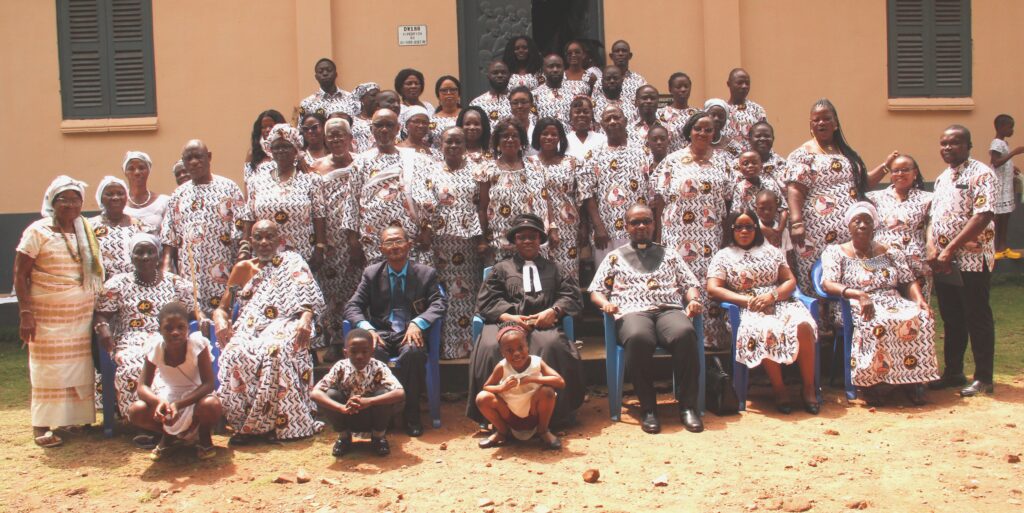
He made the call at the 40th anniversary remembrance service for the late Wesley Kwasi Kwadzo at the Evangelical Presbyterian Church, Ghana, Maranatha Congregation at Awudome Avenui in the Volta Region.
Speaking on the theme, “The Church Built on a Living Confession,” Rev. Affram said life would continually present challenges capable of testing Christians’ faith, making it necessary for believers to hold firmly to their confession that Jesus Christ is Lord.
He explained that accepting Jesus Christ as Lord and Saviour required Christians to live according to His teachings, stressing that their faith must be evident in their conduct.
“A living confession listens to God and not man,” he said, urging Christians to remain obedient to God even when faced with difficulties and pressures.
Rev. Affram further encouraged the congregation to care for vulnerable people and demonstrate concern for others, adding that such acts were practical expressions of Christian faith.
He also urged Christians to identify and use their God-given gifts to build the Church.
He said every member of the Church had a role to play and cautioned Christians against looking down on others because of their status or abilities.
The remembrance service brought together family members, friends, members of the congregation and sympathisers to commemorate the 40th anniversary of the late Wesley Kwasi Kwadzo.
By Lizzy Okai