News
Customs Division busts illicit drug syndicate

- /home/u249204778/domains/spectator.com.gh/public_html/wp-content/plugins/mvp-social-buttons/mvp-social-buttons.php on line 27
Warning: Trying to access array offset on false in /home/u249204778/domains/spectator.com.gh/public_html/wp-content/plugins/mvp-social-buttons/mvp-social-buttons.php on line 27
&description=Customs Division busts illicit drug syndicate', 'pinterestShare', 'width=750,height=350'); return false;" title="Pin This Post">
- Share
- Tweet /home/u249204778/domains/spectator.com.gh/public_html/wp-content/plugins/mvp-social-buttons/mvp-social-buttons.php on line 72
Warning: Trying to access array offset on false in /home/u249204778/domains/spectator.com.gh/public_html/wp-content/plugins/mvp-social-buttons/mvp-social-buttons.php on line 72
&description=Customs Division busts illicit drug syndicate', 'pinterestShare', 'width=750,height=350'); return false;" title="Pin This Post">
The Customs Division of the Ghana Revenue Authority, in collaboration with other security agencies, has intercepted a cache of substances suspected to be illicit drugs from an alleged Nigerian drug syndicate at Kpoglo near Aflao in the Volta Region on Friday.
The team also seized from the syndicate an amount of US$200, 000 comprising 1,946 and 108 pieces of 100 and 50 dollar notes respectively.
The substances now in the custody of the security agencies are six parcels labelled Fatal (767.3g), 45 white pebbles (3,097.1g), 40 blisters of 10 tabs 225mg of tramadol tablets (353.5g), and three cans labelled ‘Praise palm cream’ (2,265.7g) with brown substance sealed in them.
The rest are eight parcels wrapped in brown cellotape (7,743.1g), four parcels wrapped in black polythene (5,079.2g) and 51 parcels wrapped in transparent polythene (5,045g).
Also retrieved from the group is two Nigerian passports with the names Orhoser Endurance and OsibokOcuko Gabriel, First Bank ATM card, an Ecobank cheque booklet, a driver’s license with the name Aminu Saliu Sholadoye.
Commissioner of Customs, Colonel (Rtd)Kwadwo Damoah, briefing the Ghanaian Times in Accra yesterday said that from their preliminary investigations, “these are substances that could qualify for any of the narcotic drugs. They might be in the high value category of drugs”.
Asked where the suspects who were on board the Toyota Land Cruiser with registration number LSR815 FV which was being used to ferry the substances were, Col (Rtd) Damoah said nobody was arrested in the operation.
“The vehicle pulled up with only the driver but unfortunately, when the officers were busy looking at the items, he (the driver) managed to abscond. They(officers) were interested more in the item and he took advantage and before they could say jack, he had absconded.”
Col (Rtd) explained that the car was being used as a cargo to outsmart the security as cargos were permitted entry into the country despite the closure of the borders as part of measures to contain the coronavirus pandemic.
“So the items were concealed under the fuel compartment with spare parts in the vehicle,” he revealed.
Describing the operation as a “major” one, Col (Rtd) Damoah commended the security agencies for the collaboration and hinted that a manhunt would be launched for the driver and his possible accomplices.
“This shows that with collective efforts, we can manage our borders better. This is a major success as far as our efforts are concerned and we commend all the agencies who were part of this operation.”
Other agencies involved were the Ghana Immigration and Police Service, Defence Intelligence and the Bureau of National Investigations.
BY JULIUS YAO PETETSI


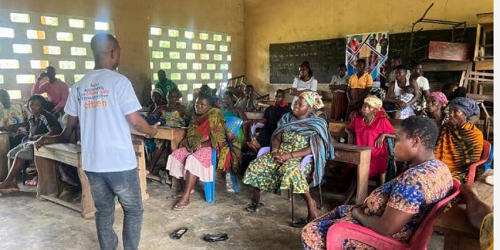
Parents and Teachers Associations (PTAs) in three basic schools in the South and Central Tongu districts have committed to establishing community-led funding mechanisms, to sustain menstrual hygiene interventions introduced under a volunteer-led project to improve girls’ education and wellbeing.
The commitment was made during PTA engagement meetings organised by the Gender and Reproductive Health Advocacy Youth Network (GRAY Network), under the Strengthening Volunteer-Led Sexual and Reproductive Health and Rights (SRHR), Menstrual Hygiene Management (MHM), and Life Skills Education in Schools and Communities Project, with support from the STAR-Ghana Foundation.
The beneficiary schools are Atsieve D/A Basic School and Avakpedome D/A Basic School in the South Tongu District, and Lakpo D/A Basic School in the Central Tongu District.
The meetings brought together parents, teachers, school management, officials of the Ghana Education Service, traditional and community leaders, and representatives of GRAY Network, to review the impact of the intervention and agree on practical measures to sustain its achievements beyond the project implementation period.
Participants observed that the initiative, implemented through trained community volunteers, had significantly improved girls’ confidence, reduced menstrual-related absenteeism and enhanced their participation in classroom activities through the provision of reusable sanitary pads, menstrual hygiene education and life skills training.
Parents also acknowledged that the reusable sanitary pads had eased the financial burden associated with the monthly purchase of disposable sanitary products, particularly for vulnerable households, while contributing to improved menstrual health management among adolescent girls.
To sustain the intervention, the PTAs resolved to establish Menstrual Hygiene Support Funds in their respective schools to mobilise local resources to support the production of additional reusable sanitary pads, assist vulnerable girls and finance menstrual hygiene education and related activities.
The stakeholders also agreed to develop and sign Memoranda of Understanding (MoUs) between the PTAs, the beneficiary schools and GRAY Network to clearly define the roles and responsibilities of each party in sustaining menstrual hygiene interventions and promoting girls’ education, health and wellbeing.
Mr Mensah Godsway, Programme Manager of GRAY Network, said the project had demonstrated that volunteerism remained an effective approach to promoting sustainable community development by empowering local actors to take ownership of development interventions.
He said the decision by the PTAs to establish community support funds and formalise partnerships through the signing of MoUs reflected the communities’ commitment to sustaining the project’s gains beyond the donor funding period.
Mr Godsway said GRAY Network remained committed to working with schools, parents, community leaders and relevant institutions to strengthen menstrual hygiene management, advance sexual and reproductive health education and ensure that adolescent girls continued to access education in safe, supportive and inclusive learning environments.
Representatives of the PTAs, school authorities and the Ghana Education Service jointly commended GRAY Network and the STAR-Ghana Foundation for the intervention, describing it as a timely initiative that had improved girls’ school attendance, confidence and participation in academic activities.
They pledged to work collaboratively to mobilise community resources and honour the commitments outlined in the MoUs to guarantee the sustainability of the initiative. -GNA
CITI FM and Channel One TV have unveiled an enhanced version of their Literacy Challenge, aimed at promoting critical thinking, digital literacy and academic excellence among basic school pupils across the country.
Launching the 2026 edition of the competition in Accra last Wednesday, Head of Programmes Production at Channel One TV, Ms Apiokor Seyiram Ashong-Abbey, said the initiative had evolved significantly since its introduction in 2008 as an essay-writing competition known as ‘The Write Away Contest.’
She explained that while the programme initially focused on writing and communication skills, changing educational and technological trends had made it necessary to broaden the concept of literacy.
“Literacy today is no longer limited to reading and writing. It also includes digital literacy, critical thinking and the ability to apply knowledge to solve problems,” she stated.
According to Ms Ashong-Abbey, the competition currently has three stages: an essay competition, an aptitude test and a live quiz contest.
Participants will first submit essays on a selected topic, after which the best entries will be shortlisted. A minimum of six students will be selected from each of the 16 regions to ensure broader national representation.
The shortlisted students will then sit for an aptitude test comprising 100 application-based questions designed to assess reasoning and problem-solving abilities. The top contestants from each region will advance to a team-based quiz competition.
Ms Ashong-Abbey said the competition achieved a major milestone in 2025 when it recorded strong participation from all 16 regions of Ghana.
The winning regional team will receive GH¢15,000, trophies, medals, certificates and laptop computers. In addition, the overall most outstanding student will receive an extra GH¢5,000.
Also speaking at the event, educationist Anis Haffar underscored the importance of critical thinking in an era increasingly influenced by artificial intelligence (AI).
He noted that while technology had transformed access to information, it could not replace human values, creativity and independent reasoning.
“Critical thinking is one skill that AI cannot do for us. We must teach our children to think for themselves and become responsible citizens,” he said.
By Esinam Jemima Kuatsinu