News
CSIR-CRI introduces new tomatoes

- /home/u249204778/domains/spectator.com.gh/public_html/wp-content/plugins/mvp-social-buttons/mvp-social-buttons.php on line 27
Warning: Trying to access array offset on false in /home/u249204778/domains/spectator.com.gh/public_html/wp-content/plugins/mvp-social-buttons/mvp-social-buttons.php on line 27
&description=CSIR-CRI introduces new tomatoes', 'pinterestShare', 'width=750,height=350'); return false;" title="Pin This Post">
- Share
- Tweet /home/u249204778/domains/spectator.com.gh/public_html/wp-content/plugins/mvp-social-buttons/mvp-social-buttons.php on line 72
Warning: Trying to access array offset on false in /home/u249204778/domains/spectator.com.gh/public_html/wp-content/plugins/mvp-social-buttons/mvp-social-buttons.php on line 72
&description=CSIR-CRI introduces new tomatoes', 'pinterestShare', 'width=750,height=350'); return false;" title="Pin This Post">
In the soil of Kumasi and Berekum, two new tomato varieties are changing the way farmers think about food, science, and the future. They are called KOPIA Tomato and CRI-Kwabena Kwabena.
Developed by the Council for Scientific and Industrial Research–Crops Research Institute (CSIR-CRI), these are Ghana’s first-ever open-pollinated tomato varieties. That means farmers can save seeds, replant, and reap the benefits without relying on expensive imports or hybrid restrictions.
“This is a game-changer,” said Dr Michael Kwabena Osei, lead research scientist on the project. “These tomatoes mature early—just 55 days—and they are built to thrive. High yields, strong disease resistance, and high Brix levels make them perfect for fresh markets and industrial processing alike,” he added.
Backed by Korea’s Rural Development Administration (RDA) and funded through the Korea Partnership for Innovation of Agriculture (KOPIA), the project also enjoys support from Ghana Care Obaatanpa under the Ministries of Agriculture and Finance.
Recently, the newly appointed KOPIA Ghana Director, Dr Young Jin Kim, visited tomato project sites in Kumasi and Berekum. Accompanied by KOPIA Administrator, Mr Noah Lanyon, Farm Manager, Mr Abdullah, and visiting scientist, Hyunju Jeong, the team toured breeder and foundation seed fields—where the future of Ghana’s tomato industry is being quietly cultivated.
Local farmers spoke with pride about the new varieties. They praised their resilience, sweetness, and market appeal. But they also voiced a clear plea that “timely access to seeds is critical if this breakthrough is to reach its full potential. These tomatoes are ready. We just need the seeds to reach us in time,” they indicated.
The varieties are already thriving in Ghana’s forest and transitional agro-ecological zones—covering Ashanti, Bono, Bono East, and Ahafo regions. Adaptive trials are underway to expand their reach nationwide.
FROM KINGSLEY E. HOPE, KUMASI
Join our WhatsApp Channel now!
https://whatsapp.com/channel/0029VbBElzjInlqHhl1aTU27


The Director of Legal Affairs of the New Patriotic Party (NPP), Gary Nimako Marfo, has questioned who will bear the cost of conducting presidential and parliamentary primaries following the Supreme Court’s ruling on the party’s delegate system.
Speaking to journalists, Mr. Nimako Marfo said he would not immediately comment on the ruling, adding that he wanted to wait for the full details before sharing his views.
“I don’t want to comment on it now. Let’s wait,” he said.
When asked about the Supreme Court’s decision that all members in good standing should vote in party elections, he shifted attention to the financial implications of implementing the ruling.
According to him, allowing all members in good standing to vote would increase the cost of organising internal party elections.
He questioned who would pay for the expanded electoral process.
“Who is going to pay for the cost of the elections?” he asked.
When a journalist suggested that political parties would bear the cost, Mr. Nimako Marfo replied, “Let’s wait and see.”
The comments come after the Supreme Court ruled that political parties should allow all members in good standing to vote in their internal elections, a decision that is expected to expand participation but also increase the financial and logistical demands of organising presidential and parliamentary primaries.
By: Jacob Aggrey
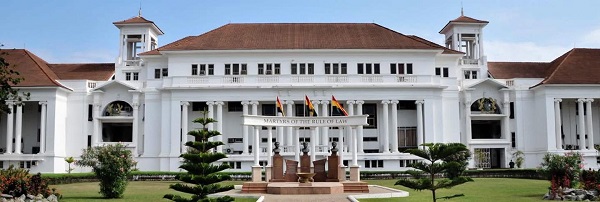
The Supreme Court of Ghana has declared the delegate system used by political parties to elect presidential and parliamentary candidates unconstitutional.
In a 5-2 majority decision delivered, the Court ruled that the long-standing system violates democratic principles and ordered all political parties to ensure every registered, card-bearing member participates in presidential and parliamentary primaries.
The ruling brings to an end decades of internal party elections conducted by a limited number of delegates.
The suit was filed by former Minister for Environment, Science, Technology and Innovation, Professor Kwabena Frimpong-Boateng; veteran politician Dr. Nyaho Nyaho-Tamakloe; and former Minister for Lands and Forestry, Dr. Christine Amoako-Nuamah.
The plaintiffs argued that the delegate system created inequality among party members by granting voting rights to a privileged minority while excluding ordinary members in good standing.
They told the Court that restricting voting rights to delegates was inconsistent with the democratic principles enshrined in the 1992 Constitution.
The Attorney-General’s Department supported the suit and urged the Court to adopt a “one member, one vote” approach.
In its submission, the State argued that political parties perform an important public function in Ghana’s democratic framework and that their internal electoral processes must reflect constitutional values of equality, participation and universal suffrage.
The Attorney-General further submitted that expanding voting rights to all registered members would strengthen accountability and deepen internal democracy within political parties.
The judgment means that going forward, presidential and parliamentary candidates will be selected by all registered members of a political party, instead of by delegates alone.
Political parties are expected to review their constitutions and structures to comply with the Court’s directive ahead of the 2028 general elections.
By Edem Mensah-Tsotorme