Features
Construction crew or demolition squad? Part 1

In every society, there are two distinct groups of people – those who solve problems and those who create problems. This reminds me of the days of yore when civics was taught as a subject in Ghanaian schools. And mind you, it was taught at the elementary level. By the way, for the uninitiated, civics is the study of the rights and obligations of citizens in a society. Not just rights as many Ghanaians have come to delude themselves that this is all democracy is about. More importantly, it is about obligations to the state.
I remember civics was my best subject at that stage of my formal education because during terminal examinations, I could easily get 100 per cent. All I needed to recall were the type of citizens and how they behaved. A question or two would almost invariably pop up from that domain. If my memory serves me right, we were told that we had the good citizens, bad citizens, active citizens, and passive citizens, of course, the active and good referring to those who were participating keenly and positively in the process of nation building. We were again told the good ones paid their taxes to help advance their societies.
On the other hand, we were taught that the bad ones, while not contributing anything to the efforts to promote their societies, were also wreaking havoc by their vices, in the process, causing their communities to retrogress. I do not recall the name of the book we were using but I remember how the passive citizen was characterised, in a pictorial representation, as someone sitting on a fence with folded arms while others were busy working hard for their communities to bring about positive change. At least, these only sat on the fence, but the bad ones indulged in all sorts of evil, kleptocracy leading by a mile.
On hindsight, I realise that it all boils down to the Construction Crew and the Demolition Squad. In biblical terms, we might say the Nehemiahs representing the builders, and the Tobiahs, Sanballats, and Geshems characterising the nation wreckers. Where do you belong as Ghana tries, through thick and thin, to move to the level where it will be respected among the community of nations?
As a nation our motto is: Freedom and Justice. Well crafted! But where is the justice after Osagyefo Dr. Kwame Nkrumah and other nationalists led us to snatch, as it were, our freedom from the jaws of the imperialist lions? Where is the justice when the slogan seems to have been implicitly replaced by the unwritten code that suggests that “All animals are equal, but some are more equal than others?”
In “Animal Farm”, the satirical masterpiece of a novel by the British author, George Orwell, he writes about the betrayal of other animals by a pig named Napoleon, and its ilk. After the animals chase the farm owner, Mr. Jones out of town for oppressing them, they draw up, as it were, a constitution, described as the Seven Commandments to promote certain principles of the animal community dubbed, “Animalism.” Those principles are as follows:
1. Whatever goes upon two legs is an enemy, (that is, humans)
2. Whatever goes upon four legs, or has wings, is a friend
3. No animal shall wear clothes
4. No animal shall sleep in a bed
5. No animal shall drink alcohol
6. No animal shall kill any other animal
7. All animals are equal
Initially, meetings are held on Sundays to plan and regulate life in the commune. But sooner than later, Napoleon and the other pigs cancel all meetings and insist that they will take all the decisions “for the good” of the other animals.
With time, Napoleon and its cohorts assume the air of superiority and arrogate to themselves the role of overlords, breaking all the rules of “animalism” and behaving just like Mr. Jones whose exploitation led to his overthrow.
First, the pigs start to take all the milk and apples for themselves to the exclusion of the other animals. Then, Napoleon and its band of traitors begin to sleep in cozy beds, drink whisky, walk on their hind legs with their chests out, that is, upright as humans, not on all fours any longer, wear clothes, and have a whip in hand ready to rein in noncompliant animals. Napoleon even trains the dogs as bodyguards which are used to charge at perceived rebels or troublemakers. Before long, Napoleon and its notorious gang replace the Seven Commandments espousing “Animalism” with the single code: “All animals are equal, but some are more equal than others.”
With sorrow of heart, the “common animals” spy on the “elite pigs” through the farmhouse window as they party hard at their expense, with a human friend they welcome into their company. Something else. Now, it is difficult to tell the difference between the pigs and humans. Does it ring a bell in Africa? Does it sound familiar in our body politic? Do you recognise those who have now put on airs; people who had nothing to boast of before they sought redemption in politics and became overnight millionaires? And why not, when no one insists that they should declare their assets as stipulated by the law!
The African-American civil rights leader and trade unionist, Asa Philip Randolph, (1889 – 1979), made a poignant declaration as follows: “Equality is the heart and essence of democracy; freedom and justice, equality of opportunity in industry, in labour unions, schools and colleges, government, politics, and before the law. There must be no dual standards of justice, no dual rights, privileges, duties, or responsibilities of citizenship. No dual forms of freedom!”
Speaking on the same issue, the 19th century British lawyer, judge, philosopher, law reformer, and writer, Sir James Fitzjames Stephen, (1829-1894) remarked:“The only shape in which equality is really connected with justice is this – justice presupposes general rules. If these general rules are to be maintained at all, it is obvious that they must be applied equally to every case which satisfies their terms.” In other words, “what is good for the goose is equally good for the gander.”
As a government where is the justice when the water that the city dwellers use to wash their cars is cleaner, in most cases, than what some cocoa farmers and other rural folk drink? Through no fault of theirs, our brothers and sisters in the rural areas are born with daunting odds stacked heavily against them. They struggle under those circumstances to meet their most basic needs of life – shelter, clothing, food, and water. Unfortunately, whatever help they get is usually piecemeal
The great pan-Africanist leader, Nelson Mandela blared the truth loud and clear when he declared that “Overcoming poverty is not a task of charity; it is an act of justice.”But where is the justice when the roads that link the food growing areas and mineral producing regions of the country to the big cities, appear to be in a perpetual state of disrepair? The dangerous roads put the lives of the people there at risk, especially, when they have to transport the critically ill to the nearest health facilities which in most cases, are mere first aid posts. We must be in government with the abiding consciousness that every human life is of equal importance. Otherwise, we have no business being there.
Government after government periodically applies some stopgap measures to improve the situation as if they are giving the people some charity. The most disrespectful aspect of this attitude is that most of the time, these repair works are done close to elections. What do you take the rural folk for? Dummies? No, they are only longsuffering and that should not be misconstrued to be a weakness.
The truth is ad hoc interventions are not the solution. An equitable distribution of projects under the national development agenda is the appropriate option. Besides, we cannot stop the rural-urban drift if we do not make the rural areas attractive enough to stem the tide. This is a basic fact that most of our leaders learnt long ago in their school days. They wrote about it in examinations and got their pass mark, or even an excellent grade. Yet they are not applying it practically. Or you think your script is not being marked any longer in school? The school of voters is scrutinising the performance of elected officials.
Do not forget that a stitch in time saves nine.
Writer’s email address:
teepeejubilee@yahoo.co.uk
By Tony Prempeh


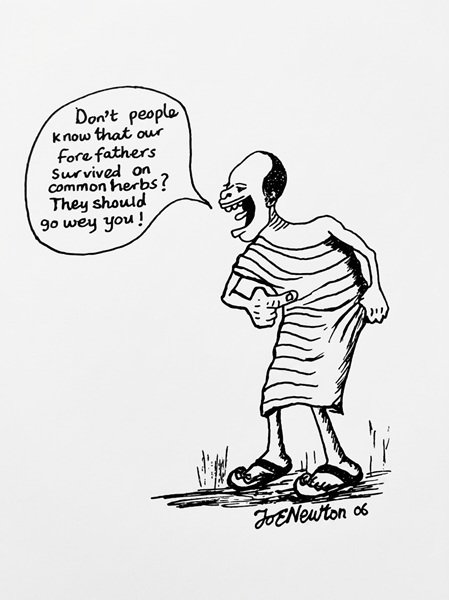
THE typical itinerant salesman in Sikaman is a herbalist. He is normally a slim macho with the capacity to perambulate the expanse of area covering the triangle of Accra-Tema-Ashiaman. In short, he can walk a total of 60 miles a day, marketing a product that cures every disease, including poverty. 
The door-to-door herbal pharmacist advertises his product by word of mouth. He has nothing to do with the Food and Drugs Board (FDB). After all, his concoctions do not feature on FM stations.
Those herbalists who cannot walk to propagate the herbal gospel, liaise with drivers of mass transportation and their mates. They are, therefore, given the chance to sell their products on Benz buses that ply the routes.
Normally, the herbalist starts his sales message with a prayer and Bible study. He asks the passengers to bow down their heads in supplication to God the father, the son, the Holy Spirit.
When a herbalist asks the passengers to close their eyes and bow their heads, Moslems on board naturally feel offended. They feel that the herbalist has no right to assume that every passenger is a Christian. They think such an assumption is an affront to Islam.
So a Moslem on board will raise the hand for a point of order. He’ll remind the herbalist that it would be in his own interest to mind his language.
“Be careful the way you address people in a public place. Not every person here is a Christian,” he’d state assertively.
Of course, the herbalist will promptly ignore him, but would all the same “watch” his tongue. Who knows whether or not the Moslem brother is inspired by Quoranic zeal to defend the tenets of Islam to the hilt?
When he starts saying, “Wallahi!” and “Inshallah!” it could be the beginning of proclaiming Islam as supreme, a point which must be driven home with talibanic precision.
So the herbalist must tread carefully lest he steps on fire.
The herbalist could even add a measure of mirth to it all, by announcing that Christians on board today have very interesting company on the journey, but that should not detract from the business of the day.
The Moslem brother will weigh the words carefully and offer a wry smile.
He must be careful the occasion does not degenerate into the use of semantics and proverbial oration to deride his conviction that public utterances must be mindful of religious sensibilities. He has made his point very clear and expects that it is taken in good faith in the interest of a peaceful journey.
The herbalist will now open the New Testament and preach salvation, stating clearly that salvation can come only through Jesus Christ and NOBODY else.
The Moslem brother will now start twitching his moustache. The visible and almost revolutionary reflexes of his upper lip can be an indication that sentiments have begun superseding reason, and the outcome could well be tragic now shift uneasily in his seat.
The time has come for him to also express his right to the religion of his fore-bears. He’ll put his hand into his pocket and rise to his feet. The time has indeed come!
This article was first published on Saturday, September 9, 2006
When the cause of a particular problem like sickness, disease, sudden illness, a social issue etc. are not known, it stands to reason that resolving it becomes a huge challenge.
Citizens would understand the government when public announcements are made to the effect that government is trying to find a solution to the issue, even though it is taking a while for it to be resolved because citizens are rational beings.
On the other hand, if the solution to a particular issue is known to everybody but the government for whatever reason, is dragging its feet in resolving it, citizens become frustrated and begin to lose trust in their leaders.
One such issue is the heavy traffic along a section of the Kasoa – Odokor road. A short stretch of bad road between the traffic light at the Weija Government Hospital and the entrance to the entrance of the overhead that leads to the N1, is the cause of the problem but nothing is being done about it, day after day, week after week, month after month. Thus is clearly unacceptable.
Another issue that requires urgent attention is the lack of pavements along a lot of streets in parts of the various Municipal Assemblies. Exercise is a prerequisite for long life and healthy living and for those of us who it has become a way of life, this issue of people putting up structures right to the edge of the drains beside the roads, are making life difficult for us.
We are compelled to walk along the roads, putting our lives at serious risk. Pedestrians should never be compelled to compete with vehicles on our streets and roads. Roads and streets are made for vehicles and pavements are made for pedestrians. That is the norm. Any attempt to normalise a situation where pedestrians are mingling with vehicles is insanity.
It is the road regulations that makes it so and therefore district or municipal assemblies are to take responsibility and ensure that spaces for pavements are not encroached upon. Citizens have rights that must be protected by their leaders and making pavements available to pedestrians, is one of them.
When we hear of teachers having sex with students, it appears it is something recent. It is not a new phenomenon. It has been there since Adam. Perhaps this issue is getting much attention due to the proliferation of social media. It was an open secret in times past when Teachers were in relationships with female students and some married them immediately after completion of school.
Some teachers were also known to be having unholy interactions with female pupils but due to the times that these acts occurred, human rights issues and the awareness around it, allowed such unscrupulous teachers to get away with their crimes.
Now we are in a different era and so a Headmaster is now in hot waters. He is alleged to have raped about 19 female students and as usual, some officials tried to cover it up and are also in hot waters and their actions or inactions in the matter are under investigation.
Why the man has been allowed to roam freely without being arrested is simply mind boggling. It appears that the law applies differently, depending on who you are. This issue came to public attention sometime in August this year, yet the police had not arrested or invited this man for question regarding the rape allegation.
It has come out that he is a Constituency Secretary of the ruling party and the question in the public domain is that, is it because he is a political figure that is why he is still walking around without questioning? I believe in the rule of law so let us hold our breadth and let the proper thing be done.
The police must however be seen to be active in this matter. God bless.
SKIP THE QUEUE, TAP THE NEWS
You can now read the Ghanaian Times and The Spectator newspapers from the comfort of your device via TimesNewsPlus.
Join our WhatsApp Channel: https://whatsapp.com/channel/0029VbBElzjInlqHhl1aTU27