Hot!
Akrasi Sarpong educates law enforcers on New Narcotics Control Act

- /home/u249204778/domains/spectator.com.gh/public_html/wp-content/plugins/mvp-social-buttons/mvp-social-buttons.php on line 27
https://spectator.com.gh/wp-content/uploads/2023/04/Mr-Sarpong-with-officers-at-workshop.jpg&description=Akrasi Sarpong educates law enforcers on New Narcotics Control Act', 'pinterestShare', 'width=750,height=350'); return false;" title="Pin This Post">
- Share
- Tweet /home/u249204778/domains/spectator.com.gh/public_html/wp-content/plugins/mvp-social-buttons/mvp-social-buttons.php on line 72
https://spectator.com.gh/wp-content/uploads/2023/04/Mr-Sarpong-with-officers-at-workshop.jpg&description=Akrasi Sarpong educates law enforcers on New Narcotics Control Act', 'pinterestShare', 'width=750,height=350'); return false;" title="Pin This Post">
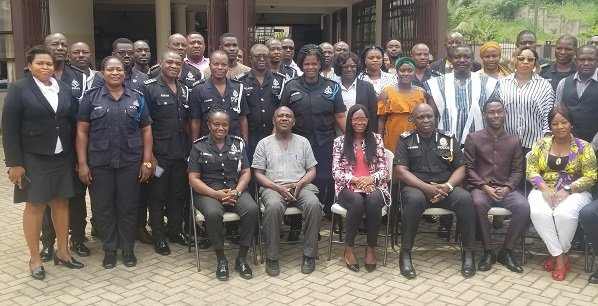
Mr Sarpong with officers at workshop
Though change is good and must be encouraged in all aspects of life, it becomes meaningless when those entrusted with implementing it fail to do the right thing, thereby making it useless.
To ensure that the right policies are carried out in the country’s amended laws, the law enforcement agents in the country have been urged to be very cautious in dealing with people who use drugs for personal gain in view of the new narcotics law of the country.
According to Mr. Yaw AkrasiSarpong, a former boss of the Narcotics Control Board (NACOB), who made the call, “the new drugs law of the country treats drug use and dependence as a public health issue rather than focusing on enforcement, incarceration, punishment, and repression.”
He told the law enforcement agencies “not to focus so much on arrests, prosecutions, and sentencing of persons using drugs for personal interest.”
Mr. Sarpong was addressing police prosecutors and detectives at a training workshop on ensuring the effective implementation of the Narcotics Control Commission Act 2020, Act 1019.
It was organised by the Perfector of Sentiment (POS) Foundation,a human rights civil society organisation that focuses its activities in the areas of access to justice, human rights,policy reform, youth development, and social accountability.
Under the theme, “Understanding the Narcotics Control Commission Act 2020, Act 1019: The Role of Law Enforcement and Prosecutors in Health, Rights-based Best Practices for Handling People Who Use Drugs in the Implementation of the Act.”
The new law was passed on March 20, 2020, and assented to by the President, Nana AddoDankwaAkufo-Addo, on May 11, 2020, which is an update on PNDC Law 236 promulgated in 1990.
Mr. Sarpong explained that people who use drugs rather need help “as it is a public health issue just like someone suffering from malaria or an ulcer.”
He questioned why the law should imprison someone for the possession of weed (or ‘wee’) for personal use and later spend taxpayer money to take care of the person in jail.
He stressed the importance for law enforcement agencies and prosecutors to be abreast of the law and know their roles in its delivery.
“I am not encouraging people to use drugs or weed; it can be addictive, but let us differentiate between private life and public safety,” he indicated.
Mentioning that the new law allows someone to possess a certain quantity of weed for daily use, he said, “the police are usually the first point of contact; their role in the safety and security of citizens is very important, hence the need to ensure proper implementation of the new law within the spirit that it is intended.”
The Executive Director of POS, Jonathan Osei-Wusu, on his part, also noted that drug use was a public health and human rights issue and described it as a “substance use disorder.”
He said, “it has been tested and proven all over the world that substance use disorder is not an issue of criminality where people are to be sentenced but rather need help.”
He pointed out that rehabilitation had been provided under the new state law to help such people reform.
The Executive Director further argued against sentencing people who use drugs for relaxation when they have not killed anyone or caused any violence.
He indicated that if such people were sentenced for smoking the substance, “they come out hardened and more problematic for society.”
Ms. Maria-GorettiAneLoglo, with the International Drug Policy Consortium, said Ghana has become an example for many West African states in reviewing its drug policies.
And there was the need to take further steps in the implementation of the law “so that we get it all right for others to follow.”
From Kingsley E. Hope, Kumasi


General Secretary of the New Patriotic Party (NPP), Justin Kodua Frimpong, has filed his nomination to contest the position of General Secretary again as the party begins its rebuilding efforts ahead of the 2028 general elections.
He was accompanied by party stalwarts and supporters who were in high spirits, expressing confidence that he is the right person to hold the position.
Speaking after filing his nomination, Mr Kodua Frimpong assured the rank and file of the party that he would not disappoint them.
“I can assure you that the faith the rank and file of the party have had in me, I will never disappoint them,” he said.
He also pledged to run a clean campaign devoid of personal attacks.
“I can assure you that our internal campaign will be devoid of personal attacks,” he told his fellow contestants and the rank and file of the party as he seeks to retain his position.
His tenure has seen the party through the 2024 general elections, where the NPP lost power to the National Democratic Congress (NDC) after eight years in government.
The party is currently in a rebuilding phase, with internal elections scheduled to elect new national executives to lead its reorganization towards the 2028 polls.
The General Secretary position is considered one of the most influential in the party’s administrative structure, responsible for the day-to-day running of the party secretariat and implementation of party decisions.
By Edem Mensah-Tsotorme

The University of Ghana Medical Centre (UGMC) has disputed claims made on social media by comedian Michael Blackson concerning the treatment given to his late mother, saying a review found that the allegations did not accurately reflect what happened during her stay at the hospital.
In a statement issued in Accra on August 5, 2026, the management of UGMC expressed condolences to Mr. Blackson and his family over the death of his 83-year-old mother, who died at the facility on July 16, 2026.
The hospital said it had taken the concerns raised by Mr. Blackson seriously and conducted a thorough review in line with its clinical and administrative procedures.
According to the statement, the facts presented by Mr. Blackson on social media contained “numerous inaccuracies” and did not accurately reflect the medical care provided to his mother.
UGMC explained that she was referred to the facility from another hospital and received treatment there from May 27 to July 16, 2026, a period of about eight weeks.
The hospital stated that it would not release details of her diagnosis, treatment, medical records or other aspects of her care because it had a duty to protect patient confidentiality, even after death.
It said the decision was intended to respect the dignity of the deceased and the privacy of her family.
UGMC further stated that all clinical decisions at the facility are made by qualified healthcare professionals based on medical judgment, established standards of care and the best interests of the patient.
The statement added that such decisions are made in consultation with authorised family representatives where necessary and that billing and financial procedures are governed by institutional policies and are separate from clinical decision-making.
The hospital noted that it values feedback from patients and their families and considers both positive and negative comments important for improving the quality of care.
Mr. Blackson had earlier used social media to criticise the care his mother received at UGMC, prompting the hospital’s response.
By: Jacob Aggrey