Features
Arming the Sikaman journalists to the teeth

- /home/u249204778/domains/spectator.com.gh/public_html/wp-content/plugins/mvp-social-buttons/mvp-social-buttons.php on line 27
https://spectator.com.gh/wp-content/uploads/2026/08/Journalist-covering-a-programme.jpg&description= Arming the Sikaman journalists to the teeth', 'pinterestShare', 'width=750,height=350'); return false;" title="Pin This Post">
- Share
- Tweet /home/u249204778/domains/spectator.com.gh/public_html/wp-content/plugins/mvp-social-buttons/mvp-social-buttons.php on line 72
https://spectator.com.gh/wp-content/uploads/2026/08/Journalist-covering-a-programme.jpg&description= Arming the Sikaman journalists to the teeth', 'pinterestShare', 'width=750,height=350'); return false;" title="Pin This Post">
THE relationship between New Times Corporation (NTC) and African Concrete Productions (ACP) is based entirely on matters of the stomach. Each depends on the other in a dietary symbiosis, reinforced by the close proximity of each other
At lunchtime, you’d see a particular set of Times workers marching regimentally to ACP to face the wall. You’d think they are soldiers. It has long been declared that the company manufactures the best kokonte in the Greater Accra Region. ACP is, therefore, a culinary haven for those NTC kokonte fans, both male and female.
As the NTC kokonte warriors cross the border to ACP, you’d see some ACP banku fanatics dancing joyously to NTC. They are lucky folks because they do not have to obtain visa to enter into ‘Times’ to attack the balls of banku with precision and accuracy. They also claim that the lightsoup at ‘Times’ is arguably the best in West Africa.
So the relationship between the two entities was quite cordial and based practically on stomach palaver, until ACP workers staged an industrial revolution, whereupon the managing director, accountant and estate manager were allegedly stripped naked and locked up in a room. An insurgency had began in earnest.
An ACP worker came to ‘Times’, this time not to eat banku and okro. He had come to inform newsmen that juicy stuff awaited them at ACP. It could make a front page lead story.
A camerawoman and a female reporter were accordingly dispatched to go and bring back news, juicy news as juicy as kokonte and groundnut soup.
I was driving to work when I espied the familiar camerawoman clicking away outside the ACP premises. I didn’t see any ‘Times’ reporter but angry workers who were on the verge of getting violent. I slowed down and the driver behind blew his horn at me like a lunatic. I drove on.
Later, I heard the reporter and camerawoman were harassed and brutalised. The report came,. “The camerawoman, Mrs Salome Adonu-Agbottah and reporter Mrs Doreen Allotey, in an attempt to retrieve the camera which the workers had seized from them were severely beaten. They were manhandled and almost pushed into a big gutter opposite the company’s premises.
BRUISES
“….The camerawoman had bruises on her body, her hand bag was destroyed and the money in it stolen. Mrs Allotey’s watch was also snatched and her feet stamped on.”
Luckily, it was not her nose that was trampled upon. She has a beautiful nose.
The bad news was received with extreme sorrow. If the victims had been men, it would not have seemed too bad. But to brutalise women is just unacceptable. The New Times Corporation has not stopped mourning the incident which has been condemned in many circles.
Some people keep asking me why Times sent females to cover a potentially violent demonstration. I tell them they might as well ask why CNN’s amazon, Christina Amanpour, is assigned to cover the carnage in Bosnia-Herzegovina and Rwanda. She is always on the frontline in jeans and jacket.
Journalism is a potentially hazardous profession, and once you accept to study and practise the trade, you might as well bone up to face any assignment as long as your superiors feel you are capable of handling it or you have demonstrated the capacity to handle it. Both males and females can be assigned anywhere, anytime just like policemen and women are assigned.
The only difference between cops and pressmen is that the latter are armed only with a pen and the former with a gun. The question is should newsmen also arm themselves so that in any event of an assault they would not be found wanting in self-defence? They can’t adequately defend themselves with a pen and a jotter. A pen cannot even disfigure an opponent’s upper lip.
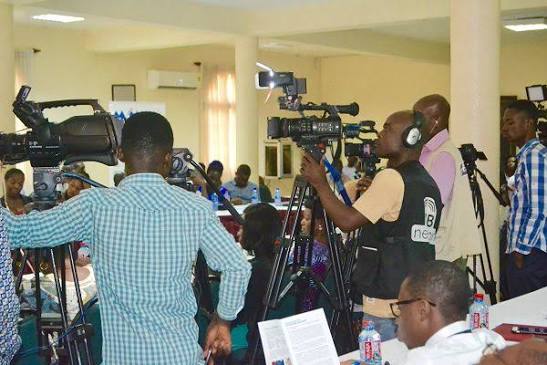
Photo-journalists have particularly suffered violence. Spectator ace-cameraman Vincent Dzatse was severely assaulted by AMA men when he attempted to take pictures of their indiscretions.
Sports cameraman, P. K. Arthur has been beaten more than once at the sports stadium when riots errupted and he wanted to capture it on his lenses.
Some sports journalists have been banned from entering the Accra Sports Stadium by supporters because in their comments, they didn’t write “sense”. Some supporters once nearly lynched Christian Abbew, Spectator Sports Editor, near a courtroom. He was stoned like the biblical Stephen. He had gone to defend a contempt charge.
I think it is time journalists met and discussed how best to defend themselves in any event of an attack by individuals or mobs. In the pursuance of their duty, they must be free from harassment and assault.
Some journalists go to work and return home with a black-eye or a double fore-head. It is just not right. Something has to be done about it. I think journalists should be armed. But first we must be trained in the use of firearms so that our warning shot do not hit below the belt. What about training in Kung Fu?
This article was first published on Saturday, October 17, 1998.

Have you noticed how many young, seemingly healthy people both in Ghana and all over the world are suddenly falling seriously ill or dying young?
When news breaks of a young person suffering a sudden stroke, a heart attack, or a total physical collapse, people are often shocked and confused. They ask, “How could this happen? They were so young!”
Medical science often blames specific diseases, but if you look deeper at how the modern world treats the human body, a much bigger picture emerges. The real killer is not just a sudden illness it is a massive, ongoing wave of chronic stress, burnout, and modern pressure.
Here is a clear, step-by-step look at why this crisis is happening, explained simply.
1. The trap of endless pressure and “hustle culture”
What is happening: Today’s youth face an overwhelming amount of pressure. Whether it is trying to find a stable job, survive tough economic times, or meet high expectations from society and family, young people are told they must constantly work harder, push further, and never stop.
Why it is dangerous: The human body can handle short bursts of intense pressure, but it was never designed to be stuck in “survival mode” 24/7. When a young person spends months and years worrying about money, the future, and survival, their brain stays convinced they are in constant danger. This keeps stress hormones flooding their system day and night.
2. The slow poison of stress chemicals on young hearts
What is happening: When your body is flooded with stress hormones like cortisol and adrenaline for years, it takes a heavy toll.
Why it’s dangerous: In the past, severe heart and blood pressure problems were things older adults dealt with. Today, because of constant stress, young people are developing stiff blood vessels, high blood pressure, and overworked hearts early in life. When a young body is pushed past its absolute limit without rest, the heart can suddenly give out.
3. Smartphone overload and brain exhaustion
What is happening: Unlike past generations, today’s youth carry a 24/7 stress machine in their pockets: their smartphones. They are constantly bombarded with bad news, financial worries, and the pressure to look successful compared to everyone else online.
Why it’s dangerous: The brain never gets a moment of true peace. Because young people check their phones late into the night, their nervous systems never get to shift into “rest-and-repair” mode. They are burning fuel faster than their bodies can replace it, leading to deep neurological and physical burnout.
4. The dangerous habit of pushing through pain
What is happening: In many cultures-especially in vibrant, hard-working communities like those in Ghana-endurance is praised as a badge of honor. Young people are taught to “hustle hard,” hide their pain, and never complain.
Why it is dangerous: When you force yourself to ignore physical exhaustion, headaches, and chest tightness because you feel you have to “keep going,” your body pays the price. Unexpressed stress turns into physical tension and hidden inflammation. Over time, ignoring what your body is screaming for breaks the biological vessel down from the inside out.
Time for a wake-up call
The rising loss of young lives globally and locally is a tragic warning sign. It proves that our modern way of living-which values endless productivity and hustle over human health-is literally killing people.
To save the youth, we have to stop treating burnout like a joke and stop glorifying dangerous overwork. We need to teach young people how to protect their health, give their nervous systems a break, and realise that true success should not cost them their lives.

Pillars for making productivity a national movement
3. Strengthen and resource productivity institutions
MDPI was established precisely to champion productivity improvement in Ghana’s public and private sectors. Yet like many institutions of its kind across Africa, it has often operated with budgets and staffing levels inconsistent with its strategic mandate. This must change. Institutions like MDPI should be treated as strategic national assets equipped with modern training infrastructure, incentivised to deploy consultants into enterprises and public institutions, and empowered to set national standards for workforce productivity. Regional- and district-level productivity extension services, analogous to agricultural extension officers, could provide practical, hands-on support to SMEs and local governments across the country.
4. Incentivise productivity in the public sector
The public sector remains the single largest employer in Ghana and sets the tone for national work culture. If productivity is rewarded and celebrated in government, it will radiate outward. Ghana should revisit its performance management frameworks for the civil and public service, moving away from input-based assessments (attendance, processes followed) toward outcome-based evaluations (results delivered, service quality achieved). Linking promotions, bonuses, and recognitions explicitly to productivity outcomes will signal, powerfully, that the state is serious. Ghana’s productivity movement must not be left to the private sector alone.
5. Harness technology as a productivity multiplier
Digital technology is the great productivity equaliser of our age. Mobile money has already transformed financial productivity for millions of Ghanaians. The question is how to extend this digital dividend to agriculture, healthcare, education, logistics, and governance. Ghana’s digital transformation agenda, including Ghana Post GPS, the digitisation of government services, and the rollout of broadband infrastructure must be purposefully linked to productivity outcomes. Beyond infrastructure, Ghanaian enterprises need support to adopt enterprise resource planning systems, data analytics tools, and digital supply chain solutions that allow them to do more with less.
The role of leadership: Modelling the movement
National movements do not sustain themselves on policies and pillars alone. They need visible, credible leaders who embody their values in practice. Ghana’s productivity movement needs champions in the Presidency, in the boardrooms of our largest companies, in the media, in our universities, in our traditional leadership structures etc, who will speak about productivity not as a development cliché but as a personal and collective commitment.
Consider how Singapore’s transformation was driven as much by Lee Kuan Yew’s relentless personal discipline and public messaging around hard work, meritocracy, and efficiency as it was by any specific policy. Or how Rwanda’s monthly Umuganda community work days, where citizens, including the President, collectively clean, build, and improve their environment, have created a visible, embodied culture of collective industry. Ghana has its own rich tradition of communal labour and shared responsibility. We need to revive and modernise these values as the cultural architecture of our productivity movement.
SMEs: The engine room of Ghana’s productivity future
Small and medium enterprises account for the overwhelming majority of employment and output in Ghana’s economy. Any serious national productivity movement must place SMEs at its centre. Currently, most Ghanaian SMEs operate with limited access to management training, modern business tools, or productivity consulting support. The result is a large swathe of the economy running at a fraction of its potential efficiency.
A national productivity movement for SMEs would involve: accessible, subsidised business management training at district level; productivity clinics staffed by MDPI consultants and retired business executives; peer-learning networks where successful SME owners share improvement strategies; and financial incentives such as tax relief or grants for enterprises that can demonstrate measurable productivity improvements. Digital platforms can democratise access to these resources far beyond what physical infrastructure alone could achieve.
Conclusion: The movement starts now
Making productivity a national movement in Ghana is not a matter of waiting for the perfect policy, the right government, or a more favourable economic environment. It begins now — with each institution deciding to be more effective, each leader choosing to model the values they preach, each worker holding themselves to a higher standard of output and quality.
Ghana’s history shows that when our people mobilise around a shared goal, be it independence, democratic consolidation, or national disaster response, we are capable of extraordinary collective achievement. Productivity is the next frontier of that mobilisation. It is quieter than political revolution, less dramatic than peacekeeping, but ultimately more transformative than either.
The policy frameworks exist. The institutions are in place. The international partnerships through initiatives like the Africa Kaizen Initiative are ready to support us. What remains is the will to move from paper to practice, from aspiration to action, and from isolated efforts to a movement that every Ghanaian feels part of.
The time for Ghana’s productivity movement is not tomorrow. It is now.
By Ethel Ansah-Antwi
Management Development and Productivity Institute (MDPI), Ghana