Features
Response of our local assembly leaders is unacceptable

- /home/u249204778/domains/spectator.com.gh/public_html/wp-content/plugins/mvp-social-buttons/mvp-social-buttons.php on line 27
Warning: Trying to access array offset on false in /home/u249204778/domains/spectator.com.gh/public_html/wp-content/plugins/mvp-social-buttons/mvp-social-buttons.php on line 27
&description=Response of our local assembly leaders is unacceptable', 'pinterestShare', 'width=750,height=350'); return false;" title="Pin This Post">
- Share
- Tweet /home/u249204778/domains/spectator.com.gh/public_html/wp-content/plugins/mvp-social-buttons/mvp-social-buttons.php on line 72
Warning: Trying to access array offset on false in /home/u249204778/domains/spectator.com.gh/public_html/wp-content/plugins/mvp-social-buttons/mvp-social-buttons.php on line 72
&description=Response of our local assembly leaders is unacceptable', 'pinterestShare', 'width=750,height=350'); return false;" title="Pin This Post">
I took my almost 86 year old mom, to see the Doctor as part of the processes for her normal checkups last Monday.
It has been raining for some time now in Accra and a section of the main road from Kasoa to Budumburam had been closed off to traffic and so back streets are the only way, one can go to certain areas close to Budumburam with a vehicle.
Instead of the local assembly ensuring that these alternative routes are made motorable, they have not done anything meaningful about them.
Usually, as is the standard practice in road construction, it is the duty of the contractor to make alternative routes available to motorists when the need for diversion occurs.
The local assembly authority also has a responsibility to ensure that such diversions are done taking into account the safety and health of the people travelling on those streets or roads as well as the communities through which the streets passes through, especially in terms of dust suppression.
Portions along the alternative streets from my mom’s place to an area close to Kasoa where one can join the main Kasoa- Cape Coast Highway, had flooded and sedans could hardly pass through.
My mom was so afraid that the vehicle that was bringing her to Kasoa, could be involved in an accident such that she lost appetite and could not continue to eat her food. Exactly a week earlier I also had a similar frustrating experience when travelling to the Western Region.
It took us two hours to cover a short distance between an area called Fan Ice to just a little beyond Budumburam. All what was required was for the use of rocky material to fill a portion of the diverted road to enable traffic to flow smoothly but this was not done.
On our return journey to Accra, nothing has still been done about it and we spent two hours again to cover that same short distance and one begins to wonder why the local authority leaders should be paid their monthly salaries.
Yesterday, there was a news item about the traffic that had built up along a stretch of Accra Kumadi highway between Sapeiman and Toman.
Apparently the stretch was so deplorable that perhaps it was worse than what I encountered on the Accra –Cape Coast road.
The road engineer whose duty it is to ensure the right thing is done by the contractor, apparently failed to do his job. In a country where people charged with responsibility by the state, fail to do their job and are not held accountable, this is one of the results we are going to experience, on a frequent basis.
There is a certain culture of someone else should do it and it is not helping our national developmental effort.
We have this tendency for let us leave it to go. Instead of citizens taking on people on authority to help correct things, everybody is afraid to tackle the problem, due to fear and as long as this attitude remains, people in authority will continue to act with impunity.
If there is no threat of shame or embarrassment or loss of job, nothing will happen. One of the issues I have decided to take the local assemblies on, is the proliferation of shops along streets without any thought for pedestrian walk ways.
Pedestrians are always compelled to walk close to speeding vehicles because there are no pavements for them to use.
What will be painful is seeing something that you know is wrong but deciding not to do anything about it and you become a victim of the problem, or someone close to you becomes a victim of it.
Let us begin to be citizens and not spectators as President Bush once said and reiterated by President Akufo-Addo. God bless.
By Laud Kissi-Mensah

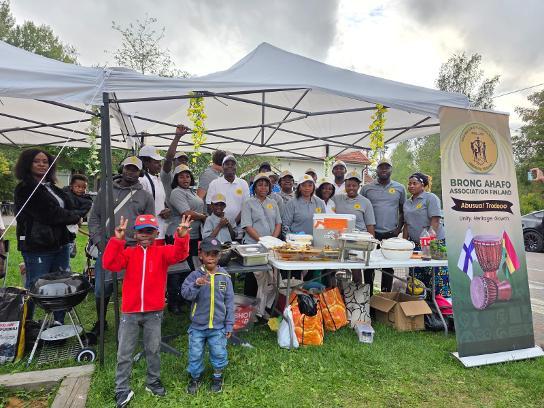
Today, I focus on the Brong Ahafo Association Finland, as I continue with my description of institutions or personalities and their accomplishments as part of the Ghanaian Diaspora in Finland.
The association in Finland has chalked significant achievements or successes which must be made known to the public.
Aim and mission
The Brong Ahafo Association Finland was established in 2007. The three people who met to plan the birth of the association are Mr Augustine Tweneboah-Kodua, Elder Matthew Anini, and the late Mrs Comfort Dapaah Agyemang. They invited many others to help establish the association, which is officially registered as the Brong-Ahafo Association Finland.
The mission of the Brong Ahafo Association includes the promotion of unity among people from the former Brong-Ahafo Region of Ghana, which is currently divided into three regions—Ahafo, Bono, and Bono East Regions.
The association also aims to preserve and promote the Bono and Ahafo culture or traditions. Also, its goals include contributing to developmental projects in the Ahafo, Bono and Bono East Regions of Ghana. Another key aim is to help strengthen cooperation of its members and other Ghanaian migrants with others in Finland as the host country.
Events and achievements
The Brong Ahafo association acts as a family to its members. In this way, it can be said that although Finland has a robust social welfare system, the association comes in where close family support or interaction is needed.
Living away from one’s home country and family is not easy and as such the Brong Ahafo Association becomes an important part of social networks, vital in providing informal social security that cannot be provided by public institutions.
The association also serves as an ambassador of Ghanaian culture in the Finnish society by promoting cultural engagements. Its members engage in volunteering its time and skills, in helping individual members and for charity projects in their home regions in Ghana. The association also actively participates in cultural celebrations and family gatherings organised by individual members. It also holds an annual Easter party during Easter period.
Role in the Ghanaian community in Finland
The association plays a prominent role in the Ghanaian community in Finland. The association was the first to be formed after the Ghana Union Finland. It is thus a pioneer in that sense of an association representing a Ghanaian ethnic group. The association helps or gives support to its members who are bereaved as a way to commiserate with them and to help them organise the funeral.
The Brong and Ahafo association also collaborates with the Ghana Union Finland, an association for Ghanaian migrants in Finland whose aims include bringing together all Ghanaian migrants resident in Finland and promoting cultural activities for a better intercultural and multicultural understanding. Thus, the group also mobilises members for various activities that help in integration efforts in the Finnish society.
Displaying a rich culture
By its activities, the Brong Ahafo association proudly displays the Bono and Ahafo culture, as part of the larger Akan culture in Ghana. Like other groups representing the Ga-Adangbe, Mfantseman, Eastern Region, and Nzema, the association endeavours to showcase the culture and values of their ethnic origins as well as hold the general Ghanaian heritage in high esteem.
“The association has been quite effective in maintaining cultural identity of the Bono and Ahafo people, creating social networks among members and with others in Finland”, the Secretary, Mr Kwasi Owusu Afriyie, stated.
Members volunteer to support in informal ways that public institutions may lack the full capacity to accomplish, which also helps to integrate members into the Finnish society. Through social events, traditional celebrations, and home visits, the association acts as family for its members during postpartum periods, child dedication in church, funeral rites, etc.
Challenges
The pace of organising things for the association can slow down sometimes, but it is quite impressive to note how members revive it and keep the ‘family spirit’ alive.
The COVID-19 period made the association quite dormant. Bringing back people together has been quite challenging, and requires much dedication before reorganisation can pay results, the Secretary hinted.
Finding a suitable venue and the funding for organising cultural events is quite challenging. It is also not easy supporting important life events such as helping nursing mothers who have no family in Finland. Thank you.

Someone said, if we cannot plan for an occurrence as predictable as the annual rains, then what else can we plan for as a country? God has caused nature to schedule rains for specific periods or months within the year and everybody knows this.
One need not be a meteorologist to tell that the rains will fall in May and June every year. Any serious person who has something that the rains can affect, would therefore plan taking into consideration the likelihood of the rains falling. Therefore to find out that a whole country like ours, had not planned effectively, is mind-boggling.
The report by the World Bank that fiscal policy measures by the Finance Minister has led to no money being released for the World Bank sponsored project to deal with the perennial flooding situation in Accra, is so disappointing. The fact that this contributed immensely to the flooding in Accra, is an understatement.
There have been fires in our markets, but who is checking the wiring on a regular basis as a system designed to prevent future outbreaks? The occurrence of fires in our markets is something that must engage the attention of government and all the stakeholders.
The causes may be several but if a system of proper fire prevention is in place, l believe the number of occurrences will be drastically minimised. Electrical wiring for instance has been found to be one of the causes of market fires. Fire as we know from the experts, can only happen if these three things are present, namely source of heat, combustible material and oxygen i.e. air.
lf any one of these is missing, there will be no fire. It has been realised that heat generated in wires have caused fires in the past and therefore, an effective system must be put in place to ensure that, only certain approved qualified electricians, can execute wiring jobs in our markets instead of the current situation where different electricians execute wiring with different types of wires, of different quality, dimensions etc.
Preventive inspections schedule must also be put in place to endure compliance with uniform wiring standard, as well as adherence to expiry dates of the wires.
What baffles me is why some MCEs and DCEs are still at post while things are deteriorating in their areas of influence and yet the President or the Minister for Local Government seems to be unwilling to relieve them of their positions. People have lost their lives, official count is about 37 lives, properties worth millions of Ghana Cedis have been destroyed, people’s livelihoods have been destroyed and they are at ground zero.
We can go on and on and on about the devastating impact of the recent floods. Suddenly, we have these local authority heads, all over the place, demolishing buildings after the flood. Is this not insanity? Where were the LUPSA Engineers who issue permits at the local assemblies?
If they were doing their jobs, for which they are paid every month, they would have seen people constructing structures at Ramseyer sites. They would have seen people putting up structures very close to the bank of streams or rivers and could have enforced the regulations, which could have averted the level of impact on lives and property.
One particular issue which drives me crazy is the Kasoa to Mallam Junction stretch of the N1. The traffic jam between West Hills Mall and Weija Junction is due to the flooding of a place called Ataala. Anytime it rains heavily, the area floods and vehicles moving from West Hills towards Weija cannot use their normal lane but are forced to switch to the inner lane of those headed towards West Hills Mall from Weija and it did not start yesterday. I am so, so disappointed. God Bless.
By Laud Kissi-Mensah