News
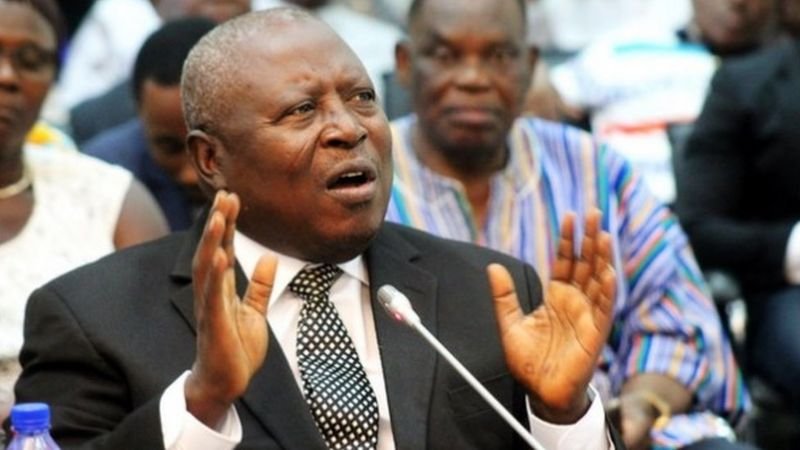
Stop the attacks or I’ll defend my integrity – Martin Amidu cautions

- /home/u249204778/domains/spectator.com.gh/public_html/wp-content/plugins/mvp-social-buttons/mvp-social-buttons.php on line 27
https://spectator.com.gh/wp-content/uploads/2020/11/Martin-Amidu.jpg&description=Stop the attacks or I’ll defend my integrity – Martin Amidu cautions', 'pinterestShare', 'width=750,height=350'); return false;" title="Pin This Post">
- Share
- Tweet /home/u249204778/domains/spectator.com.gh/public_html/wp-content/plugins/mvp-social-buttons/mvp-social-buttons.php on line 72
https://spectator.com.gh/wp-content/uploads/2020/11/Martin-Amidu.jpg&description=Stop the attacks or I’ll defend my integrity – Martin Amidu cautions', 'pinterestShare', 'width=750,height=350'); return false;" title="Pin This Post">
Former Special Prosecutor, Mr.Martin Amidu has sent a caution to government, to stop appointees attacking him, else, he will come out to defend his integrity.
Speaking in an interview with Citi FM’s Umaru Sanda Amidu, he said, the Minister of Finance, Mr.Ken Ofori-Atta was in his house on the day he was writing his report on the Agyapa royalties deal, and that he does not want to wash dirty linens in the public.
“The minister for Finance has been my friend , why will I go for him, when I was writing the report didn’t he come to this house, was he not here on the 21st October, what did I tell him, why is he churning out information about me, and budget and all that should I come out?,” he quizzed.
He further said, “Let’s stop it , and I say let’s stop it before we wash our dirty linen in public.”
“I have said that I was not going to talk to the press since my resignation. I’m being pushed by so-called responses to me which contain blatant falsehood. But I do not want anybody to blame me when I speak out and it becomes unpalatable. So, either the attacks stop or I’ll defend my integrity. It is something I won by dint of hard work from PNDC till date. So I will not allow anybody, not even the President, to pull that integrity into the mud,” he said.
“Anyone who tries to fight corruption must be aware from the beginning that corruption will fight back, and from all that is going on, corruption is fighting back and it’s demonstrating that the whole issue about fighting corruption is only rhetoric and the time of reckoning has come. And nobody should push me because if I decide to respond, I will do so without fear or favour even to the extent of losing my life for speaking the truth and defending the Constitution of Ghana.”
Responding to claims by the Assin Central Member of Parliament, Kennedy Agyapong, who reportedly said Mr. Amidu had medical records from Germany which he has been concealing.
“Kennedy Agyapong is known in Ghana as someone who spews lies at any person of integrity who tries to fight corruption. So I am not surprised that he stooped that low to make accusations without any foundation.”
“I have never been to Germany on any occasion and let alone for a medical check, therefore, his allegations are false. And if he has any document to the contrary, he should produce them because my passports are available as evidence.”
Mr. Amidu further alleged that there have been threats on his life and property, saying, President Akufo-Addo should be held responsible if he is harmed.
“Now I am a private citizen and nobody can control me and I have the constitutional right to defend myself and the Constitution of Ghana as by law established. All these threats of murdering me and burning houses, I am aware…I know the persons behind it and the President will be responsible for anything that happens to me,” he told Umaru Sanda Amadu.
By Edem Mensah-Tsotorme


The year was 1993, and the destination was Australia. Down Under, the Black Satellites—Ghana’s exceptionally gifted Under-20 national team—were busy treating the footballing world to a masterclass. They ran, they tackled, they outclassed England, and they fought their way to a historic silver medal. But while the players were leaving their blood and sweat on the pitch in Sydney, an entirely different, much more lucrative sport was being played in the VIP lounges and luxury hotel rooms.
It was the ancient, revered African art of “Management Allowance Harvesting.”
Upon the team’s return, the newly appointed Ghana Football Association (GFA) Chairman, Samuel Nana Brew-Butler, glanced at the tournament’s financial ledgers. What he discovered was a mathematical miracle that would baffle even the finest economists.
The Management Committee, heavily populated by suit-wearing, brief-case-wielding officials under the leadership of Paul Kunke, had pulled off a breathtaking victory. They didn’t win a trophy, but they had comprehensively defeated the actual athletes in the per diem stakes. The officials had taken home significantly more money in allowances than the young boys who had spent 90 minutes sweating under the blistering Australian sun.
Faced with a squad of administrators who clearly possessed a higher “strike rate” at the bank than the strikers did on the field, Nana Butler did the only logical thing. He took a giant administrative sledgehammer and completely dissolved all the GFA Management Committees.
The True “Strikers” of Ghana Football
To understand the sheer genius of the Kunke-led management committee, one must appreciate the sheer physical exertion required to be a football official in the 1990s.
While a player like Augustine Ahinful or Samuel Osei Kuffour only had to worry about running several kilometres, avoiding bone-crushing tackles, and scoring goals against Brazil, the management committee faced far more hazardous perils. There were heavy per diem envelopes to be lifted. There were grueling, five-star buffet lunches to navigate. There was the exhausting psychological stress of checking whether the hotel’s air conditioning was set to the perfect ambient temperature.
Is it any wonder, then, that the administrative “allowance-to-sweat ratio” was heavily skewed toward the boardroom? The players were running on patriotism and the promise of future glory; the officials were running on high-grade, cold, hard foreign currency. Rumour has it that the officials’ wallets were so heavy they required their own tactical formations just to be carried through airport customs.
The Butler Cleans House
When Nana Brew-Butler took over the reins of the GFA, he brought with him a revolutionary, almost bizarre philosophy: that football money should actually have something to do with the people playing football.
When the financial reports from the 1993 World Youth Championship landed on his desk, the numbers told a hilarious story. The management committee had apparently operated under the assumption that they were the primary entertainment act, and the eleven players on the pitch were merely their opening warm-up band.
Recognising that Ghana’s real footballing talent was sitting in the committee rooms engineering per diem payouts rather than scoring goals, Butler struck. In a swift, unceremonious purge, he dissolved the committees, effectively telling the suits that if they wanted to earn that much money from football, they should buy some boots, practice their step-overs, and try making the squad for the next tournament.
It was a dark day for administrative freeloaders across the capital. For a brief moment in Ghanaian history, the ecosystem was thrown out of balance: the players were treated as heroes, and the committee members were forced to look at their bank accounts and reflect on the tragic loss of their premium per diems.
A Timeless Legacy
Decades later, the ghost of Australia ’93 still hovers over Ghanaian football. Nana Butler’s mass dissolution remains a golden, satirical benchmark for how to deal with the eternal affliction of “Committee-itis”—a disease where the number of officials on a plane outnumbers the players, and where the budget for official blazers exceeds the budget for training kits.
The lesson from 1993 remains clear: if you allow the suits to score more heavily than the boots, you will eventually find yourself with an empty trophy cabinet and a very wealthy boardroom. Cheers to Nana Butler, the man who reminded the nation that football is played with a leather ball on grass, not with a calculator in a five-star hotel.
By Emmanuel Amponsah
The writer is a former Editor of The Spectator

Member of Parliament for Agona West, Ernestina Ofori Dangbey, has donated mono desks to the Swedru School of Business (SWESBUS) as part of efforts to improve education infrastructure in the constituency.
Presenting the desks on Tuesday, the MP said the intervention is aimed at addressing some of the infrastructural challenges facing the school and enhancing the learning experience of students.

“Investing in Education, Investing in Our Future. Yesterday, I presented mono desks to the Swedru School of Business as part of my ongoing efforts to strengthen the educational system in Agona West,” she stated.
“Every student deserves a conducive environment in which to learn, grow and achieve their full potential. This intervention is therefore aimed at helping address some of the infrastructural needs of the school and improving the learning experience of our students.”
Madam Ofori Dangbey reaffirmed her commitment to supporting schools in Agona West and creating opportunities for young people in the area.
“I remain committed to supporting our schools and creating opportunities for the young people of Agona West. Agona West Will Continue to Rise,” she added.
By Edem Mensah-Tsotorme