News
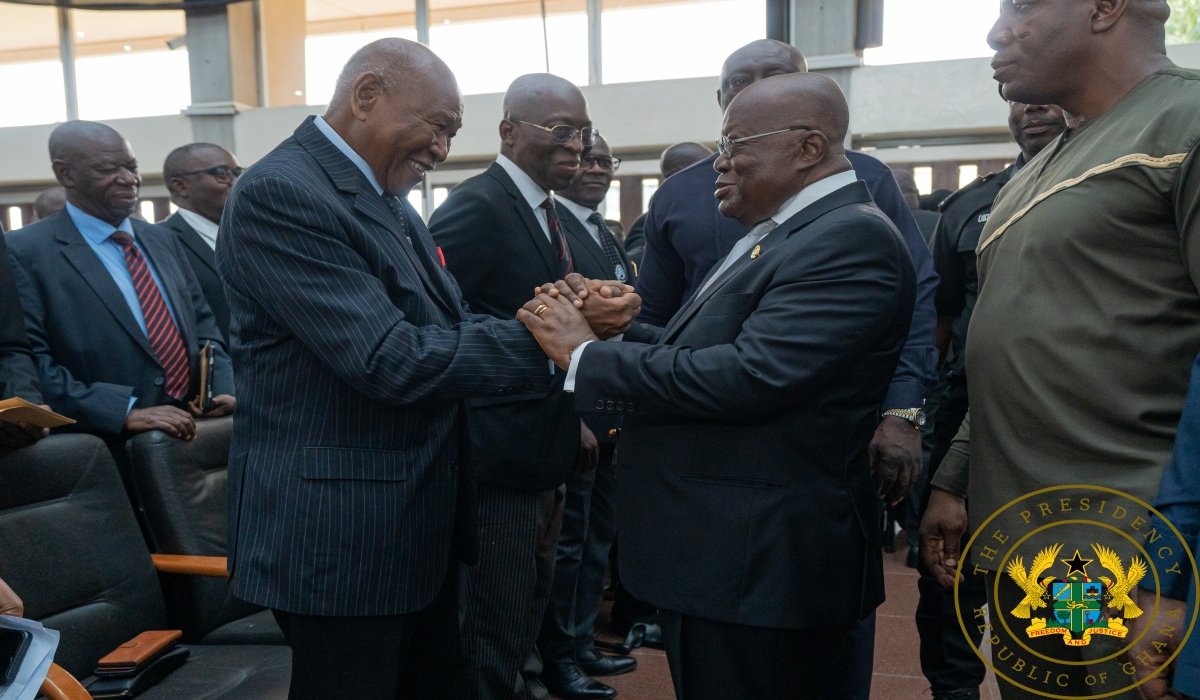
President Akufo-Addo reflects on legal career and Presidency in an emotional final address to Ghana Bar Association

- /home/u249204778/domains/spectator.com.gh/public_html/wp-content/plugins/mvp-social-buttons/mvp-social-buttons.php on line 27
https://spectator.com.gh/wp-content/uploads/2024/09/Akufo-Addo-and-Sam-1000x600.jpg&description=President Akufo-Addo reflects on legal career and Presidency in an emotional final address to Ghana Bar Association', 'pinterestShare', 'width=750,height=350'); return false;" title="Pin This Post">
- Share
- Tweet /home/u249204778/domains/spectator.com.gh/public_html/wp-content/plugins/mvp-social-buttons/mvp-social-buttons.php on line 72
https://spectator.com.gh/wp-content/uploads/2024/09/Akufo-Addo-and-Sam-1000x600.jpg&description=President Akufo-Addo reflects on legal career and Presidency in an emotional final address to Ghana Bar Association', 'pinterestShare', 'width=750,height=350'); return false;" title="Pin This Post">
In an emotional and reflective address, President Nana Addo Dankwa Akufo-Addo delivered his final speech to the Ghana Bar Association as President of the Republic, marking the eighth and last time he would address the august gathering in this capacity.
Speaking to an audience of legal professionals, the President expressed his deep connection to the Bar, recounting how his journey from a young lawyer to the highest office in the land has been shaped by his association with the legal profession.
“This is an emotional occasion for me,” President Akufo-Addo began, “addressing, for the eighth and final time, this august gathering in my capacity as President of the Republic. It is also deeply significant because of my long-standing association with the Ghana Bar Association, so I hope you will forgive me if I take some time today.”
The President did not hesitate to credit his career in law as the bedrock of his success in public life. He described the legal profession as his natural home, stating that the values he embraced as a lawyer—justice, equity, and the rule of law—have guided him throughout his years of public service.
“My journey to the highest office of the land began within the confines of the legal profession. I am a proud product of this noble profession, and it is here, amongst you, that I have always felt most at home,” Akufo-Addo said.
He noted that his involvement in the Bar had helped shape not only his career but also his worldview, borrowing the German term “weltanschauung” to describe how the profession had framed his understanding of the world.
The President recalled his early years as a young lawyer, fresh from international corporate law practice in Paris with an American law firm, and how he quickly found himself navigating Ghana’s legal system. He paid tribute to the legal minds who mentored him and shared how his rapid introduction to high-profile cases shaped his legal acumen and commitment to advocacy.
“I had the privilege of working alongside some of the finest legal minds this country has ever produced,” he said, naming esteemed lawyers such as R.S Blay, Joe Reindorf, B.J da Rocha, and Peter Ala Adjetey.
He recounted how he had been thrust into the “deep end of the pool,” unexpectedly inheriting the chambers of the renowned Jamaican barrister U.V. Campbell. Despite the challenge, Akufo-Addo described the experience as “exhilarating,” crediting it with teaching him the values of integrity, diligence, and the power of advocacy.
The President did not shy away from reflecting on his role as a lawyer during some of Ghana’s most turbulent political periods.
His involvement in the legal battles of the 1980s and 1990s, particularly during the years of military rule, underscored his commitment to the rule of law and democracy.
“The Ghana Bar Association, during those turbulent times, stood as a bastion of resistance to authoritarian rule,” Akufo-Addo said.
President Akufo-Addo noted that “We were the voice of the voiceless, the defenders of the oppressed and the guardians of the rule of law.”
He credited those experiences with solidifying his dedication to the principles of justice and democracy that would later define his political career.
Throughout his career as a lawyer, President Akufo-Addo represented clients from all walks of life, many of whom were up against powerful state institutions.
It was in the courtroom that he honed his advocacy skills and deepened his understanding of the law’s role in safeguarding freedoms. He emphasized that his legal career had always been about more than just winning cases—it was about ensuring justice and defending the rights of the oppressed.
Transitioning into politics, Akufo-Addo carried the same zeal for justice and democracy into public service.
His legal background informed his approach to governance, he said, and he has consistently worked to bring the discipline, rigour, and fairness of the legal profession into the Presidency.
“As President, I have worked to ensure that the principles of justice, transparency, and accountability are not just mere words, but are, in fact, embedded in the fabric of our governance structures,” he said.
He reflected on how his administration had implemented reforms and policies aimed at strengthening these principles, from judicial appointments to measures ensuring transparency in government.
As he prepares to leave office, President Akufo-Addo used the occasion to reflect on his presidency, describing it as an extension of his legal career.
“My presidency, in many ways, has been a continuation of my devotion to the rule of law and the protection of the rights of all Ghanaians,” he said.
He highlighted the progress made during his tenure, emphasizing that his administration had worked tirelessly to uphold the values of justice and democracy. While acknowledging the challenges faced, he expressed confidence that the legal and governance frameworks strengthened under his leadership would continue to serve Ghana well.
In his closing remarks, President Akufo-Addo expressed his gratitude to the Ghana Bar Association for their support and camaraderie over the years. He noted that his time at the Bar had been the foundation of his public life and that he would always cherish his association with the profession.
“As I prepare to hand over the reins of national leadership, it is an appropriate time to reflect on the journey we have travelled together over the past seven-and-a-half years,” he said.
His farewell was not just to the office of the Presidency, but also to the profession that had nurtured him throughout his career.
The President’s final address to the Ghana Bar Association was not just a reflection on his career but also a call to the next generation of lawyers to continue upholding the principles of justice, equity, and the rule of law.





Residents of Brodi, a farming community in the Tain District of the Bono Region, have been left in shock and mourning following the alleged murder of a 45-year-old woman by her husband, who later died by suicide.
According to information gathered by the Ghana News Agency (GNA), the suspect, popularly known as Kwabena Jack, believed to be in his 50s, allegedly attacked and killed his wife, Abena Donkor, while the couple were working on their farm on Monday, August 11, 2026.
Mr Kingsley Obah, Assembly Member for the Brodi Electoral Area, confirmed the incident to the GNA.
He explained that after news of the woman’s death spread through the community, residents launched a search for the suspect. His lifeless body was later discovered in a nearby bush on Tuesday, August 12, 2026.
Police have since conveyed both bodies to the Tain District Government Hospital, where they have been deposited for preservation and autopsy.
Investigations into the incident are ongoing. -GNA
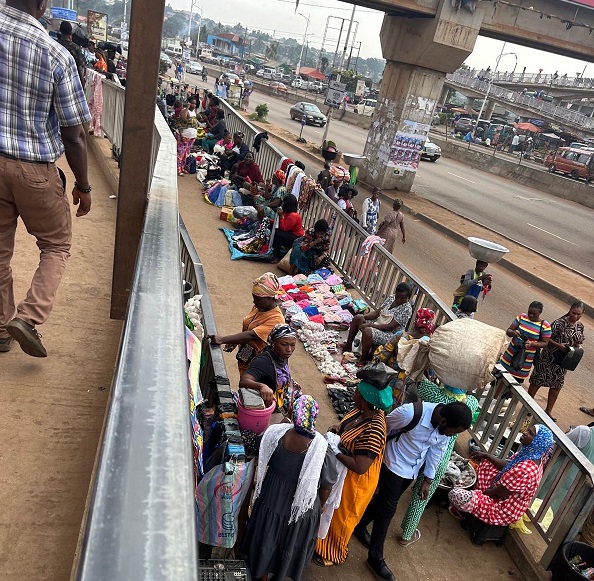
Hawkers and roaming preachers have taken over the five-metre high Madina REDCO footbridge and adjoining streets, making it increasingly difficult for pedestrians to use the facility intended to promote safe road crossing.
The traders have virtually turned sections of the footbridge into a marketplace, displaying their wares on the floor using jute sacks, plastic sheets and metal trays, while others have occupied both sides of the walkway with their merchandise.
Foodstuffs such as okro, garden eggs, pepper, onions, dried fish, smoked fish, grains, spices and other groceries are openly sold on the footbridge and along the roadside, forcing pedestrians to weave through the crowded path.
Clothing and fashion accessories including slippers, brassieres, panties, socks, bags and other household items are also displayed for sale, leaving only limited space for commuters to use.
The situation is worsened by the presence of itinerant preachers who position themselves on the footbridge with public address systems to evangelise, drawing crowds to further obstruct pedestrian movement.
Head porters are also seen crossing the highway through the median while carrying heavy loads instead of using the footbridge, exposing themselves to the danger of being knocked down by speeding vehicles.
Also, portions of the footbridge are showing signs of deterioration. Several metal railings are rusted, bent and loosely secured with pieces of wire, raising concerns about the safety of users, especially children, the elderly and persons with disabilities.
Sections of the concrete surface are worn and chipped, while makeshift wooden supports attached to parts of the structure suggest temporary repairs.
After a visit by The Spectator last week, it emerged that many commuters preferred crossing the busy Madina Highway instead of using the footbridge because of the congestion created by the trading and preaching activities.
For years, successive attempts by the police, the military and the La Nkwantanang Madina Municipal Assembly to address congestion around the REDCO and Zongo Junction enclave have yielded little success, with the area becoming notorious for roadside trading, indiscriminate parking and pedestrians refusing to use the footbridge.
A pedestrian, who gave her name only as Maame Yaa, described the situation as worrying, saying the footbridge, which was constructed to protect lives, had gradually lost its purpose because of the growing encroachment by traders and preachers.
According to her, many pedestrians were discouraged from using the facility because navigating through the crowded walkway had become difficult and uncomfortable.
She appealed to the La Nkwantanang Madina Municipal Assembly and other relevant authorities to intensify enforcement to prevent unauthorised trading and other activities on the footbridge and ensure it served its intended purpose of promoting pedestrian safety.
However, during the visit, personnel of the Ghana National Fire Service (GNFS) were seen carrying out a decongestion exercise to remove hawkers from sections of the roadside around the footbridge as part of efforts to improve public safety and ease the movement of both pedestrians and motorists.
The exercise forms part of a pilot project initiated by the Municipal Fire Commander for Madina, Division Officer II (DO II) Abdul Salia, who assumed command of the Madina Municipal Fire Station three months ago.
Speaking in an interview with The Spectator, DO II Abdulai Salia, who is also a long time resident of the community, said the month long project began on July 1 and ended on July 31, with 30 firefighters deployed daily to regulate traffic, clear hawkers from the streets and footbridge, and create access for emergency vehicles.
Continued on page 12
By Esinam Jemima Kuatsinu