Hot!
Akufo-Addo govt will soon introduce BoG recapitalization levy – NDC alleges

- /home/u249204778/domains/spectator.com.gh/public_html/wp-content/plugins/mvp-social-buttons/mvp-social-buttons.php on line 27
https://spectator.com.gh/wp-content/uploads/2023/08/IMG-20230809-WA0010.jpg&description=Akufo-Addo govt will soon introduce BoG recapitalization levy – NDC alleges', 'pinterestShare', 'width=750,height=350'); return false;" title="Pin This Post">
- Share
- Tweet /home/u249204778/domains/spectator.com.gh/public_html/wp-content/plugins/mvp-social-buttons/mvp-social-buttons.php on line 72
https://spectator.com.gh/wp-content/uploads/2023/08/IMG-20230809-WA0010.jpg&description=Akufo-Addo govt will soon introduce BoG recapitalization levy – NDC alleges', 'pinterestShare', 'width=750,height=350'); return false;" title="Pin This Post">
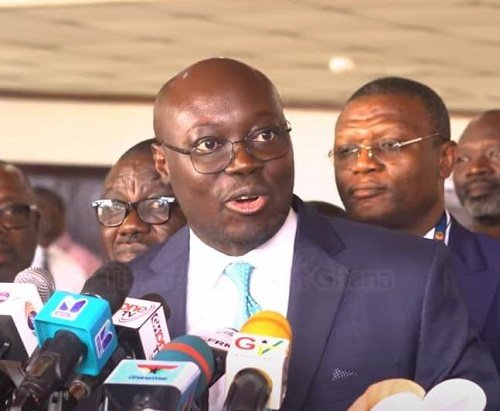
The Minority Leader, Dr. Cassiel Ato Forson has alleged that the government will soon introduce a Bank of Ghana (BoG) recapitalization levy for Ghanaians to pay.
He contends that this will be a tax to recapitalize the central bank since it is on the verge of collapsing.
This follows the National Democratic Congress’ (NDC) call for the Governor of the Bank of Ghana, Dr Ernest Addison and his deputies to resign immediately for allegedly mismanaging the institution, resulting in the GH¢60 billion losses the Central Bank recorded in 2022.
Speaking to journalists on Tuesday, August 8, 2023, Dr Ato Forson described the mismanagement at the Bank of Ghana as unfortunate.
“The IMF has made offers to assist the Government to develop a plan for the recapitalization of the Central Bank. That is why paragraph 18 of Ghana’s Memorandum of Economic and Financial Policy (MEFP) sent to IMF stated this fact. Let me assure you that very soon, Ghanaians will be made to pay for Bank of Ghana recapitalization levy, a tax to recapitalize the Bank of Ghana, because the central bank has collapsed virtually,” the Minority Leader claimed.
He lashed out at the Governor of BoG for spending $250 million on building a new head office while the apex bank struggles to stay afloat.
“Perhaps the more troubling fact is that, having brought the Bank of Ghana to this terrible financial state, the Governor and his deputies have found it prudent and expedient to invest $250 million (GHC2.8 billion) on another Head Office building somewhere at Ridge. In our circumstances, this is the height of insensitivity in the management of the finances of a troubled country”.
Credit:Citinewsroom.com


A 24-year-old tricycle (Pragyia) rider, has been jailed three months by the Nkawie Circuit Court in the Atwima Nwabiagya South Municipality of the Ashanti Region for biting a Community Police Assistant (CPA) at Nkawie.
Abdul Aziz pleaded guilty to the charge of negligently causing harm and was convicted on his own plea.
Police Inspector Kwaku Frimpong, prosecuting told the court presided by Mr Robert Addo that, complainants in the case were officers from the Nkawie Divisional Motor Traffic and Transport Department (MTTD) of the Ghana Police Service.
He said on September 3, at about 8:40am, the complainants led by Chief Inspector Abedi Larbi, were on their official patrol duty to ensure safety at Nkawie township and met the convict, who was in-charge of a Pragya tricycle with registration number M-25-A-3722.
He explained that, after a careful inspection, it was detected that the convict was without licence and other required documents, so Alhassan Seidu, the CPA, was instructed to lead him to the office for the next action.
On their way to the office, the convict took a different direction, so the CPA directed him to take the right route to the police station, but he disobeyed and attacked the CPA, resulting in a struggle between them.
In the process the convict bit the CPA on the chest, so he shouted for help and some nearby youth rushed to the scene and helped him to arrest the convict.
In his caution statement, he admitted the offence and after further investigations he was charged and brought before the court. –GNA
SKIP THE QUEUE, TAP THE NEWS
You can now read the Ghanaian Times and The Spectator newspapers from the comfort of your device via TimesNewsPlus.
Join our WhatsApp Channel: https://whatsapp.com/channel/0029VbBElzjInlqHhl1aTU27

The New Patriotic Party (NPP) has urged the government to place all 54,985 candidates affected by the 2026 Basic Education Certificate Examination (BECE) placement exercise in schools and publish the final outcome.
The party says the government must ensure that the affected candidates secure actual school places rather than merely being allowed to access the self-placement portal.
In a statement signed by the Chairman of the NPP Policy Co-ordination Committee, Kojo Oppong Nkrumah, the party expressed concern about the situation facing the candidates.
The NPP said the government had announced that 53,887 of the affected candidates could use the self-placement system after initially being told that they had not qualified for secondary school.
It, however, argued that access to the portal did not guarantee that candidates would secure their preferred schools or programmes.
“Ghanaian parents and candidates will judge the resolution of the challenge by one thing only: how many of the original 54,985 are sitting in a classroom, not how many were allowed to open a website,” the statement noted.
The party said the government’s own figures showed that the country had 859,828 declared vacancies for 623,072 BECE candidates.
It explained that the main challenge was the concentration of demand in a small number of highly subscribed schools.
The NPP noted that 313,283 candidates selected Category A schools as their first choice, while those schools had 76,417 declared vacancies.
It therefore called on the government to explore ways to improve schools with available spaces, including providing teachers, laboratories and better programmes.
The party urged the government to use the 85 private schools participating in the Free SHS programme to absorb candidates who remained without placements.
The NPP further called for clarification of the rule and pass mark used for this year’s placement exercise, saying parents were entitled to know the standard before their children sat the examination.
It urged the government to take urgent action to ensure that the affected candidates were not left behind in the transition to secondary education.
By: Jacob Aggrey