Features
When will the AU take its destiny into its own hands?


When Africa is mentioned, things that readily come to mind are poverty, conflict, famine etc. The narrative on Africa has been nothing to write home about. From West Africa to North Africa to the Central part of the continent, to the East and the Southern part, there is evidence of an unrest, a conflict or some other strife.
Currently, there is a serious conflict raging in Libya despite the COVID-19 which is ramping through nations and destroying economies. The other unenviable tag is a continent with a lot of epidemics like Ebola, which has been a thorn in the flesh. A deliberate effort at rebranding must be embarked upon to change the African story and this endeavour is non-negotiable.
The baffling question is why the African Union (AU) is in this situation when the continent is the richest in terms of resources, in the whole world? Respect is earned and not granted on a silver platter, and for as long as African countries and the AU as a collective, begs for assistance from donor countries, the requisite recognition as a partner of equal status to other trade blocs and continents would continue to be a mirage.
When other countries are adding value to their raw materials and exporting them to other places to generate enough foreign resources to increase their Gross Domestic Product (GDP) to promote the necessary growth and living standards of their populace, most African countries are still exporting raw materials.
According to the insider.com, the Chocolate industry is about $103 Billion Dollars. President Akufo-Addo in one of his numerous addresses, stated that Ghana and Ivory Coast together produces about 65 per cent of the total world cocoa production, yet can account of just about $6 Billion Dollars.
This is clearly the predicament of the African countries and, therefore, the predicament of the AU. Until there is a deliberate policy to focus on value addition and hence an industrialisation, the revenue inflows would continue to be forever inadequate and Africa would not become the economic power that it should be in order to generate the required respect from the international community.
The COVID-19 disease exposed the continent’s lack of preparedness to deal with epidemics or pandemics and the urgent need for the AU to speed up the industrialisation of the continent as part of the integration process among nations of the continent. It is not as if we need to reinvent the wheel to be able to implement policies that would speed up the integration process.
There is the European Union (EU) which has been in existence for quite some time that the AU members can study and adopt or modify where necessary to give the AU project the momentum needed, to become really established to help the people of Africa and Africa descent both on the continent and in the diaspora.
A picture sent to me via WhatsApp showed a map of Africa with the natural resources available in each country clearly displayed. A glance at the picture removes any doubt about the fact that Africa is the richest continent in terms of natural resources. In the near future, petroleum will lose its importance due to the use of electric vehicles and the clamour for reduction in CO2 emissions.
The countries or continent with other natural resources will become the most sought after trading partners and it is for that reason that the Chinese have embarked on a serious project of establishing relationships with African countries and the AU as an organisation.
According to Wikipedia, the Democratic Republic of Congo (DRC) has the potential to provide a third of the energy requirement for Africa. The right leadership that can implement policies that fit into the overall agenda of AU in the individual countries is what is required to transform the AU into a global player.
This was the vision of Dr Kwame Nkrumah and is still relevant today as it was many years ago, and, I dare say, much more relevant now when countries are establishing alliances. There is no lack of personnel with the requisite skill in any field of endeavour to bring transformation on the continent. What is required is the need to eschew selfish agenda of the various leaders of the individual countries and Africa will become a very powerful force to reckon with.
The need to address the crossing of the Mediterranean Sea by illegal migrants from Africa through Libya is an issue that must engage the attention of the AU. The conflict in Libya is what has enabled this issue to fester. The AU must take charge by sending in an AU force fashioned after the Economic Community of West African States Monitoring Group (ECOMOG) model. Africa cannot always rely on foreigners to resolve its problems totally. When it initiates an action to resolve its problems, that would mark the beginning of the process of gaining recognition and respect at the world stage.
The illegal migration from Libya can easily be resolved if there is a stable legitimate government in place in that country which the AU is obliged to help establish. The creation of an AU force must be given priority attention, so that the Libya conflict can be dealt with as soon as possible.
When the desperate attempt to embark on illegal migration to Europe across the Mediterranean Sea stops, then the international community will begin to see Africans in a different light. At the moment, in the eyes of the world, Africans are a bunch of desperate and dangerous people who do not care about their lives. The AU would have to create the necessary environment for member countries to generate employment avenues for their populations, especially the youth to enable them shun the idea of illegal migration.
A deliberate policy must be adopted to instill in the African youth, a sense of self-worth and self confidence, that he or she is equal to any other person in the whole world no matter the colour of their skin. The sense of inferiority complex established by the colonial masters should be thrown away mentally, so that the African can be mentally liberated to pursue higher dreams.
The African Continental Free Trade Area (AfCFTA) agreement signed by 54 of the 55 countries of the continent, is one of the best things to happen in the life of the AU. It provides a wonderful opportunity for trading among countries on the continent. It is a vehicle with the requisite potential to quickly facilitate the transformation required to elevate the status of the AU to that of a respected player in the geopolitical arena.
The good book even says that “money answereth all things” according to Ecclesiastes Chapter 10, verse 19. Economic power is what gives nations and trade blocs the power to influence decisions on the international stage and, therefore, it is imperative for Africa and for that matter the AU, to become an economic power house to influence international issues. It is high time the AU was given a permanent seat at the UN Security Council, given our contribution to world economy in terms of natural resources. Resources alone is not going to give us the right unless we translate the resources into huge GDP and that is what would command the respect of the world.
Writer: Laud Kissi-Mensah, a social commentator
by GhanaianTimes


On Sunday, October 11, 2026, it was the turn of Ghanaian Catholics in Finland to lead the singing in the church service of the African Catholic Chaplaincy in Finland (ACCF).
It was indeed a spirit-filled feeling for worshippers present. And for the Ghanaian migrants, the occasion also brought back to them memories of church services in their home country, Ghana.
The ACCF has a roster for each country/community to sing from time to time. Next Sunday will be the turn of the Nigerian community. Other communities that usually sing are the Kenyan/Tanzanian community, the Cameroonian, the Ugandan, group, etc.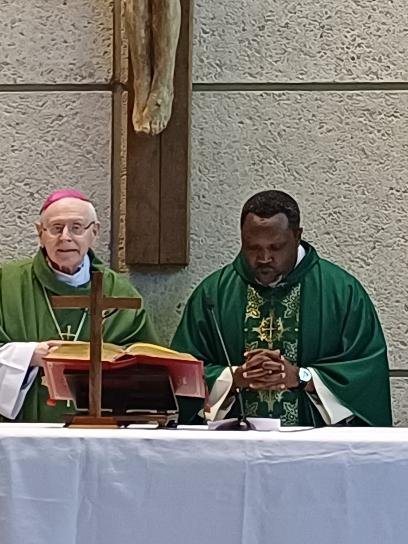
A powerful religious experience
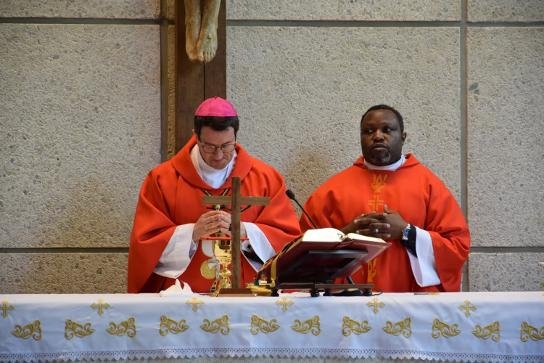
The mass services of the Chaplaincy usually give a powerful religious experience and a display of cultural diversity, especially in occasions such as when the Bishop of Helsinki, Bishop Raimo Goyarrola, celebrated mass with the Chaplaincy on Pentecost Day, May 24, 2026.
There was a similar time of spiritual joy last month (September 27, 2026) when Emeritus Bishop Teemu Sippo, former Bishop of Helsinki, visited the Chaplaincy. Bishop Teemu was the main celebrant, assisted by the Chaplain, Reverend Father Thomas Otieno.
Last Sunday, Reverend Father Bernard Sor, a Ghanaian Catholic priest based in Austria, was the main celebrant in the mass service where he performed a rite of baptism. Fr Bernard had celebrated mass a few months ago when he visited his sister and her husband in Helsinki. 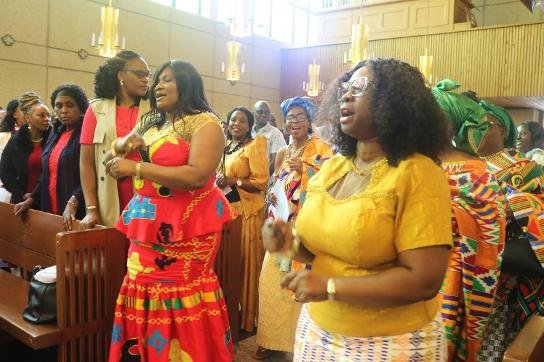
All these well-attended religious occasions indeed leave lasting memories. The homilies (peaching) by the priests usually emphasize religious tenets such as the importance of loving and serving God in truth, existing in peace with our fellow humans to promote unity in diversity, etc.
Unity in diversity and a colourful display of cultures
The African Chaplaincy church services usually produce impressive displays of diverse cultures from different parts of Africa and elsewhere. The events are often spiced by rich cultural displays of dances and colourful attires which are a delight to watch.
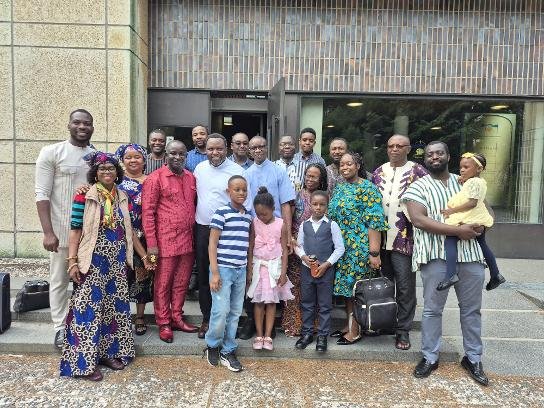
On special occasions, members of the Ghanaian Catholic community, in their gay and colourful kente attire and with adowa dance and music, usually lead the procession into the church. Other communities such as the Cameroonian, Nigerian, Kenyan and Tanzanian as well as Sudanese/South Sudanese groups also put up well-choreographed performances from their cultures.
The African Catholic Chaplaincy in Finland
The African Chaplaincy was founded on June 4, 2017, which was a Pentecost Sunday, in a Pontifical High Mass celebrated by Monsignor Emeritus Sippo S.C.I., the then Bishop of Helsinki, at the St. Mary’s Catholic Parish Church in Helsinki.
The Chaplaincy was created by Bishop Teemu in collaboration with the Diocesan body when they detected a great flocking of African immigrants to Finland, the majority of whom were Catholics. This was to give the immigrants a possibility to integrate into the Finnish society by worshiping as Catholics and in their African cultural identity.
The responsibility of the Chaplaincy was given by Bishop Teemu to Father Dr Leonard Wobilla Shwei, who is thus the first Chaplain and ably led the Chaplaincy. He was succeeded a few years ago by Father Thomas Otieno, who continues to move the Chaplaincy forward. Thank you!
GHANA MATTERS column appears fortnightly. Written in simple, layman’s terms, it concentrates on matters about Ghana and beyond. It focuses on everyday life issues relating to the social, cultural, economic, religious, political, health, sports, youth, gender, etc. It strives to remind us all that Ghana comes first. The column also takes a candid look at the meanings and repercussions of our actions, especially those things we take for granted or even ignore. There are key Ghanaian values we should uphold rather than disregard with impunity. We should not overlook the obvious. We need to search for the hidden or deeply embedded values and try to project them.
With Dr Perpetual Crentsil
SKIP THE QUEUE, TAP THE NEWS

You can now read the Ghanaian Times and The Spectator newspapers from the comfort of your device via TimesNewsPlus.
Join our WhatsApp Channel: https://whatsapp.com/channel/0029VbBElzjInlqHhl1aTU27
She did not find out he was cheating. She found out he was drowning.
It was two weeks after their beautiful wedding. The jollof was still in the fridge. A loan officer called her number-not his-and politely asked, “Madam, please tell your husband to pay his overdue loan. We have been calling him.”
That was how she discovered her new husband had entered their marriage with a hidden debt of over GH¢ 40,000. No cheating. No other woman. Just a financial secret.
And that is how many Ghanaian marriages begin to die. Not with a shout, but with a secret alert on a phone.
We prepare for the wedding. We do not prepare for the wallet.
What is money honesty?
Let me define it simply. Money honesty is not that you both earn the same. It is that you both know the same. It is the ability to sit down and say without fear:
“This is how much I earn.”
“This is how much I owe.”
“This is how I was raised to see money.”
“This is what scares me about money.”
Financial transparency is not about control. It is about clarity. You cannot build trust on top of secrets.
Many couples tell me, “Counsellor, we love each other, love will handle money.” I always answer, “Love is the car, but money honesty is the fuel. Love without honesty cannot move.”
How To Buy Your Marriage Insurance Today – My 5-Step Protocol
If you are engaged, newly married, or even 20 years in marriage, you can still fix this. At Counsellor Prince & Associates Consult—CPAC, this is what I give couples:
Step 1: The 90-Minute Money Naked Session.
No phones, no blame. Each partner writes down on paper: Monthly income, monthly debts, monthly family obligations, savings, and your biggest money fear. Then you exchange papers. Read it. Don’t react for 24 hours. Just absorb.
Step 2: Create OUR Money, YOUR Money, My Money.
You need three pots. OUR money for rent, food, school fees, utilities, properties, and the like— joint contribution. YOUR money and MY money—a small agreed allowance no one questions. This stops the feeling of being controlled.
Step 3: The No-Secret Debt Rule.
Agree from today: No new loan, no new hire purchase, no new family financial commitment above GHS 500 without telling each other first. Not permission, but information.
Step 4: Talk About Your Money Personality.
Are you a Spender or a Saver? Are you Risky or Safe? Most Ghanaian marriages are a Spender married to a Saver. Neither is wrong. But if you don’t understand your partner’s personality, you will call his saving “stinginess” and her spending “wastefulness.”
Step 5: Do a Monthly 30-Minute Money Date
Not an argument date. Light, with tea. “How did we do this month? What worried you? What should we plan for next month?” Couples who do this divorce far less.
My Final Word
Before you say “I Do” at the altar, have pre-marital counselling and also have the money talk on the sofa.
Ask your partner:
“If I lost my job today, how long can we survive?”
“What debt are you bringing into this marriage?”
“How much do you send to your family monthly and will that continue?”
If he or she gets angry that you asked, don’t get married yet. A person who is angry about accountability will be abusive about money.
Marriage insurance is not bought at Star Assurance or Enterprise. It is bought in honest conversations when no one is watching.
The wedding costs one day. The marriage costs a lifetime. Don’t enter a lifetime contract and covenant with hidden costs.
You can still insure your marriage today.
Source:
Counselor Prince Offei, CPAC’s founder, is a leading Mental Health Professional, Marriage Counsellor, Author, ADR Expert/Arbitrator, and Spectator Newspaper Columnist. He writes on relationships, marriage, parenting, special needs support, and their connection to mental health. For therapy, counselling, or enquiries, contact Counselor Prince & Associates Consult (CPAC) in Accra on 0559850604 / 0551428486.
SKIP THE QUEUE, TAP THE NEWS
You can now read the Ghanaian Times and The Spectator newspapers from the comfort of your device via TimesNewsPlus.
Join our WhatsApp Channel: https://whatsapp.com/channel/0029VbBElzjInlqHhl1aTU27