Fruitful Living
God’s plan of redemption in the letter to the Ephesians (Part 1)


- /home/u249204778/domains/spectator.com.gh/public_html/wp-content/plugins/mvp-social-buttons/mvp-social-buttons.php on line 27
https://spectator.com.gh/wp-content/uploads/2022/02/Grace-Pix-1.gif&description=God’s plan of redemption in the letter to the Ephesians (Part 1) ', 'pinterestShare', 'width=750,height=350'); return false;" title="Pin This Post">
- Share
- Tweet /home/u249204778/domains/spectator.com.gh/public_html/wp-content/plugins/mvp-social-buttons/mvp-social-buttons.php on line 72
https://spectator.com.gh/wp-content/uploads/2022/02/Grace-Pix-1.gif&description=God’s plan of redemption in the letter to the Ephesians (Part 1) ', 'pinterestShare', 'width=750,height=350'); return false;" title="Pin This Post">
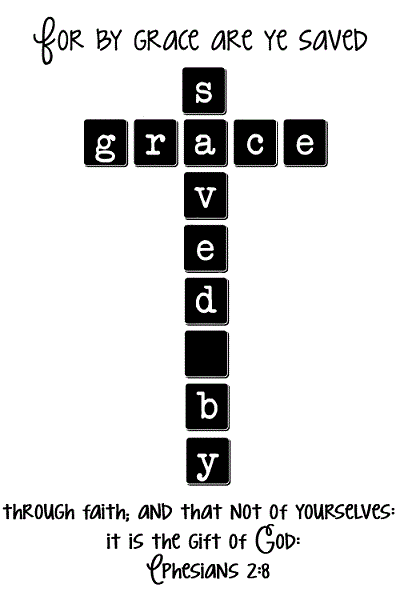
For it is by grace you have been saved, through faith—and this is not from yourselves, it is the gift of God— not by works, so that no one can boast. For we are God’s handiwork, created in Christ Jesus to do good works, which God prepared in advance for us to do – Ephesians 2:8-10
INTRODUCTION
Paul’s purpose with the letter to the Ephesians was to communicate God’s redemptive plan and power and then to challenge his readers to become everything God wanted them to be as His people. Paul describes as length the wonder of God’s plan of salvation.
Paul revealed that God’s plan is much more extensive than simply saving individual people in isolation. God gives of His people power to the Church to enable believers to live for Him and to carry out His gospel mission in the world. Paul also reminded his readers of how desperate and depraved their condition was before they responded to the gospel. He then declare the power of God’s undeserved grace toward them. Finally, he summarized the way in which believer’s good works are the result of salvation. Paul then emphasized the relational dimension of salvation. What matters most about us is not what the world tells us, how people see you, or even how we see ourselves.
Our identity is determined by what God’s says about us. Apart from Christ, we were dead and hopeless. But in Christ, we are alive and will live forever with Him. When we begin believing what God says about us, we can find the freedom to walk in good works He has planned for us.
Today we share with you, straight from Scripture, what Paul wrote to the believers in Ephesus to confirm God’s plan for our redemption.
SPIRITUAL BLESSINGS IN CHRIST.
Praise be to the God and Father of our Lord Jesus Christ, who has blessed us in the heavenly realms with every spiritual blessing in Christ. For He chose us in Him before the creation of the world to be holy and blameless in His sight. In love He predestined us for adoption to sonship through Jesus Christ, in accordance with His pleasure and will— to the praise of His glorious grace, which He has freely given us in the One He loves. In Him we have redemption through His blood, the forgiveness of sins, in accordance with the riches of God’s grace that He lavished on us. With all wisdom and understanding, He made known to us the mystery of His will according to His good pleasure, which He purposed in Christ, to be put into effect when the times reach their fulfillment—to bring unity to all things in heaven and on earth under Christ.
In Him we were also chosen,having been predestined according to the plan of Him who works out everything in conformity with the purpose of His will, in order that we, who were the first to put our hope in Christ, might be for the praise of His glory. And you also were included in Christ when you heard the message of truth, the gospel of your salvation. When you believed, you were marked in Him with a seal, the promised Holy Spirit, who is a deposit guaranteeing our inheritance until the redemption to those who are God’s possession—to the praise of His glory – Ephe. 1:3-14 NIV
THANKSGIVING AND PRAYER.
For this reason, ever since I heard about your faith in the Lord Jesus and your love for all God’s people, I have not stopped giving thanks for you, remembering you in my prayers. I keep asking that the God of our Lord Jesus Christ, the glorious Father, may give you the Spirit of wisdom and revelation, so that you may know Him better. I pray that the eyes of your heart may be enlightened in order that you may know the hope to which He has called you, the riches of His glorious inheritance in His holy people, and His incomparably great power for us who believe. That power is the same as the mighty strength He exerted when He raised Christ from the dead and seated Him at His right hand in the heavenly realms, far above all rule and authority, power and dominion, and every name that is invoked, not only in the present age but also in the one to come. And God placed all things under His feet and appointed Him to be head over everything for the church, which is His body, the fullness of Him who fills everything in every way – Ephe. 1:15-23 NIV
MADE ALIVE IN CHRIST.
As for you, you were dead in your transgressions and sins, in which you used to live when you followed the ways of this world and of the ruler of the kingdom of the air, the spirit who is now at work in those who are disobedient. All of us also lived among them at one time, gratifying the cravings of our flesh and following its desires and thoughts. Like the rest, we were by nature deserving of wrath. But because of His great love for us, God, who is rich in mercy, made us alive with Christ even when we were dead in transgressions—it is by grace you have been saved. And God raised us up with Christ and seated us with Him in the heavenly realms in Christ Jesus, in order that in the coming ages He might show the incomparable riches of His grace, expressed in His kindness to us in Christ Jesus. For it is by grace you have been saved, through faith—and this is not from yourselves, it is the gift of God— not by works, so that no one can boast. for we are god’s handiwork, created in Christ Jesus to do good works, which God prepared in advance for us to do – Ephe. 2:1-10 NIV
ONE IN CHRIST.
Therefore, remember that formerly you who are Gentiles by birth and called “uncircumcised” by those who call themselves “the circumcision” (which is done in the body by human hands)— remember that at that time you were separate from Christ, excluded from citizenship in Israel and foreigners to the covenants of the promise, without hope and without God in the world. But now in Christ Jesus you who once were far away have been brought near by the blood of Christ.
For He Himself is our peace, who has made the two groups one and has destroyed the barrier, the dividing wall of hostility, by setting aside in His flesh the law with its commands and regulations. His purpose was to create in Himself one new humanity out of the two, thus making peace, and in one body to reconcile both of them to God through the cross, by which He put to death their hostility. He came and preached peace to you who were far away and peace to those who were near. For through Him we both have access to the Father by One Spirit. Consequently, you are no longer foreigners and strangers, but fellow citizens with God’s people and also members of His household, built on the foundation of the apostles and prophets, with Christ Jesus Himself as the chief cornerstone. In Him the whole building is joined together and rises to become a holy temple in the Lord. And in Him you too are being built together to become a dwelling in which God lives by His Spirit – Ephe. 2:11-22 NIV
Stay Blessed!
For further inquiries please contact us on Tel Nos. 0243588467 or 0268130615
Email: saltnlightministries@gmail.com
Website: saltandlightministriesgh.org
By Dr Joyce Aryee, the author

Fruitful Living
Environmental stewardship is an act of worship: The Islamic response to climate change, environmental degradation (Part 2)
Clean air and safe water protect human life; fertile land supports livelihoods and wealth; a healthy environment safeguards future generations; and responsible use of natural resources enables communities to fulfil their religious obligations without unnecessary hardship.
Conversely, environmental degradation threatens all five objectives by exposing populations to disease, undermining food security, destroying economic opportunities, and jeopardising the welfare of future generations.
This understanding transforms environmental stewardship from an optional charitable activity into a religious obligation. Caring for creation is an expression of gratitude to Allah, fulfilment of the trust of Khalifah, and practical implementation of the higher objectives of Islamic law.
Muslims are, therefore, called not only to avoid harming the environment but also to actively restore and protect it. Every tree preserved, every river protected, every piece of land rehabilitated, and every effort to promote sustainable development as it becomes part of fulfilling humanity’s covenant with Allah.
Recognising ourselves as Khalifah fundamentally changes how we view the environment. Rather than seeing nature as a limitless resource for exploitation, Islam teaches believers to regard it as a sacred trust to be preserved with wisdom, justice, moderation, and compassion. This theological foundation provides the basis for understanding why environmental destruction is condemned in Islam as a form of corruption on earth.
Environmental degradation as fasād (corruption on earth)
One of the most profound contributions of Islam to contemporary environmental discourse is its moral framing of ecological destruction. While modern environmental science describes pollution, deforestation, biodiversity loss, and climate change in technical terms, the Qur’an characterises actions that disrupt the natural order as fasād—corruption, disorder, or mischief on the earth. This concept elevates environmental degradation from a scientific and policy concern to a moral and spiritual issue for which humanity will ultimately be accountable before Allah.
The Qur’an unequivocally warns against causing corruption after the earth has been set in order. Allah says, “And do not cause corruption upon the earth after its reformation. And invoke Him in fear and aspiration. Indeed, the mercy of Allah is near to the doers of good” (Qur’an 7:56, Sahih International). This verse portrays the earth as a divinely ordered system, created with balance, harmony, and purpose. Human activities that destroy this balance—whether through pollution, reckless extraction of natural resources, or unsustainable consumption—represent violations of Allah’s intended order.
The consequences of such misconduct are vividly described in another powerful verse: “Corruption has appeared throughout the land and sea by what the hands of people have earned so He may let them taste part of the consequence of what they have done that perhaps they will return [to righteousness]” (Qur’an 30:41, Sahih International).
This verse is remarkably relevant to contemporary environmental challenges. Climate change, contaminated rivers, desertification, coastal erosion, declining biodiversity, and increasingly frequent floods are not merely natural phenomena; they are, in many cases, the cumulative consequences of human behaviour. The Qur’an therefore invites humanity to reflect upon these environmental crises as opportunities for repentance, reform, and responsible stewardship rather than continuing on a path of ecological destruction.
The principle of environmental balance (Mīzān) is another defining feature of the Islamic worldview. Allah declares, “And the heaven He raised and imposed the balance, that you not transgress within the balance. And establish weight in justice and do not make deficient the balance” (Qur’an 55:7–9, Sahih International). Although these verses emphasize justice in human affairs, many Muslim scholars also understand Mīzān as reflecting the harmony embedded within creation (Nasr, 1996). Every ecosystem functions through delicate relationships among living organisms, water, soil, forests, wildlife, and the atmosphere. Human activities that upset this balance ultimately threaten both nature and human survival.
Environmental pollution provides a clear example of fasād in practice. Across many urban centres, indiscriminate disposal of solid waste clogs drainage systems, contributes to flooding, contaminates water bodies, and creates breeding grounds for disease. Plastic waste has become one of the most visible environmental threats, polluting rivers, beaches, and agricultural land while endangering aquatic life. Such practices are fundamentally inconsistent with Islamic teachings, which emphasise cleanliness, public welfare, and the prevention of harm.
According to the Intergovernmental Panel on Climate Change (2023), West Africa is projected to experience increasing temperatures, erratic rainfall patterns, prolonged droughts and more frequent extreme weather events. These changes threaten agricultural productivity, food security, public health and economic development, particularly in climate-sensitive economies such as Ghana.
The Prophet Muhammad (peace be upon him) consistently encouraged behaviours that protected public spaces and safeguarded community health. He said, “Removing harmful things from the road is an act of charity” (Sahih al-Bukhari, Hadith 2989; Sahih Muslim, Hadith 1009).
Although this Hadith refers to clearing pathways of hazards, its underlying principle extends naturally to contemporary environmental responsibilities. Proper waste disposal, maintaining clean public spaces, preventing pollution, and protecting shared resources all embody this Prophetic ethic of removing harm from society.
Islam further condemns extravagance and wastefulness, both of which contribute significantly to environmental degradation. Allah commands, “Eat and drink, but be not excessive. Indeed, He likes not those who commit excess” (Qur’an 7:31, Sahih International).
Modern patterns of overconsumption, excessive plastic use, food waste, and unsustainable exploitation of natural resources stand in stark contrast to this Qur’anic call for moderation. Sustainable living is, therefore, not simply an environmental strategy; it is an expression of Islamic ethics that reflects gratitude for Allah’s blessings.
The author is the Chief Imam of Kpone Katamanso Municipal and a certified Counsellor and Governance Expert.
By Imam Alhaji Saeed Abdulai
Fruitful Living
Environmental Stewardship Is an Act of Worship: The Islamic Response to Climate Change and Environmental Degradation

Introduction
In the name of Allah, the Most Gracious, the Most Merciful. May His peace and blessings be upon the Holy Prophet Mohammed (pbuh), his household companions and all those who follow andsupport him till the last day.
Environmental degradation has emerged as one of the greatest threats to human existence in the twenty-first century. Across the globe, climate change, deforestation, biodiversity loss, pollution, and unsustainable exploitation of natural resources continue to undermine livelihoods, public health, and economic development. Ghana is no exception. The devastating effects of illegal mining (galamsey), indiscriminate waste disposal, pollution of rivers and streams, deforestation, and changing climatic conditions are increasingly affecting agriculture, food security, access to clean water, and the wellbeing of present and future generations (Intergovernmental Panel on Climate Change [IPCC], 2023; United Nations Environment Programme [UNEP], 2024).
Public discourse often presents environmental protection as the exclusive responsibility of governments, environmental scientists, and development agencies. While these stakeholders play indispensable roles, faith communities also possess a profound moral responsibility to protect the natural world. For Muslims, caring for the environment is not merely a civic obligation or a matter of public policy; it is an act of worship rooted in obedience to Allah and guided by the teachings of the Qur’an and the Sunnah of Prophet Muhammad (peace be upon him).
The Qur’an consistently reminds humanity that the heavens, the earth, and everything within them belong to Allah. Human beings have not been granted unrestricted ownership over creation but have been entrusted with its care as Khalifah (stewards or vicegerents). Allah declares, “It is He who has made you successors upon the earth…” (Qur’an 6:165, Sahih International). This divine
appointment confers both privilege and accountability, requiring humanity to use natural resources responsibly, preserve ecological balance, and avoid actions that lead to destruction and injustice.
The Prophetic tradition further reinforces this responsibility by linking environmental care to acts of charity and righteousness. The Prophet Muhammad (peace be upon him) said, “If a Muslim plants a tree or sows seeds, and then a bird, or a person, or an animal eats from it, it is regarded as a charitable gift (Sadaqah) for him” (Sahih al-Bukhari, Hadith 2320). This remarkable teaching transforms environmental conservation from a secular concern into a continuous act of worship that benefits both humanity and all living creatures.
This article argues that Islam offers a comprehensive ethical framework for addressing contemporary environmental challenges. Drawing upon the Qur’an, authentic Hadith, principles of Islamic jurisprudence, and Ghana’s environmental realities, it demonstrates that environmental stewardship is an expression of faith, a fulfilment of humanity’s divine trust, and a practical pathway toward sustainable development. In an era marked by climate change and ecological
degradation, Muslims have both a spiritual and civic duty to safeguard Allah’s creation for the benefit of present and future generations.
Humanity as Khalifah: The Islamic Concept of Stewardship and Divine Trust
The Islamic worldview begins with the recognition that the universe is neither ownerless nor a product of chance. Everything in existence belongs to Allah, the Creator and Sustainer of the heavens and the earth. Human beings therefore do not possess absolute ownership over the environment; rather, they are entrusted with its care and responsible use. This trusteeship is encapsulated in the Qur’anic concept of Khalifah (vicegerency or stewardship), which defines humanity’s relationship with creation.
Allah announced this divine appointment when He said to the angels: “Indeed, I will make upon the earth a successive authority (Khalifah)” (Qur’an 2:30, Sahih International). This declaration established humanity as Allah’s representatives on earth, entrusted with managing natural resources in accordance with His guidance. The role of a Khalifah is therefore one of responsibility rather than domination, stewardship rather than exploitation, and service rather than selfish gain.
The Qur’an reinforces this responsibility by reminding humanity that its authority over the earth is temporary and subject to divine accountability. Allah says, “It is He who has made you successors upon the earth and has raised some of you above others in degrees [of rank] that He may try you through what He has given you” (Qur’an 6:165, Sahih International). Environmental resources— land, forests, rivers, minerals, wildlife, and the atmosphere—are thus part of a divine trust through which humanity is tested. The measure of success lies not in how much people extract from nature but in how faithfully they preserve and utilise it for the common good.
This concept is further strengthened in the Qur’an where Allah commands: “He has produced you from the earth and settled you in it” (Qur’an 11:61, Sahih International). Classical Muslim scholars have interpreted this verse as an instruction to cultivate, develop, and improve the earth rather than destroy it (Ibn Kathir, 2003). Productive agriculture, sustainable commerce, responsible urban
development, and environmental conservation are therefore consistent with Islamic teachings because they contribute to the flourishing of society while preserving the integrity of creation.
Closely linked to Khalifah is the concept of Amanah (trust). Allah entrusted humanity with responsibilities that carry profound moral consequences. Although the Qur’an discusses Amanah broadly, its principles extend to every responsibility placed upon humankind, including the protection of the natural environment. Since Allah is the ultimate Owner of creation, every river polluted, every forest destroyed, and every ecosystem degraded represents not merely environmental damage but a breach of a sacred trust.
The Prophet Muhammad (peace be upon him) emphasized that accountability is a defining characteristic of leadership. He said, “Every one of you is a shepherd and every one of you is
responsible for his flock” (Sahih al-Bukhari, Hadith 7138; Sahih Muslim, Hadith 1829). While this Hadith primarily addresses social responsibility, its underlying principle extends to all forms of stewardship. Governments are responsible for environmental governance, traditional authorities for protecting communal lands, corporate institutions for sustainable business practices, religious leaders for cultivating environmental ethics, and individual citizens for preserving their immediate surroundings.
Islam also teaches that the natural world possesses intrinsic value because it reflects the signs (Ayat) of Allah. The Qur’an repeatedly invites believers to observe the alternation of day and night, the diversity of plants and animals, the mountains, the rivers, and the rain as evidence of Allah’s wisdom and power (Qur’an 3:190–191). Nature is therefore not merely a collection of economic
resources but a manifestation of divine artistry deserving of respect and protection. Destroying creation without just cause diminishes humanity’s appreciation of these signs and undermines its spiritual relationship with the Creator.
The concept of stewardship is further illuminated through the objectives of Islamic law (Maqāṣid al-Sharī’ah). Classical scholars, particularly Al-Ghazali and later Al-Shatibi, identified five overarching objectives: the preservation of religion, life, intellect, lineage, and wealth (Auda, 2008). Environmental stewardship directly advances each of these objectives. Clean air and safe water protect human life; fertile land supports livelihoods and wealth; a healthy environment
safeguards future generations; and responsible use of natural resources enables communities to fulfil their religious obligations without unnecessary hardship. Conversely, environmental degradation threatens all five objectives by exposing populations to disease, undermining food security, destroying economic opportunities, and jeopardizing the welfare of future generations.
This understanding transforms environmental stewardship from an optional charitable activity into a religious obligation. Caring for creation is an expression of gratitude to Allah, fulfilment of the trust of Khalifah, and practical implementation of the higher objectives of Islamic law. Muslims are therefore called not only to avoid harming the environment but also to actively restore and protect it. Every tree preserved, every river protected, every piece of land rehabilitated, and every effort to promote sustainable development becomes part of fulfilling humanity’s covenant with Allah.
Recognising ourselves as Khalifah fundamentally changes how we view the environment. Rather than seeing nature as a limitless resource for exploitation, Islam teaches believers to regard it as a sacred trust to be preserved with wisdom, justice, moderation, and compassion. This theological foundation provides the basis for understanding why environmental destruction is condemned in
Islam as a form of corruption on earth.
By Imam Alhaji Saeed Abdulai ,Kpone Katamanso Municipal Chief Imam
Certified Counsellor & Governance Expert