News
Young people are losing trust in political leaders – Afenyo-Markin

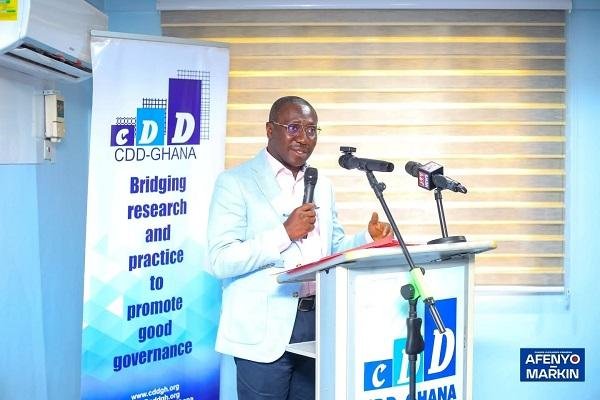
Minority Leader in Parliament, Alexander Afenyo-Markin, has warned that young people in Ghana are gradually losing trust in political leaders, a situation he believes could threaten the country’s democracy if not addressed.
Speaking at a programme organised by the Centre for Democratic Development (CDD), the Minority Leader commended the organisation for its contribution to strengthening democracy, stressing that civil society groups play a crucial role in Ghana’s governance.
He, however, disagreed with suggestions for the creation of a Second Chamber of Parliament, made up of chiefs or elites, to improve law-making.
According to him, Ghana as a unitary state does not need another chamber but rather more resources to strengthen the work of the existing Parliament and a more proactive Council of State.
Mr. Afenyo-Markin admitted that there was growing apathy and inertia in governance, saying many citizens viewed politicians as corrupt, while political leaders also failed to demand accountability from citizens.
This, he said, had created a cycle of impunity.
He cited past social intervention programmes, from the Rawlings Poverty Alleviation Fund through to Kufuor’s MASLOC, Mills, and Akufo-Addo’s empowerment schemes, explaining that most beneficiaries never paid back loans.
He said this culture of non-payment had turned such initiatives into political patronage, where citizens saw government support as free gifts.
Sharing his own experiences, the Minority Leader revealed that beneficiaries in his constituency often refused to repay loans for fishing, taxi operations, and small businesses, insisting they were “freebies.”
He described this as a national attitude problem that undermines development, warning that without a culture of responsibility, the country’s resources would continue to leak.
On the proposed 24-hour economy, Mr. Afenyo-Markin said the idea was good for private sector growth but questioned how it would work if people still refused to repay funds or be accountable.
He also raised concerns about education and culture, criticising international schools for failing to teach Ghanaian languages. He said this created a disconnect between young people and their culture, noting that many final-year students he had interacted with were unaware of basic government structures, such as ministries and their functions.
The Minority Leader further expressed worry about the abuse of political power, where successive governments allegedly used power for revenge by dismissing public servants or even judges on partisan grounds. He cautioned that if such practices continued, future governments would repeat them, undermining the country’s democratic foundations.
Mr. Afenyo-Markin warned that young people were increasingly frustrated with the political class, both NPP and NDC, and that social media could amplify their anger to the point of rejecting democracy altogether.
He assured, however, that the Minority’s role was not to obstruct government but to provide constructive criticism and work together to build stronger democratic institutions. Having served in government before, he said he understood its challenges and preferred collaboration over conflict.
He urged CDD to continue its advocacy despite criticism, and called on political actors to avoid vindictiveness, protect national institutions, and make democracy more attractive for the youth.
By Jacob Aggrey









All 6 US crew members on refueling aircraft that crashed mid-air are confirmed dead, bringing total US killed in action to 13 during Operation Epic Fury.
Earlier report from the US Central Command(CENTCOM) noted that four out of the six had passed on.
However, in an update, they have confirmed that all 6 crew members have died.
The crew members aboard a U.S. KC-135 refueling aircraft went down in western Iraq.
The aircraft was lost while flying over friendly airspace March 12 during Operation Epic Fury.
The circumstances of the incident are under investigation. However, CENTCOM noted that the loss of the aircraft was not due to hostile fire or friendly fire.
They added that identities of the service members are being withheld until 24 hours after next of kin have been notified.
The Public Utilities Regulatory Commission has announced a reduction in electricity and water tariffs for the second quarter of 2026.
According to the Commission, electricity tariffs will reduce by an average of 4.81 percent while water tariffs will go down by 3.06 percent.
The new tariffs will take effect from April 1, 2026.
In a press release issued on March 13, 2026, the Commission explained that the review forms part of its quarterly tariff adjustment mechanism which allows it to reflect changes in key economic indicators that affect the operations of utility service providers.
It noted that the quarterly review considers factors such as the exchange rate between the Ghana cedi and the United States dollar, the rate of inflation, the cost of fuel used in electricity generation, and the mix of electricity generation sources.
The Commission indicated that it applied a projected weighted average exchange rate of GHS11.1931 to one United States dollar for the second quarter of 2026.
This represents a 6.78 percent reduction from the previous quarter rate of GHS12.0067 to one dollar.
It explained that a three month average inflation rate of 4.17 percent was used for the review period, which reflects a downward change of 47.87 percent compared to the previous quarter.
The Commission further stated that the weighted average cost of gas used for power generation increased slightly to 8.0988 dollars per MMBtu, representing an increase of 2.84 percent from the previous rate.
It added that the electricity generation mix for the period remains unchanged, with 20.90 percent coming from hydro sources and 79.10 percent from thermal generation, as outlined in the 2025 Multi Year Tariff Order.
The Commission explained that these adjustments are meant to maintain the real value of tariffs so that utility service providers remain financially stable while continuing to deliver reliable services to consumers.
It announced that, for the first time, a commercial electric vehicle charging tariff has been introduced to support the transition to green energy.
According to the Commission, the new tariff is expected to encourage the growth of electric vehicle charging services in the country.
By: Jacob Aggrey