Features
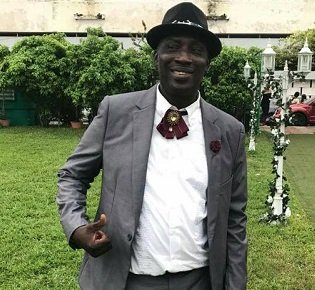
When cometh another Felix?–Tribute to a bosom friend

“When I am gone, release me, let me go.
I have so many things to see and do,
You mustn’t tie yourself to me with too many tears,
But be thankful we had so many good years.
I gave you my love, and you can only guess
How much you’ve given me in happiness.
I thank you for the love that you have shown,
But now it is time I travelled on alone.
So grieve for me a while, if grieve you must,
Then let your grief be comforted by trust.
It is only for a while we must part,
So treasure the memories within your heart.
I won’t be far away for life goes on.
And if you need me, call and I will come.
Though you can’t see or touch me, I will be near.
And if you listen with your heart, you’ll hear,
All my love around you soft and clear.
And then, when you come this way alone,
I’ll greet you with a smile and a ‘Welcome Home.’ ”
― Robert Bryndza
I am heartbroken by the loss of my bosom friend which occurred about five weeks ago. I am, however, honoured to have the opportunity to reflect on his life today.
Indeed, readers, it is very important that we acknowledge and fully experience the emotions of this moment, on which I have earmarked to say goodbye to Felix Ameni Annoh-Quarshie, my companion, my soul mate and my confidant.
It is fascinating to note that my good friend Felix might have foreseen his call to eternity before it actually occurred. As a Realist and a mystic man, I believe so, because of what my friend and brother said to me about three-quarters of a year ago.
Uncharacteristic of him, Felix stormed my office unannounced early this year with the intention of coming to congratulate me on my elevation to the position of the Editor of The Spectator last November. I recalled, vividly, something intriguing happened when he entered my new office, and I now comprehend why he did so.
At the time, I was writing a tribute of a senior colleague journalist who had passed on the eve of Christmas day, last year. Strangely, Felix walked straight to where I was sitting, ignoring my beckoning to him to sit, and corked his sharp-looking eyes at the screen of my desktop computer for a brief period.
Unexpected of him, he quietly but emotionally said: “Kwapay (as l am affectionately called), if I go (die) before you go, please, write the same intro for me in your tribute, ‘wati’.” “Why?” I asked. “Because, the poem you used as the intro for your colleague is very insightful, very discerning and very deep,” he replied with a baritone voice. I swiftly retorted, “You’re not going to die anytime soon, bro.” But, he insisted, and I gave him a weak nod.
As if by design, today, Felix’s body lies motionless at a funeral home at Haatso in Accra, awaiting burial at the Madina Cemetery next Saturday.
Felix came into my life about 45 years ago, and the first day we met, in Accra, instantly, we realised it was going to be a long journey of intimate friendship. Little wonder, we found ourselves living as neighbours at Madina a few years later. It was semi-detached apartments belonging to his mother. My parents had moved in from Burma Camp; he had relocated from a bungalow situated near Sankara Circle, where his father and stepmother, both senior police officers, and his siblings resided. Sincerely, I didn’t know it was his family property until the day he moved in to join his mother, a retired staff of the University of Ghana, Legon.
Hence, our friendship gained roots, very solid and firm to the extent that we were even sharing the same room. I nicknamed him ‘Adjei Koti’, because his Sankara-based parents were police officers; he nicknamed me ‘Kwapay’, claiming it was another name for Kwabena (we were both born on Tuesday), which I doubted, though, but accepted it to satisfy him.
Young Felix was a staff of Barclays Bank (now Absa Bank); I was a pupil teacher at Labone Preparatory School at Madina, but later enrolled at the Ghana Institute of Journalism in Accra, and passed out successfully to become a Sports Writer for Ghanaian Times. Felix introduced me to the driver of their staff bus that I was his younger brother, so he permitted me to board the bus to Sankara Circle and continued from there to New Times Corporation, near Kwame Nkrumah Circle, where I work to date.
He was not a church fan, but I managed to convince him to join me to my church, Queen of Peace Catholic Parish at Madina Old Road every Sunday for first Mass. In spite of our busy schedule, we joined one of the Madina football teams, Islamic Stars and played in the Legon-Madina Football League at the third division level. He played centre back, because he was over six feet; I played right/left half back. The blend was fluid, and it was marvellous to watch us play.
As our friendship kept growing, it suffered a setback. I vividly recollect it was a rainy Saturday evening when my parents called us to announce their decision to relocate with me to an area near Ritz Junction, on the border between Madina and Adenta. The tears that flowed from our eyes upon receiving the ‘bad’ news was so infectious that, it even compelled my mother to shed tears also
It was a tragic time for Felix and I. So this friendship, the most important things we have had in our lives, was going to crash? The invaluable love and support we got from our friendship was about to collapse? These were the questions that popped up in our minds, and it was conspicuously reflected on our sad faces as we tried to cope with the news.
However, we had the belief that, it had been ordained by the oracle, that our friendship was never to be put apart, it could only happen temporarily, but not for long. The D-day finally came, and I left with my parents for our new place.
Incredibly, a few weeks after our relocation, Felix relocated also to our area, about two minutes walk away from where we lived. Initially, my parents and I thought Felix was only joking, when he broke the news to us. But it was not an ‘April Fool’ statement he made.
Apparently, he had moved into his father’s new house, ahead of the rest of the family. We hugged each other immediately after the good news broke, and tears of joy flowed, reinforcing the bond of friendship that existed between the two of us
My narration cannot be complete, if I fail to recount how Felix decided to spend the rest of his life with Hetty, his dear wife. It all started when he was transferred to their Kotoka International Airport (KIA) branch. Hetty was a staff of M&J Travel and Tour at their KIA office. I joined Felix at the airport every working day, so we returned home together, because he worked late into the night. He worked until the last flight of the night arrived before he closed.
One evening, he expressed his intention of proposing to Hetty, if only I gave the green light. We agreed I scrutinise only her ‘vital statistics’ and give my findings and recommendation, because he knew her character already.
Apparently, he knew her, because she was a school mate of his younger sister, Jemima. According to Felix, Hetty used to pay Jemima a visit at their Sankara residence, and got to know that she was a serious ‘Chrife’ just as his sister. So, the only confirmation he needed from me was whether her ‘vital statistics’ were standard. As an experienced examiner, I inspected thoroughly, and she got full marks. Highly motivated by the recommendation, Felix expressed interest in her which she agreed. They started a serious romantic relationship before Felix took her to the altar. Their marriage was blessed with two beautiful children, Felix Jnr and Janice.
Felix was an introvert but easy-going. I am extrovert and easy-going, too. He hardly shared his secrets with friends or family members, except me.
Certainly, it is very devastating when you lose a friend, who is so close to you, to death, the inevitable. The pain of losing Felix, a man so important and special to me, cannot be overstated. Indeed, death has unfairly torn us from our lives. But I would find some relief in the fact that others have gone through a similar bereavement, and have felt the same emotions I am experiencing at the moment. Maybe, that should inspire me to feel less alone.
As Robert Southey, a poet laureate, said: “The loss of a friend is like that of a limb; time may heal the anguish of the wound, but the loss cannot be repaired.”
So, rest in perfect peace, Felix, and may the Almighty God keep you in His bosom until the last days of resurrection when we shall meet again. Amen.
By Emmanuel Amponsah


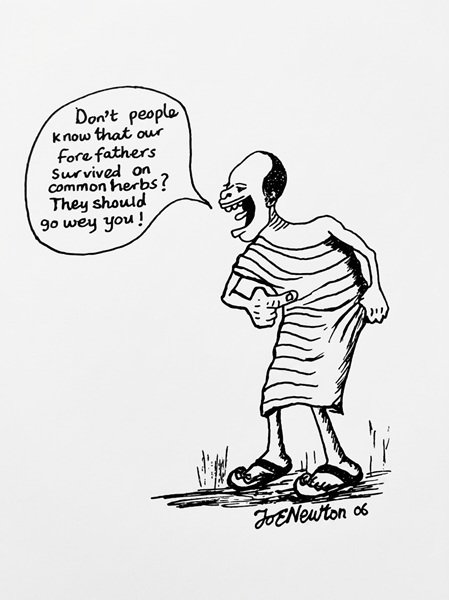
THE typical itinerant salesman in Sikaman is a herbalist. He is normally a slim macho with the capacity to perambulate the expanse of area covering the triangle of Accra-Tema-Ashiaman. In short, he can walk a total of 60 miles a day, marketing a product that cures every disease, including poverty. 
The door-to-door herbal pharmacist advertises his product by word of mouth. He has nothing to do with the Food and Drugs Board (FDB). After all, his concoctions do not feature on FM stations.
Those herbalists who cannot walk to propagate the herbal gospel, liaise with drivers of mass transportation and their mates. They are, therefore, given the chance to sell their products on Benz buses that ply the routes.
Normally, the herbalist starts his sales message with a prayer and Bible study. He asks the passengers to bow down their heads in supplication to God the father, the son, the Holy Spirit.
When a herbalist asks the passengers to close their eyes and bow their heads, Moslems on board naturally feel offended. They feel that the herbalist has no right to assume that every passenger is a Christian. They think such an assumption is an affront to Islam.
So a Moslem on board will raise the hand for a point of order. He’ll remind the herbalist that it would be in his own interest to mind his language.
“Be careful the way you address people in a public place. Not every person here is a Christian,” he’d state assertively.
Of course, the herbalist will promptly ignore him, but would all the same “watch” his tongue. Who knows whether or not the Moslem brother is inspired by Quoranic zeal to defend the tenets of Islam to the hilt?
When he starts saying, “Wallahi!” and “Inshallah!” it could be the beginning of proclaiming Islam as supreme, a point which must be driven home with talibanic precision.
So the herbalist must tread carefully lest he steps on fire.
The herbalist could even add a measure of mirth to it all, by announcing that Christians on board today have very interesting company on the journey, but that should not detract from the business of the day.
The Moslem brother will weigh the words carefully and offer a wry smile.
He must be careful the occasion does not degenerate into the use of semantics and proverbial oration to deride his conviction that public utterances must be mindful of religious sensibilities. He has made his point very clear and expects that it is taken in good faith in the interest of a peaceful journey.
The herbalist will now open the New Testament and preach salvation, stating clearly that salvation can come only through Jesus Christ and NOBODY else.
The Moslem brother will now start twitching his moustache. The visible and almost revolutionary reflexes of his upper lip can be an indication that sentiments have begun superseding reason, and the outcome could well be tragic now shift uneasily in his seat.
The time has come for him to also express his right to the religion of his fore-bears. He’ll put his hand into his pocket and rise to his feet. The time has indeed come!
This article was first published on Saturday, September 9, 2006
When the cause of a particular problem like sickness, disease, sudden illness, a social issue etc. are not known, it stands to reason that resolving it becomes a huge challenge.
Citizens would understand the government when public announcements are made to the effect that government is trying to find a solution to the issue, even though it is taking a while for it to be resolved because citizens are rational beings.
On the other hand, if the solution to a particular issue is known to everybody but the government for whatever reason, is dragging its feet in resolving it, citizens become frustrated and begin to lose trust in their leaders.
One such issue is the heavy traffic along a section of the Kasoa – Odokor road. A short stretch of bad road between the traffic light at the Weija Government Hospital and the entrance to the entrance of the overhead that leads to the N1, is the cause of the problem but nothing is being done about it, day after day, week after week, month after month. Thus is clearly unacceptable.
Another issue that requires urgent attention is the lack of pavements along a lot of streets in parts of the various Municipal Assemblies. Exercise is a prerequisite for long life and healthy living and for those of us who it has become a way of life, this issue of people putting up structures right to the edge of the drains beside the roads, are making life difficult for us.
We are compelled to walk along the roads, putting our lives at serious risk. Pedestrians should never be compelled to compete with vehicles on our streets and roads. Roads and streets are made for vehicles and pavements are made for pedestrians. That is the norm. Any attempt to normalise a situation where pedestrians are mingling with vehicles is insanity.
It is the road regulations that makes it so and therefore district or municipal assemblies are to take responsibility and ensure that spaces for pavements are not encroached upon. Citizens have rights that must be protected by their leaders and making pavements available to pedestrians, is one of them.
When we hear of teachers having sex with students, it appears it is something recent. It is not a new phenomenon. It has been there since Adam. Perhaps this issue is getting much attention due to the proliferation of social media. It was an open secret in times past when Teachers were in relationships with female students and some married them immediately after completion of school.
Some teachers were also known to be having unholy interactions with female pupils but due to the times that these acts occurred, human rights issues and the awareness around it, allowed such unscrupulous teachers to get away with their crimes.
Now we are in a different era and so a Headmaster is now in hot waters. He is alleged to have raped about 19 female students and as usual, some officials tried to cover it up and are also in hot waters and their actions or inactions in the matter are under investigation.
Why the man has been allowed to roam freely without being arrested is simply mind boggling. It appears that the law applies differently, depending on who you are. This issue came to public attention sometime in August this year, yet the police had not arrested or invited this man for question regarding the rape allegation.
It has come out that he is a Constituency Secretary of the ruling party and the question in the public domain is that, is it because he is a political figure that is why he is still walking around without questioning? I believe in the rule of law so let us hold our breadth and let the proper thing be done.
The police must however be seen to be active in this matter. God bless.
SKIP THE QUEUE, TAP THE NEWS
You can now read the Ghanaian Times and The Spectator newspapers from the comfort of your device via TimesNewsPlus.
Join our WhatsApp Channel: https://whatsapp.com/channel/0029VbBElzjInlqHhl1aTU27