News
UG professor calls for responsible behavior from Ghanaians during the rainy season to prevent malaria

- /home/u249204778/domains/spectator.com.gh/public_html/wp-content/plugins/mvp-social-buttons/mvp-social-buttons.php on line 27
https://spectator.com.gh/wp-content/uploads/2026/05/WhatsApp-Image-2026-05-29-at-12.34.32.jpeg&description=UG professor calls for responsible behavior from Ghanaians during the rainy season to prevent malaria', 'pinterestShare', 'width=750,height=350'); return false;" title="Pin This Post">
- Share
- Tweet /home/u249204778/domains/spectator.com.gh/public_html/wp-content/plugins/mvp-social-buttons/mvp-social-buttons.php on line 72
https://spectator.com.gh/wp-content/uploads/2026/05/WhatsApp-Image-2026-05-29-at-12.34.32.jpeg&description=UG professor calls for responsible behavior from Ghanaians during the rainy season to prevent malaria', 'pinterestShare', 'width=750,height=350'); return false;" title="Pin This Post">
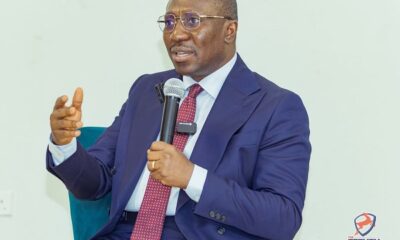
Lecturer at the University of Ghana, Legon Professor Yaw Asare Afrane has called on Ghanaians to act responsibly during the rainy season by keeping their surroundings clean to help prevent malaria and other mosquito borne diseases.
Delivering a public lecture on Thursday, May 28, 2026 In Accra on the topic “Mosquitoes, Environment and Public Health: The Role of Communities in Disease Prevention,” he explained that mosquitoes remain among the deadliest animals in the world because they transmit diseases such as malaria, lymphatic filariasis, dengue fever and yellow fever.
He noted that according to the World Health Organization’s 2025 report, about 503 million malaria cases were recorded globally, adding that many more unreported cases existed because several infected persons relied on self medication rather than visiting health facilities.
He further indicated that approximately 70 people could have been dieing from malaria
during the time of the lecture.
Professor Afrane stated that lymphatic filariasis, commonly associated with elephantiasis, remained endemic in 118 districts in Ghana, although interventions by the Ghana Neglected Tropical Diseases Programme had reduced the burden to only eight highly affected districts.
He disclosed that dengue fever outbreaks had been reported in Ghana’s Eastern and Central Regions, stressing that more than 2,000 cases were identified through research activities rather than routine hospital diagnosis.
He explained that his research journey began at the Kumasi Centre for Collaborative Research in Tropical Medicine, where he developed an interest in mosquitoes and malaria transmission through urban agriculture.
According to him, irrigation activities in urban farming areas created breeding grounds for mosquitoes, increasing malaria transmission in cities such as Kumasi.
He recounted that his early research findings earned him an opportunity to present at a malaria conference in Tanzania in 2002, where he secured a scholarship to pursue his PhD studies.
Professor Afrane further revealed that his doctoral research in Kenya focused on the relationship between environmental changes, deforestation and malaria epidemics in highland regions.
He explained that clearing forests increased temperatures and created stagnant water pools that supported mosquito breeding, making malaria transmission possible in areas previously considered too cold for mosquitoes to survive.
He added that his studies established that deforestation caused significant temperature increases that accelerated mosquito and parasite development.
Speaking on mosquito ecology in Ghana, he indicated that mosquitoes bred mainly around human settlements rather than in forests. He cited discarded car tyres, broken containers, stagnant drains, air conditioner water collection points and poorly maintained surroundings as common mosquito breeding sites.
He stressed that heavy rainfall and improper environmental sanitation contributed significantly to the spread of mosquito borne diseases.
Professor Afrane stated that Ghana had made progress in malaria control through interventions such as insecticide treated bed nets, indoor residual spraying and larval control programmes.
However, he warned that mosquito resistance to insecticides and pesticides posed major challenges to control efforts.
He explained that exposure to agricultural pesticides and household insecticides enabled mosquitoes to develop resistance, reducing the effectiveness of many control measures.
He further disclosed that invasive mosquito species from Asia had entered Ghana through ports such as Tema and Takoradi, increasing concerns about new disease outbreaks.
According to him, climate change and environmental degradation could also allow mosquitoes to spread into colder and high altitude areas previously free from mosquito borne diseases.
Professor Afrane advocated stronger environmental management, improved urban planning and increased investment in mosquito research and control.
He urged communities to clear stagnant water, dispose of waste properly and maintain clean surroundings to reduce mosquito breeding. He also called for renewed enforcement of sanitation regulations and the training of more experts in mosquito research and vector control.
The Vice Chancellor of the University of Ghana, Professor Nana Aba Appiah Amfo, commended Professor Afrane for delivering what she described as an engaging and enlightening lecture that highlighted the strong connection between environmental management and public health.
She observed that human activities such as urban farming, mining, deforestation and poor sanitation continued to create favourable conditions for mosquito breeding and disease transmission.
Professor Appiah Amfo stated that mosquitoes had demonstrated remarkable adaptability by changing their behaviour and developing resistance to chemicals used against them.
She stressed that Africa could not continue fighting mosquito borne diseases with outdated methods and therefore needed innovation, stronger surveillance systems and environmentally sustainable approaches to vector control.
She praised Professor Afrane’s research contributions, noting that his work had influenced malaria control strategies and public health interventions in Ghana and across Africa.
She highlighted his role in mentoring young African scientists and building research capacity through collaborations and international partnerships.
Professor Appiah Amfo further stressed that mosquito control was not solely the responsibility of scientists or government institutions but required collective action from communities and individuals.
She urged the public to maintain clean environments, remove stagnant water and support proper sanitation practices to reduce mosquito breeding sites.
She concluded by encouraging members of the public to take personal responsibility for environmental sanitation, stressing that controlling mosquitoes and mosquito borne diseases depended largely on changing human behaviour and improving community practices.
By: Jacob Aggrey









The Supreme Court has heard arguments in an application for interlocutory injunction filed by former GIIF CEO, Mr. Solomon Asamoah, the first accused person in the ongoing Skytrain scandal trial.
Mr. Asamoah has filed a certiorari application at the Supreme Court seeking to quash the High Court’s decision to dismiss his submission of no case, as well as an order quashing what he describes as a variation of his bail conditions.
Pending the determination of the certiorari application, he is asking the Supreme Court to injunct proceedings at the trial court.
The Attorney-General is opposed to both applications.
The Court, constituted by Justice Senyo Dzamefe, JSC, sitting as a sole judge of the Supreme Court, heard arguments from Mrs. Victoria Barth, counsel for the applicant, and Deputy Attorney-General, Dr. Justice Srem-Sai, and has adjourned the case to Monday, August 31, at 10 a.m. for a ruling.

The Ghana Tourism Authority (GTA) has extended the deadline for submission of event proposals for the 2026 edition of December in GH to Monday, September 7, 2026.
The extension gives event organisers, promoters, cultural innovators and experience creators additional time to submit concepts for inclusion in Ghana’s premier festive season.
This year’s December in GH calendar will run from December 1, 2026 to January 3, 2027, featuring culture, creativity, entertainment, heritage and unforgettable experiences.
According to the Authority, as a defining expression of the Black Star Experience, the season continues to evolve beyond a calendar of events into a nationwide cultural journey showcasing the rhythms, stories, flavours and expressions that make Ghana unique.
Selected events will form part of the official December in GH 2026 programme and will be integrated into the national campaign and amplified through GTA’s local and international promotional platforms.