Features
TUC nominates 2 ‘unfit persons’ to he boards of SSNIT and NPRA?

Trades unions are said to be continuous associations of workers formed for the purpose of maintaining and improving their conditions of employment.
Their aim is not merely to fight against wage cuts but also to fight for higher wages.
Broadly, trades unions perform two types of functions: (1) fraternal and mutual-help and (2) fighting or militant functions.
The fraternal functions include, organising social and infrastructure development for their members. These include; games, lectures and running of schools, clinics and hospitals for their members.
The militant functions of the unions refer to the struggles with their employers to get higher wages or for getting their grievances redressed.
Sometimes, however, for very good reasons, the militant ‘gesticulations’ of some of the labour unions are directly pointed at their own leadership or specific members of constituted Boards of Trustees of state-interest institutions.
It is, therefore, not surprising that this column has sighted a petition addressed to the leadership of the Trades Union Congress of Ghana (TUC), for the withdrawal of two ‘unfit’ TUC nominees, appointed to represent Organised Labour on the boards of the Social Security and National Insurance Trust (SSNIT) and the National Pensions Regulatory Authority (NPRA).
Readers, the petition dated, 9th May, 2022, was directed to the Secretary General of the TUC and signed by Mr Seth Abloso, a Labour Consultant and a member of the Ghana Association of Certified Mediators and Arbitrators.
It was titled:”Petition for the withdrawal of unfit persons as representatives of Organised Labour on the Boards of Trustees of SSNIT and NPRA.”
The petition was copied to: (a) Member Unions of Organised Labour (b) the Governor of the Bank of Ghana (c) The Managing Director of GCB Bank LLC (d) the Chief Labour Officer (e) the Director General – SSNIT (f) the Chief Executive Officer – NPRA (g) the Executive Secretary – Ghana Anti-Corruption Coalition (h) the Executive Director – Ghana Integrity Initiative and the two “unfit persons”.
The petition reads:” I hereby petition you, in your capacity as convenor of Organised Labour, to take steps to have unfit persons who have been presented as representatives of Organised Labour on the Board of Trustees of SSNIT, as well as the Board of NPRA, withdrawn forthwith.
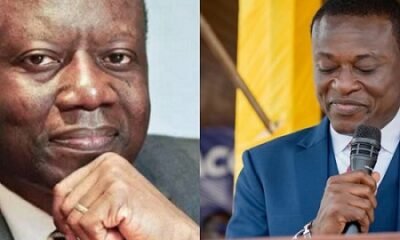
“They are, John Senanu Amagashie, General Secretary of the Union of Industry, Commerce and Finance Workers (UNICOF) and Alex Nyarku-Opoku, who doubles as National Chairman of UNICOF and a Manager of the Burma Camp branch of GCB Bank LLC.”
It must be noted that Mr Nyarku-Opoku is also the Chairman of the General Council of the TUC.
According to the petition:”Available evidence indicates that the two persons mentioned above have been involved in acts of dishonesty, by lying under oath in the execution of Credit Facility Agreement between UNICOF and GCB Bank LLC, dated 12th May, 2020.”
The petition said: “An earlier ruling of the National Labour Commission (NLC) dated 2nd June 2017, which was subsequently affirmed by the High Court on 24th June 2019 in Suit No. MSIL/03/2019, had implications on the finances of UNICOF, besides the finding that Alex Nyarku-Opoku committed perjury.”
The petition reminded the TUC boss: “You would recall that I brought the 2nd June, 2017, ruling to your attention in a letter dated 14th February 2020.
“It comes as a surprise that notwithstanding the adverse findings in the ruling of the NLC, those identified as having been associated with practices that make them unfit to hold office, continue in utter contempt of the NLC and go on to commit further acts of dishonesty in the Agreement with GCB Bank LLC.”
The petition strongly added: “It should be instructive to draw your attention to Section 177 of the Companies Act, 2019 (Act 992) – RESTRAINING FRAUDULENT PERSONS FROM MANAGING COMPANIES – and in particular to 177(1)(c) where a person has been culpable of a criminal offence, whether convicted or not, in relation to a body corporate or of fraud, or in breach of duty in relation to a body corporate, he or she shall not be a Director of or in any way, whether directly or indirectly , be concerned or take part in the management of a Company……”
According to the petition, “these developments and matters arising, there from, can neither be swept under the carpet nor ignored.
“It is, therefore, my expectation that you will take steps towards sanitising the frontline of Organised Labour to ensure that its affairs as well as the affairs of associated institutions are conducted with a high sense of integrity.”
So, in effect, the petition is asking the TUC leadership to replace the two “unfit” TUC nominees on SSNIT and NPRA Boards with new nominees who are “fit” to represent Organised Labour on the two boards.
Readers, the contention is that of the four TUC nominees on the Board of SSNIT representing Organised Labour, the petition is asking the TUC to withdraw only Mr Amagashie because the petition says, he is “unfit” to be appointed to the board.
Wikipedia defines ‘unfit’ as a thing or person not of the necessary quality to meet a particular purpose.
Synonyms for “unfit” include; unsuitable for, unsuited to, inappropriate to, ill-suited to, not good enough for, not cut out for and not up to scratch.
Readers, from the petition, the indication is that there are many and many workers who are “fit” and from which the TUC could effortlessly nominate to represent Organised Labour on relevant Boards of Trustees but the TUC ‘decided’ to nominate the two ‘highprofile’ but “unfit” persons to the boards of SSNIT and NPRA.
As we await the response to the petition from the leadership of the TUC, this column urgently urges the appropriate state institutions to investigate the matter as set out in the petition.
The outcome of the investigation, in the view of this column, must be published for public consumption.
This is because crucial matters concerning Organised Labour and its related institutions must be ‘mirrored’ in ‘a national glass’.
By G. Frank Asmah
Contact email/ WhatsApp of the author:
asmahfrankg@gmail.com (0505556179)


I experienced something on Monday, June 15, that really frustrated me. I had to go to the ministries but I could not get up early that day so I decided to pick a taxi and get to the Tuba Junction.
When I got there I realised that Traffic had built up from the Toll Booth towards Accra. After a while I got a Taxi and it was when we got to a certain spot on the road, that I realised why there was a traffic jam.
There is a short stretch of the road where each time it rains heavily, loose material run down the hill onto the road, blocking one side of the road. Vehicles from Kasoa to Accra are then forced to move into one of the lanes of those going towards Kasoa from Accra.
The two lane road from Accra to Kasoa becomes a single carriage way. That was the reason for the traffic jam from the toll booth onwards.
This has been a perineal problem and yet, no permanent solution has been found till date. The area falls under Ga South and even though, a new MCE has taken over, the technocrats are still there and so the problem is not new to them.
There is therefore no excuse for the inability of the Ga South Metropolitan Assembly to resolving the problem on that stretch of the road. Apart from the Ga South Metropolitan Assembly, another institution that must be held accountable is the Ghana Highways Authority.
The Highways Authority cannot say they are unaware of this issue. The fact that the problem falls within the area of responsibility of the Ga South Assembly, does not relieve the Ghana Highways Authority, of their responsibility of ensuring that our highways are maintained in a motorable state at all times.
A collaboration between the Ghana Highways Authority and The Ga South Municipal Assembly is required for a permanent resolution of the problem.
There was another traffic jam at a place called Atala about 250 metres to the traffic light at Old Barrier as a result of an issue similar to the one close to the toll booth, that I talked about earlier.
When we got to Weija junction, we encountered another traffic jam. The cause of this jam was a bad condition of road about 80 metres from the traffic light at Ga South Hospital heading towards Accra.
Due to the bad nature at that section of the road, vehicles are compelled to slow down resulting in a traffic jam stretching all the way to Weija Junction.
I started wondering if that short stretch of road cannot be sorted on one Sunday when traffic is usually light. When we got to the traffic light at Odorkor, there was another issue.
When the traffic light shows green, there is a slow down because there is a big pothole or should I say manhole in the outer lane, right at the traffic light. Vehicles in the outer lane are compelled to swerve into the second lane thereby causing a traffic to slow down and resulting in a traffic jam.
It is very important to take into account the effect of traffic jam on the national economy. If we are able to assess the value of the loss to the economy of the nation, I believe the issue of traffic jam will be prioritised.
Imagine persons working at various Government Organisations like Registrar General’s Department, Ghana Ports and Habours Authority, Ghana Revenue Authority, CEPS etc. and lives at Kasoa and whose job is to collect revenue for the state and is held up in traffic.
Just imagine the effect their lateness to work will have on the economy if you consider the delays in say clearing of goods at the port and as a result traders cannot sell their goods for government to generate the required taxes.
Let us deal with the traffic jams on our streets to promote economic growth. God bless.
By Laud Kissi-Mensah
Mortality is an inherent aspect of life, a universal experience that has sparked philosophical, theological, and scientific inquiry throughout human history.
This article aims to provide a comprehensive and nuanced exploration of mortality, acknowledging the complexity of the topic and the diverse perspectives surrounding it.
The biological imperative
From a biological standpoint, death is a natural part of the life cycle. It serves as a mechanism for the evolution of species, allowing for the passing on of genetic material and the adaptation to environmental changes.
Evolutionary perspective: Death allows for the recycling of resources, promoting the survival and adaptation of species.
Life span and senescence: Cellular aging and the limitations of biological systems contribute to mortality.
Philosophical and existential perspectives
Existentialism: Emphasises individual freedom and responsibility in the face of mortality.
Meaning and purpose: The finite nature of life can prompt individuals to seek meaning and purpose.
The human condition: Mortality is a fundamental aspect of the human experience, shaping our perceptions and values.
Cultural and spiritual views
Afterlife and spirituality: Many cultures and religions believe in an afterlife or spiritual continuation.
Rituals and mourning: Cultural practices surrounding death reflect the significance of mortality in human experience.
Legacy and remembrance: The impact of one’s life can transcend mortality.
Ethical considerations
End-of-life care: Ethical debates surround issues like euthanasia, assisted dying, and palliative care.
Quality of life: Balancing the value of life with the quality of life is a complex ethical issue.
Resource allocation: Societal decisions about healthcare and resource distribution involve considerations of mortality.
Psychological impact
Grief and loss: The experience of mortality can evoke profound emotional responses.
Fear and anxiety: The awareness of mortality can lead to existential anxiety.
Appreciation and gratitude: Recognising mortality can foster appreciation for life.
Conclusion
Mortality is a multifaceted aspect of human existence, influencing how we live, relate, and find meaning. Understanding and acknowledging mortality can prompt deeper reflections on life and our place in the world.
By Robert Ekow Grimmond-Thompson