Hot!
The names behind some Ghanaian innovative tech startups


Last week, we focused on young tech prodigy who is helping people appreciate the essence and potential of emerging technologies.
As a sequel to last week’s issue, we stay in the technology space but, this time, the attention is on some Ghanaian startups who have applied innovative technology and built businesses to solve problems in some specific areas. Here is a summary of the six personalities you may or may not know.
Mr. Mathias Charles Yabe

Mathias is the co-founder of AkoFresh, a Green Cold Chain Enterprise that offers farmers practical and affordable preservation services to end post-harvest losses.
He founded the agritech startup in 2018 when a volunteer trip exposed him to the issue of post-harvest losses affecting the people of Akumadan in the Offinso North District of the Ashanti Region.
As a young innovator who grew up in a small farming village, this problem inspired him to design a solar-powered cold storage preservation technology that extends the shelf life of perishable crops from five days to 21 days. The off-grid cold store is available to smallholder farmers as a service where they (farmers) pay a meagre daily or weekly subscription fee.
This innovation has earned him recognition including eight awards for participating in several accelerator programmes.
Ms. Constance Elizabeth Swaniker

Constance Swaniker is a renowned Ghanaian sculptor making strides in the arts and craft sector with global recognition. She obtained a Bachelor of Arts degree majoring in Sculpture at the Kwame Nkrumah University of Science & Technology (KNUST) in Kumasi in 1999.
After graduating from KNUST, she established Accents and Art Limited. She is the Founder of Design and Technology Institute (DTI). This institution offers students a practical approach to help them hone their talents in a conducive environment surrounded by instructors who are passionate about art and design.
Having spent 18 years in other countries including, The Gambia, Botswana, and Zimbabwe, the diversity in her experience has been the dominant factor in how she approaches the “arts” and business.
While a university student, Constance worked as an apprentice carpenter for five years in a joinery company but specialised in metal work and sculpture, graduating with honours in sculpture.
She is the recipient of several awards, and her works can be found in a wide range of upscale homes, offices, and diplomatic missions both home and abroad. Her works have been showcased in solo and group exhibitions in Ghana, Nigeria, France, and Germany.
Mr. MacCarthy Mac-Gbathy Abdullai

MacCarthy is the founder of HOPin Academy. He established the Academy in 2013 to curb rural-urban migration in Northern Ghana and reduce youth unemployment. The man who wants to reduce poverty rate drastically believes that entrepreneurship is the solution.
HOPin engages in educational innovation to ensure that entrepreneurship becomes part of the core subjects within Basic Schools in Ghana. It acts as an innovation hub to provide goal-oriented, practice-oriented learning for young people coupled with technology.
The organisation’s programmes cover entrepreneurship, digital communication, Information Technology, video production, and business consultancy.
The founder is an Executive Board Member and a Communications Director of the Ghana Hubs Network, with over 50 network members in 10 regions. He is part of several Boards globally and since 2013, he has overseen 54 startups.
Mr. Maxwell Deladem Xonu
Maxwell is championing eco-friendliness in Ghana. He has built EBAPreneur, a climate-action enterprise that focuses on promoting positive impacts on climate and helping local farmers combat post-harvest losses.
Founded in 2019, EBAPreneur produces briquettes from wastes such as corn husk, cassava and potato peels, and sawdust. The startup fabricates solar driers from locally sourced materials to help farmers reduce post-harvest losses.
The solar driers create a suitable temperature for drying harvested farm produce faster, such as cassava, without any atmospheric disturbance.
Mr.Jonathan Kennedy Sowah

Jonathan is the founder of InovTech STEM Centre. He is a passionate, innovative, and creative young leader with a track record of establishing successful students and teachers with industry-relevant skills in the STEAM field.
His institution provides students with high-quality, industry-relevant, and sought-after skills and experiences, especially in underserved communities in science, technology, engineering, arts, and mathematics (STEAM) through Robotics Education.
InovTech leverages Educational Robots, Artificial Intelligence, Machine Learning, and Embedded Systems for its notable course. The STEAM Centre aims to be a world leader in providing innovative and creative STEAM programmes that inspire, engage and develop citizens for Africa’s social well-being, economic prosperity, and sustainability.
Since its inception, InovTech has impacted over 10,000 students and 2,000 teachers across Ghana.
Mr. Andrew Takyi-Appiah

Andrew is the Co-founder and Managing Director of Zeepay, the fastest-growing fintech company. He is an expert in Banking and Mobile Payments with over 15 years of experience in Banking and Business Development.
He has working experience in more than seven markets, including Nigeria, Kenya, Uganda, Rwanda, Ghana, Burundi, Zambia, Malawi, and South Africa. He has been part of vital retail deployments across Africa. His company focuses on improving financial inclusion and making the world a better place to live.
Zeepay connects digital assets such as mobile money wallets, cards, ATMs, bank accounts, and digital tokens to International Money Transfer Operators, Subscriptions, International Airtime, among others.
By Spectator Reporter


The professor who spends his days exploring the intricacies of African languages found himself at the centre of a different kind of lesson on Friday, October 2, 2026. 
This time, there were no lecture notes, academic arguments or university classrooms. Instead, there was the weight of tradition, the rhythm of a community celebration and the solemnity of an oath at a royal palace.
Professor Ọbádélé Kambon, a full Professor of African Linguistics at the University of Ghana, was enstooled as Apagyahene and Sunsum Ɔsahene of Akuapem Mampong in the Eastern Region in a ceremony that brought academia and traditional authority together.
For the professor, the occasion was more than a new title. It was a moment that connected his academic interests in African languages and indigenous knowledge with the living traditions of an Akan community.
The day’s events unfolded through a series of customary observances. Kambon was first taken to the compounds of the Ɔkyeamehene and Gyasehene, where the preparations for his installation continued.
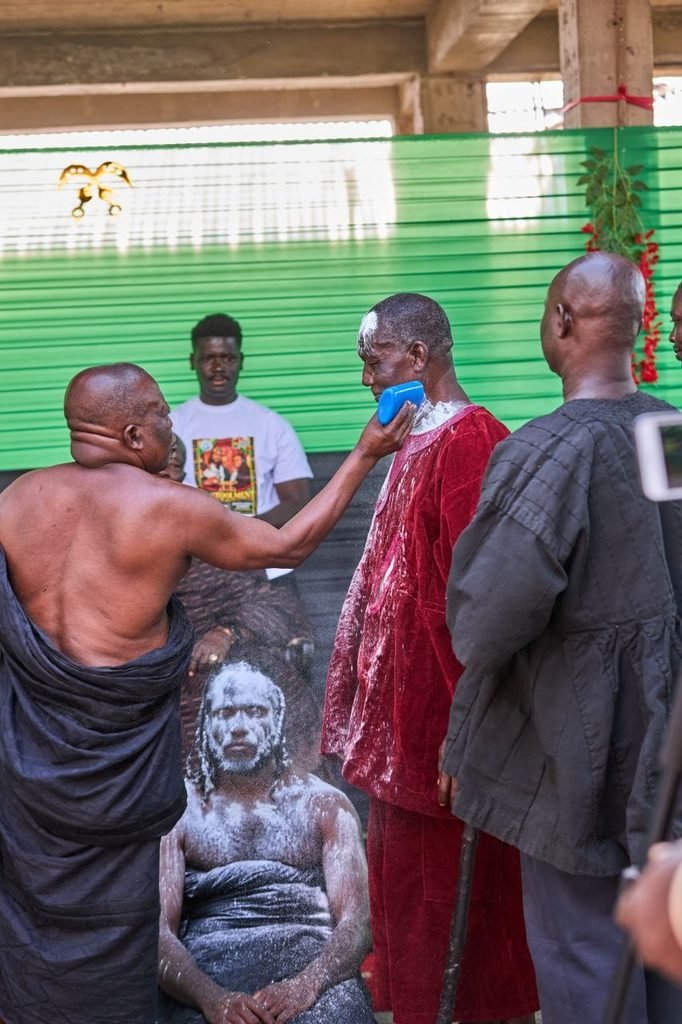
Then came the application of hyire, the white kaolin powder associated with traditional rites.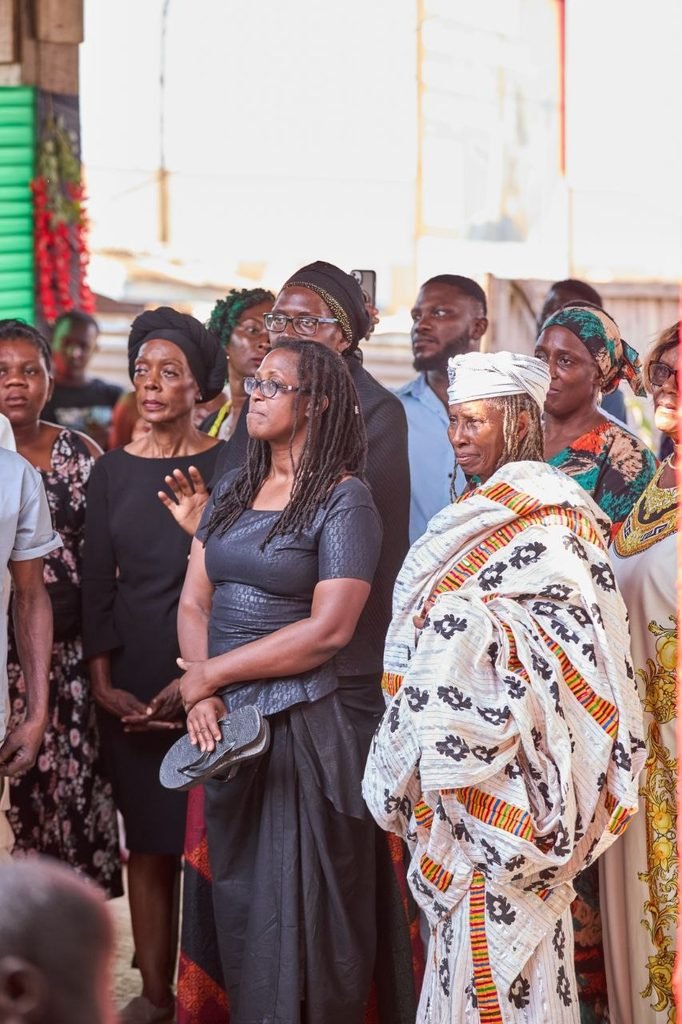
With the customary proceedings underway, the new chief was lifted onto the shoulders of celebrants and carried along the main thoroughfare of Akuapem Mampong.
The procession transformed the streets into a public stage for a ceremony rooted in the community’s traditional institutions.
There was something striking about the image, a university professor, accustomed to the measured language of academic discourse, being carried through the town in a display of traditional recognition.
Yet the celebration was not complete with the procession.
A ram was sacrificed at the Mamponghene’s compound before Kambon was taken to the palace, to swear the oath associated with his new offices.

The ceremony brought him formally into his roles as Apagyahene and Sunsum Ɔsahene.
Beyond the colourful proceedings, the titles themselves carry layers of historical meaning.
Kambon in his research explores the historical connections between Apagya and Akan political and military organisation.
Accounts cited in his work linked Apagya to an asafo, or military company, while historical writing traces an Apagya stool in Asante to the reign of Opoku Ware I in the eighteenth century.
These historical associations offer a glimpse into the institutions that have shaped Akan society over generations, although they do not automatically define the precise responsibilities of the office in Akuapem Mampong.
Kambon’s own professional life reflects a similar interest in preserving and examining African knowledge.
His work encompasses Akan language structure, naming practices across the Black world, proverbs and indigenous intellectual traditions.
Through Abibitumi, the platform he founded, he also promotes language learning, scholarship and cultural engagement.
But tradition was only one part of the story that day.
When the formal ceremony gave way to a reception, the occasion expanded into a celebration of three milestones: Kambon’s enstoolment, his promotion to full professor and his daughter Ama’s admission to the University of Ghana.
The gathering therefore carried a personal significance that went beyond the honours bestowed on one man. 
It celebrated professional advancement, the continuation of family aspirations and a connection to cultural heritage.
For a father, seeing a daughter gain admission to the same university where he holds a distinguished academic position offered another reason to celebrate.

For the professor, the moment placed family achievement alongside his own professional and traditional milestones.
Kambon had already established a place in the traditional life of Akuapem Mampɔn through an earlier installation as Banmuhene Kyidɔmhene, recorded in 2017.
His latest enstoolment adds another chapter to that relationship.
In Akuapem Mampɔn, the day brought together the university, the palace and the family table in one celebration. And for Kambon, the journey from the lecture room to the traditional procession showed how scholarship, cultural responsibility and family achievement could converge in a single memorable occasion.
By Enoch Ntiamoah Siaw
SKIP THE QUEUE, TAP THE NEWS
You can now read the Ghanaian Times and The Spectator newspapers from the comfort of your device via TimesNewsPlus.
Join our WhatsApp Channel: https://whatsapp.com/channel/0029VbBElzjInlqHhl1aTU27

Intercity STC Coaches Limited has interdicted a driver captured in a viral video allegedly hitting a Sprinter bus during an overtaking manoeuvre at Pokuase before driving away from the scene.
In a public notice, the company described the driver’s conduct as unacceptable, stressing that it did not reflect the safety standards and professionalism it upholds.
Management said it had commenced an immediate investigation into the incident and identified the driver, who has been interdicted pending the outcome of the disciplinary process.
The company added that it was awaiting an official report from the Pokuase Police Command to help establish the facts surrounding the incident.
STC reaffirmed its commitment to passenger safety and responsible road use, while thanking members of the public for bringing the incident to its attention.
Management assured the public that appropriate action would be taken following the investigation.
By: Jacob Aggrey